

For years, America’s public-school establishment operated under a simple assumption: parents had nowhere else to go.
A family could dislike the curriculum, question the school’s values, complain about classroom disorder, or watch its child fall behind academically. But unless the parents were wealthy enough to pay private-school tuition or capable of moving to a better district, the system could safely ignore them.
That arrangement is beginning to collapse.
Parents are increasingly exploring private schools, charter schools, homeschooling, microschools, online programs, education savings accounts, and other alternatives to the neighborhood public school. This is not merely a temporary reaction to the pandemic. It is a broader revolt against an education system that many families believe has stopped treating them as the primary authorities in their children’s lives.
According to federal data, public-school enrollment fell from approximately 50.8 million students in fall 2019 to 49.4 million in fall 2020 and remained at that level in 2021. It recovered only slightly to 49.6 million in 2022. More recent national data indicate that enrollment during the 2024–25 school year remained about 1.4 million students below its pre-pandemic level.
Falling birth rates and demographic changes explain part of that decline. But they do not explain why so many parents are actively searching for alternatives.
The more uncomfortable explanation is that families have lost trust in the institution.
Parents No Longer Believe Public Schools Are Delivering a Good Education
The most basic responsibility of a school is to teach children how to read, write, calculate, reason, and understand the world around them.
Yet the academic results remain deeply troubling.
The 2024 National Assessment of Educational Progress found that average reading scores declined by two points for both fourth- and eighth-grade students compared with 2022. Those results followed earlier declines between 2019 and 2022. Fourth-grade math improved slightly in 2024, but the improvement was largely driven by middle- and higher-performing students. Lower-performing students made little progress, while eighth-grade math remained essentially flat after its historic decline in 2022.
This means parents are not imagining the problem. Many children really are struggling with foundational academic skills.
And yet the public debate frequently seems more concerned with funding formulas, administrative initiatives, political messaging, and institutional prestige than with whether a ten-year-old can read a paragraph and explain what it means.
Parents notice this disconnect.
They hear that their local district needs more money. Then they see another administrative position created, another consultant hired, another training seminar conducted, and another year of unimpressive academic results.
The issue is not that every public school is failing or that every public-school teacher is incompetent. Many teachers are hardworking professionals attempting to educate children inside institutions burdened by bureaucracy, disorder, absenteeism, and conflicting political demands.
But parents do not enroll their children in a statistical average. They make decisions about a specific child in a specific classroom. When that classroom is not working, assurances about the public-school system as a whole are irrelevant.
Schools Have Become Political Battlegrounds
A growing number of parents believe that public schools have drifted away from education and toward political formation.
The concern is not simply that children encounter controversial subjects. Schools inevitably teach history, government, literature, biology, and other subjects that involve difficult moral and political questions.
The conflict is about who ultimately has authority.
Should schools help parents educate their children, or should educators view themselves as moral authorities entitled to override the family?
Pew Research Center found that 54% of Americans believed teachers bringing their personal political and social views into classrooms was a major reason public education was headed in the wrong direction. An even larger share—69%—said schools were not spending enough time on core subjects such as reading, mathematics, science, and social studies.
That combination captures the frustration perfectly.
Parents see schools struggling to teach basic literacy while simultaneously finding time for politically charged lessons, ideological terminology, social activism, and disputes over gender, race, identity, and sexuality.
Many families do not object to children learning that political disagreements exist. They object to schools presenting one side of those disagreements as unquestionable moral truth.
The disagreement becomes especially intense when parents are denied the ability to opt their children out of sensitive material. Pew found that 54% of American adults believed parents should be allowed to opt their children out of lessons involving sexual orientation or gender identity.
When schools respond to these concerns by dismissing parents as ignorant, intolerant, dangerous, or misinformed, they confirm the parents’ suspicion: the institution does not view the family as its client. It views the family as an obstacle.
Parents Are Tired of Being Treated Like Intruders
The education establishment frequently speaks about “parental involvement,” but what it often means is parental cooperation.
Parents are welcome when they raise money, supervise field trips, help with homework, or endorse the school’s priorities. They become a problem when they question those priorities.
A parent who asks why a child is falling behind may receive educational jargon instead of a direct answer. A parent who questions a book or lesson may be told to trust the experts. A parent who objects to a school policy may be accused of attacking teachers.
This attitude misunderstands the relationship entirely.
Schools do not loan children to parents. Parents entrust their children to schools.
Teachers and administrators may possess professional expertise, but that expertise does not erase parental authority. Educators see a child for part of the day and usually for one academic year. Parents are responsible for the child’s health, character, beliefs, development, and future.
A school that forgets this distinction should not be surprised when families leave.
Classroom Disorder Is Making Real Education Nearly Impossible
Parents are also leaving because too many schools cannot maintain basic order.
A classroom cannot function when students routinely disrupt lessons, threaten teachers, fight classmates, ignore instructions, or spend the day staring at their phones.
Federal data for the 2020–21 school year showed that 32% of public-school teachers said student misbehavior interfered with their teaching. Thirty-seven percent said tardiness and class cutting interfered with instruction.
NCES data have also documented public schools reporting verbal abuse of teachers, student disrespect, classroom disorder, harassment, and other disciplinary problems.
These statistics do not mean every school is chaotic. They do demonstrate that disorder is not an invention of conservative commentators or frustrated parents.
In many districts, discipline has become politically sensitive. Administrators are pressured to reduce suspensions, avoid negative statistics, and keep disruptive students in ordinary classrooms. The intention may be compassionate, but the burden often falls on well-behaved children and teachers who are attempting to teach them.
A school can have the most advanced curriculum in the country. It means nothing if the teacher spends half the lesson trying to persuade students to sit down, stop shouting, put away their phones, or refrain from attacking one another.
Families who value discipline do not necessarily expect children to behave like silent machines. They expect adults to be in charge.
When that expectation is no longer met, parents begin looking elsewhere.
Chronic Absenteeism Reveals a System Losing Its Grip
Public schools are also confronting a massive attendance crisis.
The U.S. Department of Education reported that chronic absenteeism—generally defined as missing at least 10% of the school year—reached approximately 31% during the 2021–22 school year and remained around 28% in 2022–23. A later analysis covering most states estimated that the national rate had declined to approximately 23.5% in 2024 but was still well above pre-pandemic levels.
A school cannot educate children who are not there.
Chronic absenteeism also affects students who attend regularly. Teachers must repeat lessons, accommodate wide differences in progress, and manage classrooms in which a significant portion of the student body is academically disconnected.
Public-school teachers themselves recognize the severity of this problem. Pew found that 61% of high-school teachers considered chronic absenteeism a major problem at their schools.
The absenteeism crisis reflects more than laziness or irresponsible parenting. It includes mental-health difficulties, family instability, transportation problems, illness, disengagement, and the lingering effects of pandemic-era closures.
But it also reflects something more fundamental: many students and families no longer consider school an essential institution.
That loss of seriousness is devastating.
The Pandemic Broke the Monopoly
Before 2020, many parents had little direct knowledge of what happened inside their children’s classrooms.
The pandemic changed that.
Remote learning brought lessons, assignments, classroom practices, and teacher-student interactions into the home. Parents witnessed both the strengths and weaknesses of the system firsthand.
They also discovered that education could occur outside the traditional school building.
Some children did poorly online and urgently needed to return to in-person instruction. Others flourished with flexible schedules, smaller learning environments, independent study, tutoring, or parent-directed education.
Once families experienced alternatives, the traditional public-school model no longer seemed inevitable.
Federal estimates indicate that 5.2% of school-age children received academic instruction at home during the 2022–23 school year, up from 3.7% in 2018–19. That category included both homeschooled students and children receiving full-time virtual instruction.
The pandemic did not create every problem in public education. It exposed problems that had been easier to conceal when parents were kept at a distance.
It also taught parents a dangerous lesson—from the establishment’s perspective: they had options.
Homeschooling Is No Longer Considered an Extreme Choice
For decades, homeschooling was portrayed as a strange practice reserved for isolated religious families.
That stereotype has collapsed.
Today’s homeschooling population includes religious conservatives, secular families, rural households, urban professionals, parents of children with disabilities, families concerned about bullying, and parents who simply want a more customized academic program.
Homeschooling allows families to adjust the pace of instruction, choose curricula, accommodate medical or developmental needs, reduce wasted time, and provide direct supervision.
It also exposes how inefficient the conventional school day can be.
A homeschooled child may complete focused academic work in several hours because the day does not include attendance procedures, classroom transitions, disciplinary interruptions, assemblies, administrative announcements, and constant attempts to manage dozens of students simultaneously.
Homeschooling is not easy. It requires time, organization, financial sacrifice, and serious parental commitment. It will not work for every household.
But it no longer has to work for every household. It only has to work better for a particular family than the available public school.
For a growing number of parents, it does.
School Choice Has Made Leaving Financially Possible
Dissatisfaction alone does not produce change. Families also need practical alternatives.
That is why education savings accounts, vouchers, scholarship programs, charter schools, and tax-credit initiatives have become so important.
An education savings account generally allows eligible parents to use state-supported education funds for approved expenses such as private-school tuition, tutoring, online learning, special-needs services, or curriculum materials.
By 2026, EdChoice counted 21 ESA programs operating across 18 states. The organization also reported that 19 states had adopted programs with universal or near-universal eligibility by 2025, although funding levels, participation caps, and regulations varied significantly.
Critics argue that these programs divert money from public schools and may not provide sufficient accountability for participating private providers.
Those concerns deserve scrutiny. Public money should not disappear into fraudulent programs or institutions that refuse to demonstrate basic competence.
But defenders of the existing system rarely apply the same logic consistently.
A public school may fail children for years and still demand more funding. A private or alternative provider, meanwhile, is told that allowing parents to choose it would be an irresponsible experiment.
The deeper objection to school choice is often not financial. It is philosophical.
Choice transfers power from institutions to families.
A district receives funding because a parent selected it—not because the parent happened to live inside a boundary drawn by the government. That means schools must persuade families rather than merely process them.
Institutions accustomed to guaranteed customers naturally find this terrifying.
Safety and Bullying Are Driving Families Away
For many parents, leaving public school is not primarily about politics or standardized-test results. It is about protecting a child.
Bullying, fights, threats, drugs, sexual harassment, and persistent classroom intimidation can transform school into a daily source of fear.
Pew’s survey of public-school teachers found that 34% of middle-school teachers considered bullying a major problem at their schools. Teachers in higher-poverty schools were also more likely to identify fights and gangs as serious concerns.
Large schools may struggle to monitor every hallway, bathroom, lunchroom, bus, and social-media conflict. Even when administrators intervene, parents sometimes conclude that the environment itself is the problem.
A child should not have to endure years of misery simply because adults have declared the assigned public school socially necessary.
The system often asks parents to sacrifice their actual child for an abstract ideal of public education.
Increasingly, parents are refusing.
Families Want Education That Reflects Their Values
Every school teaches values.
A school teaches values through the books it assigns, the behavior it tolerates, the history it emphasizes, the holidays it recognizes, the moral language it uses, and the habits it rewards.
The idea of a perfectly neutral school is fiction.
Public schools often claim neutrality because they avoid explicit religious instruction. But secularism is not the absence of a worldview. Nor is political progressivism neutral simply because it is common among education professionals.
Many Christian parents want education that treats faith as a central part of life rather than an eccentric private hobby. Other families want classical education, stricter discipline, traditional moral standards, vocational training, advanced science instruction, or a curriculum less influenced by political activism.
These parents are not necessarily demanding that every school adopt their beliefs.
They are asking for the freedom to choose schools consistent with those beliefs.
That is what pluralism should mean.
A genuinely diverse country cannot require every family to send its children through the same ideological and institutional pipeline.
Public Confidence Has Reached a Breaking Point
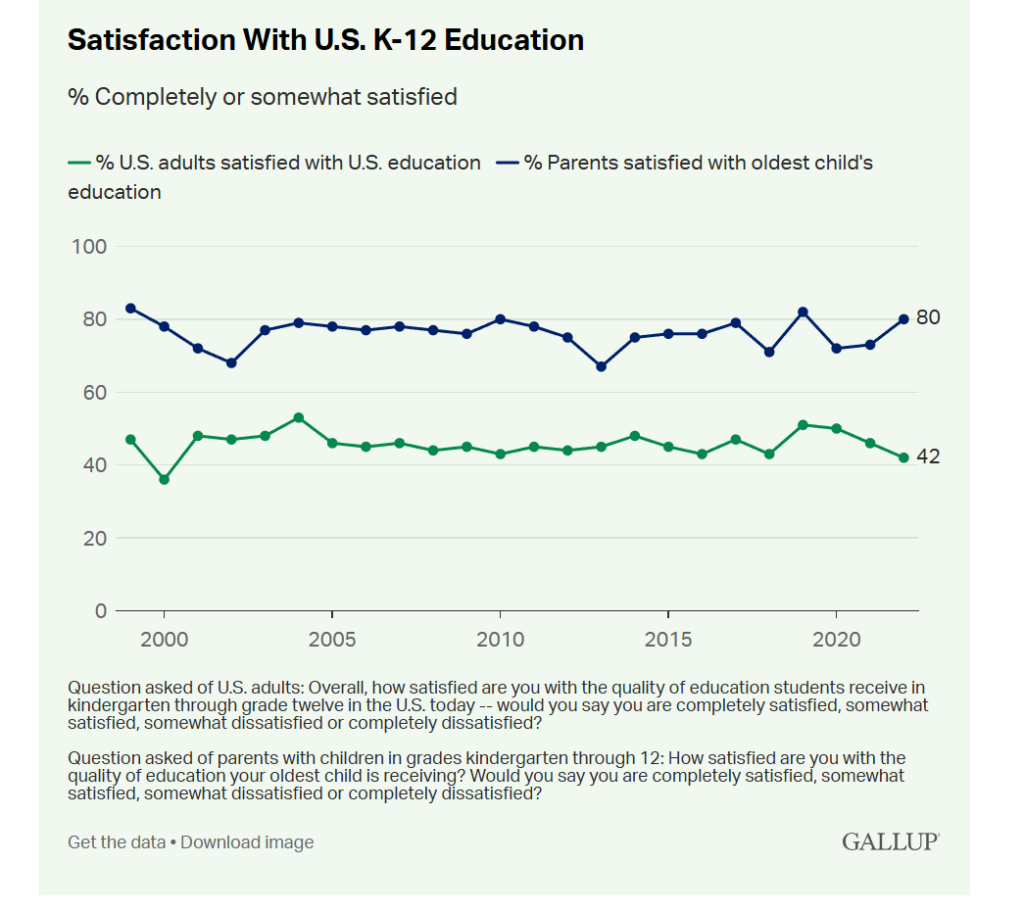
In 2025, Gallup found that only 35% of American adults were satisfied with the quality of K–12 education in the United States—the lowest level recorded in its trend. Sixty-two percent were dissatisfied.
Parents tend to rate their own children’s schools more favorably than the national system. Gallup found in 2024 that 70% of K–12 parents were satisfied with the education their oldest child was receiving.
That distinction is important. The public-school system is enormous, and experiences vary dramatically by district, neighborhood, teacher, and student.
But the broader loss of confidence still matters.
Families may like a particular teacher while distrusting the district. They may appreciate a local principal while opposing state standards. They may be satisfied for several years and then leave after a curriculum change, safety incident, disciplinary dispute, or decline in academic quality.
Public education is not collapsing everywhere at once.
It is losing legitimacy one family at a time.
Are Parents Abandoning Public Education?
Not exactly.
Most American children still attend public schools, and many families remain satisfied with them. Public schools also educate students with severe disabilities, unstable home lives, language barriers, and other complex needs that alternative institutions may be unwilling or unequipped to serve.
Public education will remain a central American institution.
But parents are abandoning the idea that public education must mean one government-assigned school operating without meaningful competition or parental control.
That distinction is crucial.
Supporting education does not require supporting every bureaucracy that claims to provide it. Supporting teachers does not require defending failing administrators. Supporting disadvantaged children does not require trapping them in institutions their families desperately want to escape.
A public education system should serve the public.
It should not own the public’s children.
What Would Bring Parents Back?
Public schools do not need another branding campaign. They need to address the reasons families are leaving.
They must restore academic fundamentals, enforce meaningful discipline, provide curriculum transparency, respect parental authority, remove political activism from ordinary classroom instruction, protect students from bullying, and hold administrators accountable for results.
They must also stop behaving as though parents who choose alternatives are enemies of education.
Competition can expose weakness, but it can also encourage improvement. A school that knows families can leave has a stronger incentive to listen to them.
The public-school establishment can continue denouncing homeschooling, private education, vouchers, charter schools, and parental-rights movements.
Or it can ask the question it has avoided for years:
Why are so many parents willing to reorganize their lives, sacrifice income, pay tuition, move homes, or educate their children themselves simply to get away from the system?
The answer is not mysterious.
Parents are leaving because they believe public schools no longer consistently provide academic excellence, physical order, moral trust, or respect for the family.
And until the system admits that these concerns are real, the exodus will continue.
Frequently Asked Questions
Why are parents pulling their children out of public schools?
The most frequently cited concerns include poor academic performance, classroom disorder, bullying, politically controversial curricula, insufficient parental control, chronic absenteeism, safety issues, and dissatisfaction with one-size-fits-all instruction.
Is public-school enrollment declining?
Yes. National public-school enrollment remains below its pre-pandemic level, although some of the decline is also connected to falling birth rates, migration patterns, and other demographic changes.
Is homeschooling increasing in the United States?
Federal estimates show that the percentage of school-age children receiving instruction at home increased from 3.7% in 2018–19 to 5.2% in 2022–23. This includes traditional homeschooling and full-time virtual instruction.
What are the biggest problems facing public schools?
Current concerns include declining reading performance, persistent learning gaps, chronic absenteeism, disruptive behavior, teacher burnout, bullying, student mental-health challenges, and conflict between schools and parents over curriculum and values.
What alternatives to public school are parents choosing?
Common alternatives include private schools, religious schools, charter schools, homeschooling, online schools, hybrid schools, microschools, learning pods, tutoring programs, and education savings account–funded options.
Does school choice hurt public schools?
Supporters argue that school choice gives families leverage and forces schools to improve. Critics contend that it can reduce district funding, increase inequality, and move students into providers with weaker public oversight. The practical impact depends heavily on how each state’s program is funded, regulated, and implemented.
Why do conservative parents oppose some public-school curricula?
Many conservative parents believe schools spend too much time on contested political and social issues and too little time on core academics. They also argue that parents—not school employees—should have the final authority over children’s moral and religious formation.