


This is a guide for homeschool families looking to get TEFA funding. This step-by-step guide explains their eligibility criteria, steps, and more.
Quick Answer: Can Homeschool Families Use the Texas Education Freedom Account?
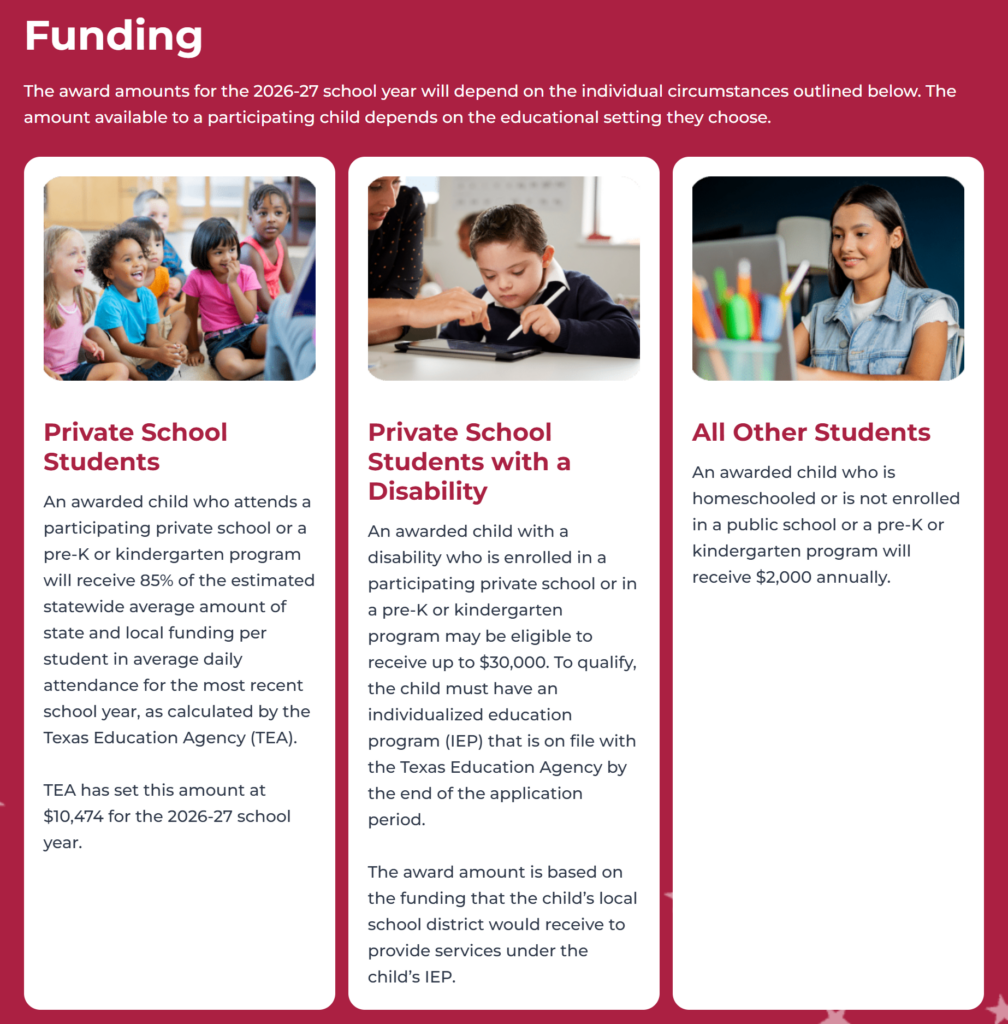
Yes. Texas homeschool families may be eligible for the Texas Education Freedom Accounts program, also called TEFA. For the 2026–27 school year, an awarded child who is homeschooled or otherwise not enrolled in a public school, charter school, private school, pre-K program, or kindergarten program receives $2,000 annually.
This is not a salary for parents. It is restricted education funding that must be used for approved education-related expenses through the TEFA program marketplace and Odyssey portal.
For Texas homeschool families, TEFA can help pay for items such as instructional materials, online courses, academic assessments, tutoring, approved educational services, and limited technology where allowed. However, families must follow program rules, approved expense categories, documentation requirements, and opt-in deadlines.
Key Takeaways
- Texas homeschool students may qualify for up to $2,000 per year through TEFA.
- Private school students receive a higher amount than homeschool/other students.
- Homeschool students with disabilities are still limited to the homeschool/other amount if they remain in the homeschool/other category.
- Funds are not paid as unrestricted cash to parents.
- Approved purchases are handled through the Odyssey platform.
- TEFA funds may not be used to pay a family member.
- Remaining funds may roll over if the child remains eligible and in the program.
- A child enrolled in a Texas public school or charter school during the school year may be removed from the program.
- Texas homeschool law remains separate from TEFA participation, but families using TEFA must also follow TEFA rules.
What Is the Texas Education Freedom Account?
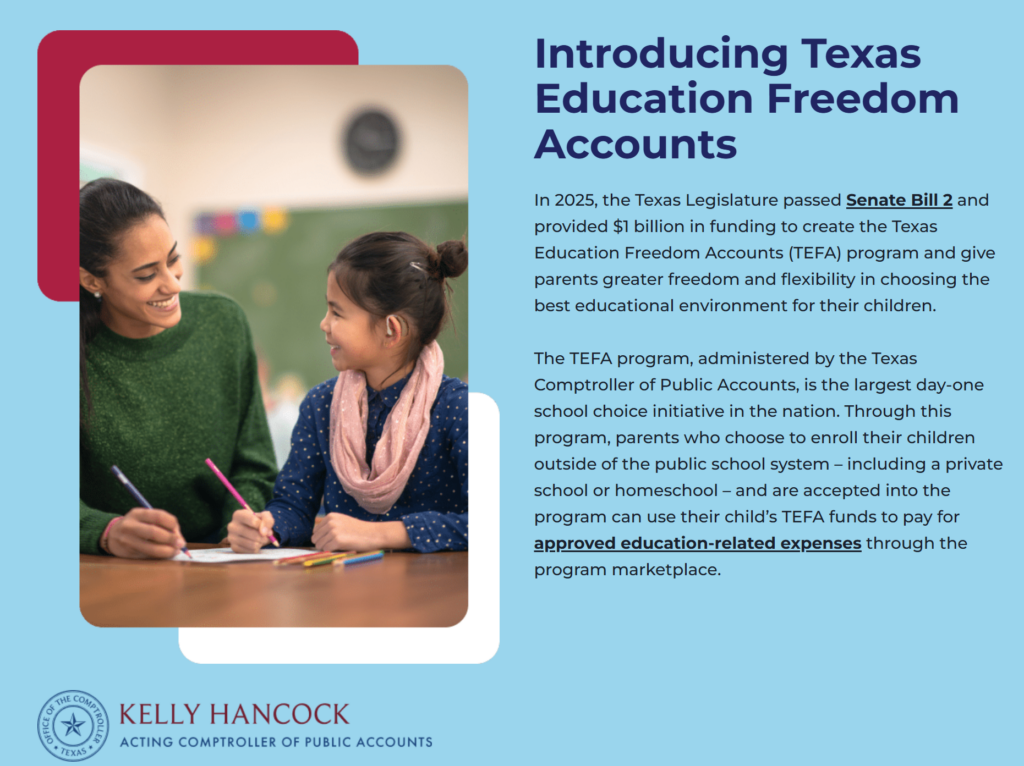
The Texas Education Freedom Accounts program is Texas’s state school choice funding program. It was created to give eligible families more flexibility in choosing an educational setting outside the traditional public school system.
The program is commonly discussed as an ESA, or education savings account, because it allows education dollars to follow the student into approved nonpublic education options. In Texas, the public-facing program name is Texas Education Freedom Accounts, often shortened to TEFA.
For homeschool families, TEFA matters because it introduces a direct funding option for families educating children at home. Instead of paying entirely out of pocket for curriculum, instructional materials, online courses, testing, or tutoring, awarded homeschool families may receive a restricted $2,000 annual account.
How Much Do Texas Homeschool Families Get Through TEFA?
For the 2026–27 school year, homeschool/other students receive $2,000 annually if awarded a Texas Education Freedom Account.
That amount is different from the private school award. Private school students attending a participating private school are eligible for a larger amount tied to a percentage of the statewide average public education funding amount. For 2026–27, that private school amount is $10,474.
Here is the practical difference:
| Student Type | 2026–27 TEFA Amount | What It Means |
| Homeschool/other student | $2,000 | For approved education expenses, usually received in one installment |
| Participating private school student | $10,474 | Primarily for tuition and approved private school-related expenses |
| Participating private school student with qualifying IEP | Up to $30,000 | Based on eligible special education funding, subject to program rules |
For homeschool families, the key point is simple: TEFA can help, but it is not designed to fully cover the cost of a comprehensive private education plan. It is a supplemental homeschool funding account.
Does Texas Pay Parents to Homeschool?
No. Texas does not pay parents a salary to homeschool.
The Texas Education Freedom Account is not a paycheck, wage, or unrestricted payment to a parent. It is a restricted education account for an eligible child. Funds must be used for approved education-related expenses, and purchases are handled through the program’s approved process.
This distinction is important for searchers asking questions like:
- “Does Texas pay you to homeschool?”
- “Can I get paid to homeschool in Texas?”
- “How much money does Texas give homeschoolers?”
- “Does the Texas ESA cover homeschool curriculum?”
The better answer is: Texas may provide $2,000 in restricted TEFA funds for an awarded homeschool/other student, but parents do not personally get paid to homeschool.
Who Is Eligible for TEFA as a Homeschool Family?
To participate in TEFA, the child must meet the program’s eligibility rules. In general, the child must be a U.S. citizen or lawfully present in the United States, be eligible to attend a Texas public school or open-enrollment charter school, and reside in Texas.
The parent must also be a Texas resident.
For homeschool families, this means the student does not have to be currently enrolled in public school to apply, but the student must still meet Texas eligibility rules for school attendance.
Families should also understand that approval is not automatic. If eligible applications exceed available funding, Texas uses a prioritization and lottery system.
TEFA Prioritization: Who Gets Funded First?
TEFA is not first come, first served. For the 2026–27 launch year, Texas uses a priority structure.
The highest priority goes to children with a disability from households at or below 500% of the Federal Poverty Level. After that, priority is based mainly on household income brackets.
The 2026–27 priority order is:
- Children with a disability whose household income is at or below 500% of the Federal Poverty Level
- Children whose household income is at or below 200% of the Federal Poverty Level
- Children whose household income is between 200% and 500% of the Federal Poverty Level
- Children whose household income is at or above 500% of the Federal Poverty Level, with some added priority for certain former public school students
For later years, the program also gives priority to siblings of participating children and new eligible applicants before certain returning categories.
This matters for homeschool families because applying does not guarantee funding. A family can be eligible but still waitlisted if demand exceeds available funds.
What Can Texas Homeschool Families Use TEFA Funds For?
TEFA funds can be used only for approved education-related expenses. For homeschool families, the most relevant categories are usually instructional materials, online learning, assessments, tutoring, educational services, and limited technology.
Approved expenses may include:
Textbooks and Instructional Materials
This is one of the most important categories for homeschool parents. It may include textbooks, workbooks, learning materials, and other instructional resources tied to the child’s education.
For SEO purposes, many parents will search for “Texas EFA homeschool curriculum.” In practice, families should think in terms of approved instructional materials and confirm whether a specific curriculum or provider is allowed in the TEFA platform before purchasing.
Online Educational Courses or Programs
TEFA funds may be used for fees connected to online educational courses or programs. This can be helpful for homeschool families who want structured math, language arts, science, coding, foreign language, or high school coursework.
Before enrolling, parents should verify that the course or provider is eligible through the TEFA marketplace.
Academic Assessments
Assessment-related costs may qualify. This can include testing or academic evaluations that help measure a student’s progress.
This is useful for homeschool families who want documentation, placement information, annual progress records, or readiness assessments.
Private Tutoring
Tutoring can be an approved TEFA expense, but Texas rules require the tutor to meet program requirements. Parents should not assume any tutor qualifies.
A homeschool family planning to use TEFA for tutoring or subject support should verify the tutor’s approval status before scheduling sessions.
Educational Therapies and Services
Educational therapies may qualify when they are not covered by federal, state, local government benefits, Medicaid, CHIP, or private insurance. Examples may include behavioral therapy, occupational therapy, speech therapy, and physical therapy.
Families with children who need learning support should carefully document the educational purpose of these services and confirm provider eligibility.
Transportation to Approved Providers
Transportation may qualify when it is connected to travel to and from a preapproved education service provider or vendor.
For homeschool families, this may matter if the child attends part-time classes, therapy, tutoring, or other approved services outside the home.
Computer Hardware, Software, and Technology
Technology is limited. The program places a cap on computer hardware or software expenses, and technology must be used primarily for educational purposes.
For a homeschool/other student receiving $2,000, the 10% technology limit means families should be especially careful before trying to use TEFA funds for a laptop, tablet, software, or other device. Technology purchases should be checked through the program before spending.
What Can TEFA Funds Not Be Used For?
TEFA funds cannot be treated like general household money. Families should avoid using the account for ordinary family expenses, entertainment, non-educational electronics, household furniture, general transportation, or purchases that are not tied to approved education categories.
Important restrictions include:
- Funds may not be used to pay a family member.
- Purchases must fit approved education-related categories.
- Technology is limited and must meet program rules.
- Educational therapies cannot duplicate costs covered by Medicaid, CHIP, other public benefits, or private insurance.
- Unapproved vendors or providers may not qualify.
- A student enrolled in a public or charter school during the school year may be removed from the program.
If an item feels educational but is not clearly listed or available through the program marketplace, parents should verify before buying.
How TEFA Works Through Odyssey
Texas uses Odyssey as the certified educational assistance organization helping administer TEFA under the oversight of the Texas Comptroller.
For families, this means applications, notifications, opt-in steps, and approved purchases are connected to the Odyssey portal.
Homeschool families should treat the Odyssey portal as the central place to:
- Check application status
- Review funding or waitlist notifications
- Opt in as a homeschool/other student
- View approved vendors and providers
- Make approved purchases
- Track account activity
- Save records and confirmations
- Monitor deadlines
This is especially important because approved purchases and payments are not handled like ordinary out-of-pocket homeschool spending. A curriculum, tutor, class, or service may be useful, but that does not automatically mean TEFA will pay for it.
2026–27 TEFA Timeline for Homeschool Families
For the 2026–27 school year, the application window opened February 4, 2026 and closed March 31, 2026. Families who applied received funding or waitlist notifications through the Odyssey portal.
For homeschool/other students, the funding process is different from private school students. Private school awards are paid in installments. Homeschool/other students receive the full $2,000 in a single installment after they opt in.
Key 2026–27 timing points:
| Timeline Item | Homeschool/Other Relevance |
| February 4–March 31, 2026 | Parent application window |
| April 2026 | Funding and waitlist notifications posted |
| June 15, 2026 | Opt-in deadline to receive funding on July 1 |
| July 1, 2026 | Earliest funding date |
| July 31, 2026 | Opt-in deadline to receive funding by mid-August |
| September 15, 2026 | Deadline to confirm homeschool/other opt-in for full award amount |
| Later waitlist awards | Funding may be issued as practicable and may be prorated depending on timing |
For future school years, families should check the official TEFA portal for the updated application window and deadlines.
Does TEFA Change Texas Homeschool Law?
TEFA does not erase Texas homeschool law. Texas homeschool families still need to understand the state’s general homeschool rules.
The Texas Education Agency states that it does not regulate, index, monitor, approve, register, or accredit homeschool programs chosen by parents. Texas homeschooling has been treated as a legal alternative to public schooling since the Leeper decision, and parents who homeschool are required to follow a course of study that includes good citizenship.
That said, TEFA participation adds a separate layer of program rules. A family can be a Texas homeschool family and still have to follow TEFA requirements if using state funds.
In simple terms:
- Texas homeschool law governs whether the child is legally homeschooled.
- TEFA rules govern whether state education funds can be used and how they must be spent.
Parents should not confuse the two.
Are Texas Homeschool Students with Disabilities Eligible for More Than $2,000?
This is a major point of confusion.
Private school students with qualifying IEP documentation may be eligible for up to $30,000 depending on the child’s IEP and program rules. However, TEA guidance states that if a child is homeschooled, the total funding is limited to $2,000 per school year.
That means a homeschool family with a child who has a disability should not assume they will receive the private-school special education amount while remaining in the homeschool/other category.
For families comparing options, this distinction matters. A child’s funding level may depend not only on disability documentation but also on the educational setting selected under the program.
Best Ways to Use $2,000 in TEFA Homeschool Funds
Because the homeschool amount is limited, families should spend strategically. The goal is not to buy every possible resource. The goal is to use the funds where they produce the most educational value.
1. Core Curriculum and Instructional Materials
Start with the basics: math, reading, writing, science, and social studies. If TEFA allows the materials through the marketplace, this is usually one of the most practical uses of the account.
A parent might use funds for:
- Math curriculum
- Language arts workbooks
- Reading programs
- Science instructional materials
- History or social studies textbooks
- Writing curriculum
- Subject-specific workbooks
2. Online Courses for Subjects Parents Do Not Want to Teach Alone
Online classes can be valuable for subjects such as algebra, chemistry, coding, foreign language, essay writing, or high school electives.
For many homeschool families, using TEFA for a strong online course can provide more structure than buying another workbook.
3. Tutoring for Learning Gaps
If a child is struggling in reading, math, writing, or test preparation, tutoring may be a high-value use of funds.
Because the total homeschool award is $2,000, families should use tutoring carefully. A few targeted sessions for a specific academic problem may be more effective than spreading funds thinly across many extras.
4. Assessments and Testing
Academic assessments can help parents identify gaps, choose the right curriculum level, and document progress. This can be useful for both elementary homeschoolers and high school students planning for college or career pathways.
5. Educational Therapy or Intervention
For children with learning differences, speech delays, dyslexia, ADHD-related academic challenges, or other needs, approved educational therapies may be one of the most meaningful uses of TEFA funds.
Families should confirm whether the therapy is covered by insurance or public benefits first, because TEFA rules may restrict duplicate payments.
6. Limited Technology
Technology should not be the first assumption, but it may be useful when clearly allowed. Because the technology cap is limited, homeschool families should confirm whether a software program, device, or technology purchase qualifies before planning around it.
Sample $2,000 TEFA Homeschool Budget
Here is a practical example of how a Texas homeschool family might plan a $2,000 TEFA account.
| Category | Example Budget | Purpose |
| Math curriculum or online math course | $350 | Core academic instruction |
| Language arts curriculum | $300 | Reading, grammar, writing |
| Science materials or online class | $300 | Structured science learning |
| Academic assessment | $150 | Placement or progress tracking |
| Tutoring | $600 | Targeted help in math or reading |
| Educational software or technology | $200 | Only if approved and within the technology limit |
| Supplemental instructional materials | $100 | Workbooks, reference books, or subject support |
This is only an example. The best budget depends on the child’s grade level, learning needs, and approved marketplace options.
Common Mistakes Texas Homeschool Families Should Avoid
Mistake 1: Assuming TEFA Pays Parents Directly
TEFA is not income. It is restricted education funding. Parents should not market it to themselves as being “paid to homeschool.”
Mistake 2: Assuming Every Homeschool Curriculum Qualifies
A curriculum can be popular and still not qualify under the program’s approved purchasing process. Always verify before buying.
Mistake 3: Missing Opt-In Deadlines
A student may be awarded funds but still need to complete required opt-in steps. Missing deadlines can delay or reduce access to funds.
Mistake 4: Spending Without Checking the Marketplace
Approved spending is tied to the program process. If a vendor, item, or service is not available or approved, reimbursement may not be available.
Mistake 5: Ignoring the Public School/Charter School Rule
Students who are found to be enrolled in a Texas public or charter school during the school year can be removed from the program.
Mistake 6: Assuming Disability Funding Applies to Homeschool Students
The higher special education amount is tied to specific program conditions. Homeschool/other students remain limited to the homeschool/other amount.
Mistake 7: Using Funds for Family Payments
TEFA funds may not be used to pay a family member. Parents should avoid arrangements that could appear to route funds to relatives.
How to Prepare for the Next TEFA Application Window
Families who missed the 2026–27 application window should prepare early for the next school year.
A preparation checklist:
- Join the official TEFA interest list or family update list.
- Gather proof of Texas residency.
- Gather proof of the child’s citizenship or lawful presence.
- Estimate household income and understand the priority tiers.
- Decide whether the child will be homeschool/other or private school.
- Make a list of likely approved expenses.
- Research approved providers and vendors.
- Save homeschool records and educational plans.
- Review whether any disability documentation is relevant.
- Watch the official TEFA portal for next-year deadlines.
Because demand was high in the first year, families should not wait until the last week of the application window to prepare.
Texas Education Freedom Account Homeschool vs Private School: Which Is Better?
The answer depends on the family’s goals.
TEFA homeschool funding is better for families who want to keep a parent-directed education model and use the $2,000 as supplemental support. It can help with curriculum, online learning, tutoring, testing, or educational services.
TEFA private school funding may be better for families who want full-time private school enrollment and can find a participating school that fits the child’s needs. The private school award is larger, but it also comes with school enrollment requirements and school-specific tuition decisions.
Homeschool families should compare:
- Desired learning environment
- Total annual education cost
- Child’s academic needs
- Availability of approved vendors
- Need for special education services
- Distance to participating schools
- Flexibility requirements
- Religious or values-based preferences
- Parent teaching capacity
- Whether $2,000 is enough to meaningfully support the plan
For many families, the homeschool option provides flexibility. For others, the larger private school award may be more practical.
FAQ: Texas Education Freedom Account Homeschool
Can Texas homeschool families apply for TEFA?
Yes. Texas homeschool families may apply if they meet eligibility requirements. If awarded under the homeschool/other category, the student may receive $2,000 annually.
How much does TEFA give homeschool students?
For the 2026–27 school year, awarded homeschool/other students receive $2,000 annually.
Does Texas pay parents to homeschool?
No. Texas does not pay parents a salary to homeschool. TEFA provides restricted education funding for eligible children, not unrestricted cash for parents.
Can TEFA funds be used for homeschool curriculum?
TEFA funds may be used for approved instructional materials, textbooks, online programs, and other education-related expenses. Parents should verify whether a specific curriculum or provider is approved through the TEFA platform.
Can TEFA pay for tutoring?
Yes, tutoring may qualify if it meets program rules. Parents should confirm tutor eligibility and approval before using funds.
Can TEFA pay for a laptop?
Technology is limited and capped. Parents should not assume a laptop or tablet qualifies without checking TEFA rules and marketplace approval.
Can homeschool students with disabilities receive up to $30,000?
Not if they remain in the homeschool/other category. Texas guidance states that homeschooled students are limited to $2,000 per school year.
Do TEFA homeschool funds roll over?
Funds remaining at the end of the school year may roll over as long as the child remains in the TEFA program and eligible under program rules.
Can a student use TEFA and attend public school?
No. A student found to be enrolled in a Texas public school or charter school during the school year can be removed from the program.
Is TEFA available for every eligible applicant?
Not necessarily. If applications exceed available funding, Texas uses a priority and lottery system.
Final Thoughts: Is TEFA Worth It for Texas Homeschool Families?
The Texas Education Freedom Account is a meaningful new funding option for homeschool families, but it should be understood correctly.
For homeschoolers, TEFA is not a full education budget and not a payment to parents. It is a $2,000 restricted education account that can help offset the cost of approved learning expenses.
For families already homeschooling in Texas, TEFA may help cover curriculum-like instructional materials, online courses, tutoring, testing, educational therapies, or other approved services. For families comparing homeschool and private school, the difference in funding amount is significant and should be part of the decision.
The best approach is to treat TEFA as a planning tool. Build a realistic homeschool budget, check approved expense rules, use the Odyssey portal carefully, keep documentation, and monitor official deadlines.