
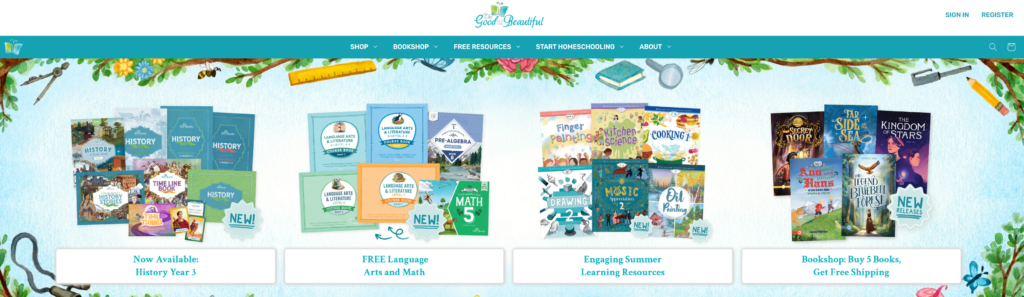
The first thing most parents notice about The Good and the Beautiful is exactly what the name promises.
The books are beautiful.
The pages feature detailed artwork, nature photography, maps, stories, poetry, and clean layouts that look more like premium children’s books than ordinary school workbooks. When I first examined the curriculum, I immediately understood why it had become so popular among homeschooling families.
But attractive pages are not enough.
As a homeschooling dad, I care about whether a curriculum actually teaches children to read, write, calculate, reason, and understand the world. I also want to know how much preparation falls on the parent, whether the Christian content fits our family, whether the courses are rigorous enough, and how much the complete program will really cost.
After reviewing its current language arts, math, science, history, and elective programs, my conclusion is this:
The Good and the Beautiful is one of the best-value homeschool curricula available for Christian families who want beautiful materials, short lessons, strong literature, and minimal daily preparation. However, it is not a complete one-box curriculum, and some children may need additional spelling, writing, or math practice.
The Good and the Beautiful Review: Quick Verdict
The Good and the Beautiful is best for families who want:
- An affordable Christian homeschool curriculum
- Free language arts and math PDF courses
- Open-and-go daily lessons
- Beautiful artwork and wholesome literature
- A gentle but structured approach
- Family-style science and history
- A broadly Christian rather than heavily denominational curriculum
- Shorter lessons with relatively little parent preparation
- A mixture of reading, workbooks, games, videos, and hands-on activities
It may not be ideal for families who want:
- A completely secular curriculum
- A single boxed package containing every subject
- A fully online or teacher-led school
- Intensive drill and repetition
- A strict classical or traditional textbook program
- Accredited enrollment, transcripts, or diplomas
- A curriculum requiring almost no parent participation
- Advanced high-school coverage across every core subject
What Is The Good and the Beautiful?
The Good and the Beautiful is a Christian homeschool curriculum company founded by Jenny Phillips.
It offers materials in:
- Language arts
- Mathematics
- Science
- History
- The U.S. Constitution and government
- Handwriting
- Botany
- Typing
- Music appreciation
- Arts and crafts
- Health and physical education
- Marine biology and other electives
The company describes its approach as focusing on family, God, high character, nature, and wholesome literature. Its history, science, and many elective courses are designed for family-style teaching, while language arts and math are generally completed at each child’s individual level.
One of its most unusual features is its pricing model.
Complete PDF versions of many language arts and math courses are available for free. Families can print the materials themselves or purchase professionally printed physical books.
That makes The Good and the Beautiful especially appealing to parents who want to examine a curriculum before investing hundreds of dollars.
Is The Good and the Beautiful Accredited?
No.
The Good and the Beautiful is a curriculum publisher, not an accredited private school or online academy.
Purchasing its books does not enroll your child in a school. The parent remains responsible for:
- Meeting state homeschool requirements
- Selecting courses
- Teaching or supervising lessons
- Tracking attendance
- Grading work
- Maintaining records
- Preparing transcripts
- Issuing a homeschool diploma where permitted
For most homeschool families, this is normal.
However, parents should understand the difference between buying curriculum and enrolling in an accredited program. The Good and the Beautiful provides educational materials. It does not automatically supply a teacher, registrar, guidance counselor, or official school transcript.
My First Impression as a Homeschooling Dad
My first impression was that this curriculum understands something many traditional publishers forget:
Children learn better when the material invites them in.
A child is more likely to approach a lesson positively when the page includes a beautiful painting, an interesting animal, an engaging story, or a well-designed map rather than a wall of tiny black text.
That does not mean children should be entertained every second. Education requires effort, discipline, and repetition.
But presentation matters.
If I am going to sit beside my child every morning, I would rather open a book that makes both of us curious than one that looks as though it was printed by a government department in 1987.
The curriculum also feels less bureaucratic than many boxed programs.
I do not need several teacher manuals, a separate scheduling binder, and an elaborate preparation routine. Most courses tell the parent what to say, what the child should do, and which materials are required.
That simplicity is valuable in a home where the parent may also be balancing work, younger children, household responsibilities, multiple grade levels, medical appointments, co-op activities, and ordinary family life.
What Makes The Good and the Beautiful Unique?
1. Free Language Arts and Math PDFs
The free-course model is the curriculum’s most distinctive feature.
The company provides full-course PDF downloads for multiple language arts and math levels. These can include course books, answer keys, novels, and other required components, depending on the level.
This means a family with access to a printer can begin core instruction without purchasing the curriculum files.
However, “free PDF” does not necessarily mean free to use.
Parents must still consider:
- Printer ink
- Paper
- Binding
- Cardstock
- Double-sided printing
- Time spent organizing pages
- Math manipulatives
- Required readers
- Optional apps or physical extras
For a short workbook, home printing may save money. For a full-color, 400-page course, professionally printed books may be cheaper and considerably easier.
Still, the free downloads give parents something rare in homeschooling: the ability to inspect and use a complete course before making a substantial financial commitment.
2. Beautiful Artwork and Design
The visual quality is not merely decorative.
Art, geography, nature, and literature are frequently integrated into language arts lessons. Children may analyze a painting, learn vocabulary through geography, read a historical story, or study a poem while developing grammar and writing skills.
That integrated structure helps children understand that academic subjects are connected.
Language arts is not merely about identifying nouns. It involves reading good writing, observing the world, learning to communicate, and developing a richer vocabulary.
3. Multiple Subjects Are Combined
The language arts courses may include:
- Phonics
- Reading
- Spelling
- Grammar
- Punctuation
- Vocabulary
- Literature
- Writing
- Art appreciation
- Geography
- Poetry
- Character development
This reduces the number of separate programs a parent needs to purchase and schedule.
Instead of assigning separate grammar, spelling, writing, literature, vocabulary, and geography books, the parent may cover several areas through a single course.
The benefit is simplicity.
The potential weakness is that a combined program may not provide enough depth in every area for every child. A struggling speller may need a specialized spelling program. A gifted writer may need more demanding composition assignments.
An all-in-one course is convenient, but convenience does not eliminate individual learning needs.
4. Broadly Christian, Nondenominational Content
The Good and the Beautiful describes itself as Christian but not tied to a single denomination.
Its curriculum emphasizes broad principles such as:
- Honesty
- Kindness
- Gratitude
- Prayer
- Hard work
- Moral character
- Appreciation for God’s creation
That approach makes it accessible to a wider range of Christian families than curricula built around detailed denominational doctrine.
Parents should still examine the samples.
“Nondenominational” does not mean religiously neutral. References to God, prayer, Scripture, Christian character, and faith are integrated into the curriculum.
A secular family may find the religious content incompatible with its beliefs. A family wanting intensive theology or catechism will probably need to add a separate Bible or doctrinal program.
5. Open-and-Go Lessons
The curriculum is designed to minimize advance preparation.
Parents generally gather the listed supplies, open the course book, and follow the instructions.
That does not mean the curriculum teaches itself.
Younger children still need a parent to:
- Explain new concepts
- Listen to reading
- Lead games
- Check handwriting
- Correct mistakes
- Discuss stories
- Supervise manipulatives
The term “open and go” should be understood as low preparation, not no parental involvement.
As a dad, I consider that a fair compromise. I want to teach my child. I simply do not want to spend two hours planning a 25-minute lesson.
6. Family-Style Science and History
Science and history courses are designed so that several children can study the same central topic together.
A parent might teach a unit to children in several grades and then assign age-appropriate notebooks, activities, or reading.
This is a significant advantage for larger families.
Teaching three separate science courses and three separate history courses can consume the entire day. Family-style learning allows the parent to gather everyone together for the main lesson.
Older children can complete more demanding work, while younger children participate through:
- Coloring
- Maps
- Oral narration
- Simple experiments
- Activity books
- Read-aloud stories
7. Wholesome Literature
The Good and the Beautiful places unusual emphasis on morally clean books.
Its literature generally avoids:
- Graphic sexuality
- Excessive profanity
- Cynicism
- Gratuitous violence
- Material the publisher considers spiritually harmful
For many parents, that is a major attraction.
Children do not have to be exposed to every form of ugliness to become educated. A young child can learn literary analysis through stories of courage, family, sacrifice, nature, adventure, and faith.
However, “wholesome” should not become synonymous with shallow.
Older students eventually need to encounter difficult historical realities, moral ambiguity, and challenging literature. Parents should evaluate whether the assigned books are preparing a particular child for advanced reading and college-level analysis.
8. Companion Apps Without Becoming a Screen-Based School
The curriculum uses optional digital tools without making the entire school day dependent on a computer.
The app may provide:
- Spelling instruction
- Audio narrations
- Vocabulary practice
- Grammar songs
- Geography resources
- Reading exercises
- Art videos
- Course videos
Parents who want a completely screen-free curriculum should examine the requirements of the specific course level. Some app activities are optional, while others contribute meaningfully to instruction.
I generally like this balance. A short instructional video can clarify a concept without turning the child’s education into hours of clicking through an online platform.
The Good and the Beautiful Language Arts Review
Language arts is arguably the company’s flagship program.
The courses combine reading, phonics, grammar, spelling, writing, literature, vocabulary, art, and geography into a single sequence.
What I Like About the Language Arts Curriculum
The Lessons Feel Connected
Children are not constantly jumping between unrelated workbooks.
A lesson may begin with a story, introduce vocabulary, examine sentence structure, include spelling practice, and finish with a short writing activity.
This can make learning feel coherent rather than fragmented.
The Books Are Visually Inviting
The artwork, maps, and nature themes make lessons more pleasant for both the parent and child.
A beautiful book does not guarantee academic quality, but a well-designed page can reduce resistance.
The PDF Courses Offer Exceptional Value
Full-course downloads are available for several levels without charge.
For a family on a limited budget, this is difficult to beat.
Literature Is Built Into the Program
Upper levels include assigned novels rather than treating reading as a separate optional activity.
It Requires Little Daily Preparation
The lesson sequence is printed directly in the course book, making it straightforward for new homeschool parents.
Possible Language Arts Weaknesses
Spelling May Need Additional Attention
Parent feedback is mixed regarding spelling.
Some children succeed with the integrated approach and app practice. Others need more systematic rules, dictation, or repetition.
A child who repeatedly misspells basic words should not continue merely because the curriculum schedule says the lesson is complete.
It Can Feel Like Too Many Subjects in One Book
Integration is efficient, but it can also make the course feel busy.
A parent may begin a lesson expecting grammar and suddenly encounter geography, art, poetry, and spelling.
Some children enjoy the variety. Others may find the transitions distracting.
Lessons May Take Longer Than Expected
Although the curriculum is marketed as concise, language arts can take longer for children who write slowly, struggle with reading, or need additional explanation.
Strong Readers May Need More Challenging Literature
The assigned books are generally wholesome and accessible, but advanced readers may need additional classic or contemporary literature.
Printing the Free PDF Can Be Expensive
Large, full-color course books use considerable ink and paper.
Before printing at home, compare the total cost with purchasing the bound course set.
Simply Good and Beautiful Math Review
Simply Good and Beautiful Math is a colorful, spiral-based program.
The elementary curriculum combines:
- Direct instruction
- Short stories
- Games
- Puzzles
- Manipulatives
- Mental math
- Review
- Workbook practice
- Everyday applications
What I Like About the Math Curriculum
It Makes Elementary Math Less Intimidating
The lessons use colorful pages, stories, and activities rather than presenting children with endless rows of calculations.
It Includes Built-In Review
The spiral approach means previously learned concepts reappear throughout the course.
That can be helpful for children who forget skills after completing a single chapter.
It Uses Games and Manipulatives
Younger levels use Math Boxes and other hands-on materials to demonstrate abstract concepts.
Many PDF Courses Are Free
Families can download several elementary and middle-school math courses without purchasing the printed books.
It Is Open and Go
Parents generally do not need to study lessons extensively in advance.
Possible Math Weaknesses
Some Children Need More Practice
A visually attractive spiral course can still move too quickly for a child who has not mastered multiplication facts, long division, or fractions.
Parents may need:
- Flashcards
- Additional worksheets
- Math-fact practice
- Games
- Online review
- A supplemental mastery program
The Spiral Approach Does Not Suit Everyone
Some students prefer studying one concept deeply before moving on.
Those children may find frequent topic changes frustrating.
Manipulatives Add Cost and Clutter
The PDFs may be free, but Math Boxes and physical resources must usually be purchased separately.
Each Child Needs a Consumable Course Book
This reduces savings for larger families unless parents print separate PDF copies.
Parents Should Use the Placement Test
The course level does not always correspond perfectly to a child’s age or previous school grade.
Use the official placement test rather than automatically selecting the child’s nominal grade.
The Good and the Beautiful Science Review
Science is organized primarily through family-style unit studies.
Available topics have included courses such as:
- Botany
- Marine biology
- Mammals
- Birds
- Reptiles, amphibians, and fish
- Ecosystems
- Weather and water
- Space science
- Health and the physical body
- Chemistry
- Geology
- Arthropods
Courses generally combine:
- A parent-led lesson
- Full-color science text
- Videos
- Experiments
- Vocabulary
- Student notebooks
- Nature study
- Optional books
Science Strengths
The courses are visually impressive and usually engaging.
Children study photographs, diagrams, animals, ecosystems, and natural processes rather than completing only textbook questions.
Family-style teaching also makes science manageable for households with several children.
Many experiments use ordinary household materials, although parents should review the supply list before beginning.
Science Weaknesses
The unit-study structure is not always sequential.
A family may study botany one year and marine biology the next, but parents must ensure that children eventually receive broad coverage of:
- Life science
- Physical science
- Earth science
- Chemistry
- Physics
- The scientific method
- Laboratory skills
Some families may also want a more formal textbook or laboratory-based program for high school.
The science courses are Christian but generally written for a broad faith audience. Parents with specific convictions concerning creation, evolution, or the age of the Earth should inspect individual courses rather than assuming the exact position from the Christian label.
The Good and the Beautiful History Review
The redesigned history curriculum uses a multiyear cycle combining world and U.S. history.
Lessons may use:
- Stories
- Timelines
- Maps
- Images
- Games
- Primary-source excerpts
- Biographies
- Discussions
- Student notebooks
- Family read-alouds
History Strengths
The story-based presentation makes historical people and events memorable.
Maps and illustrations help children place events geographically.
The family-style design reduces the burden of teaching separate history programs to several children.
History Weaknesses
Families should verify that the particular course year and edition they need are currently available.
The broad chronological scope may also limit depth. Parents of older students may need additional:
- Primary sources
- Essays
- Document analysis
- Detailed biographies
- Government and economics instruction
- Formal research projects
The Good and the Beautiful Pricing in 2026
There is no single complete grade-package price because the curriculum is sold by subject.
Language arts and math PDFs may be free, but physical books, science units, history sets, manipulatives, readers, handwriting materials, and electives are purchased separately.
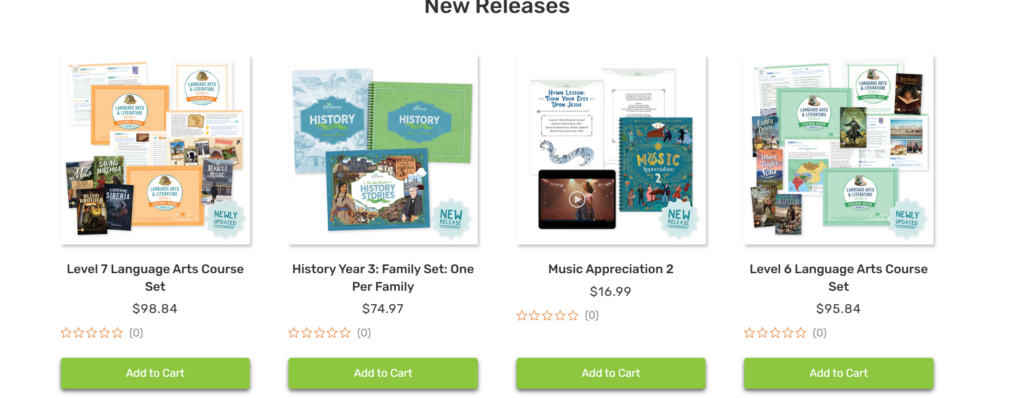
Current Pricing Examples
| Product | Price |
| Language Arts Level 6 physical course set | $95.84 |
| Language Arts Level 7 physical course set | $98.84 |
| History Year 3 family set | $74.97 |
| History Year 3 Big Book of Stories | $25.99 |
| History Year 3 Maps & Images | $22.99 |
| Level K Reading Booster A Books | $23.99 |
| Level K Handwriting Workbook | $12.99 |
| Music Appreciation 2 | $16.99 |
| Level 7 answer key | $16.99 |
| Typing annual subscription | $34.99 |
| Creative Writing Notebook 2 | $14.99 |
Approximate Annual Cost
A family using free PDFs can keep costs relatively low, but a realistic annual budget depends on printing and subject choices.
Budget Digital Approach
A parent might use:
- Free language arts PDF
- Free math PDF
- Library books
- One purchased science unit
- One history set shared by the family
- Printed handwriting pages
Estimated curriculum spending could remain around $75 to $175 per child, excluding printing, ink, and supplies.
Mostly Physical Books
A family purchasing professionally printed language arts, math, science, history, handwriting, and required readers might spend approximately $250 to $500 per child.
The cost can be lower for siblings because science and history family sets are often reusable.
Multiple Electives and Bookshop Titles
Adding typing, music, arts and crafts, extra literature, physical education, and supplementary notebooks could push the annual total beyond $500 per child.
These are estimates rather than official packages because families select subjects individually.
Hidden Costs to Consider
Parents should budget for:
- Printer ink
- Paper
- Binding
- Math Boxes
- Science supplies
- Student notebooks
- Required novels
- Handwriting books
- Shipping
- Optional apps or subscriptions
- Replacement consumable books
- Additional spelling or math practice
The curriculum is inexpensive compared with many premium programs, but it is not automatically free.
Pros and Cons of The Good and the Beautiful
Pros
1. Exceptional Value
Free language arts and math downloads make it one of the most accessible Christian curricula available.
2. Beautiful Materials
The illustrations, photographs, and layouts are unusually attractive.
3. Low Parent Preparation
Most courses are genuinely open and go.
4. Broad Christian Worldview
The content emphasizes God and moral character without focusing heavily on one denomination.
5. Strong Literature Component
Children encounter stories, novels, poetry, and biographies rather than relying entirely on dry textbooks.
6. Family-Style Science and History
Parents can teach several ages together.
7. Integrated Language Arts
Grammar, spelling, writing, literature, art, and geography are combined.
8. Hands-On Math
Games and manipulatives help younger students understand abstract concepts.
9. Flexible Purchasing
Parents can use one subject without committing to the entire curriculum.
10. Free Placement Tests and Samples
Families can examine materials and select levels more carefully.
Cons
1. It Is Not a Complete Boxed Curriculum
Parents must assemble subjects individually.
2. Some Children Need More Repetition
Math facts, spelling, and grammar may require supplementation.
3. Printing Can Be Expensive
Free full-color PDFs can consume large amounts of ink and paper.
4. Family-Style Courses Still Require Adaptation
Younger and older children may need different notebooks and expectations.
5. Limited Full High-School Coverage
Families may need other providers for advanced mathematics, laboratory science, foreign language, or college-preparatory electives.
6. Religious Content Will Not Suit Secular Families
The curriculum refers openly to God, prayer, Scripture, and Christian virtues.
7. Integrated Language Arts Can Feel Busy
Some children may prefer separate, more focused subject books.
8. Optional App Content Adds Screen Time
Some spelling and instructional resources are delivered digitally.
9. It Is Not Accredited
Parents remain responsible for records and transcripts.
10. Course Revisions Can Be Confusing
Families should ensure that they purchase compatible editions, readers, and answer keys.
The Good and the Beautiful vs. Master Books
Both programs appeal to Christian families seeking gentle, attractive, and affordable curriculum.
| Feature | The Good and the Beautiful | Master Books |
| Christian approach | Broadly Christian | Conservative evangelical |
| Free curriculum | Language arts and math PDFs | Limited free samples |
| Visual style | Highly artistic | Colorful and practical |
| Language arts | Literature, art, and geography integrated | Story-based living education |
| Math | Spiral and hands-on | Story-based and practical |
| Science | Family-style unit studies | Grade-level and topical courses |
| Creation approach | Varies by course | Explicit young-earth creationism |
| Parent preparation | Low | Low |
| Academic feel | Gentle to moderately advanced | Generally gentle |
| Best feature | Value and beauty | Simplicity and worldview consistency |
Choose The Good and the Beautiful When:
- Cost is a major concern
- Your child loves artwork and literature
- You want broader Christian content
- You prefer family-style science
- You want to inspect complete PDFs before purchasing
Consider Master Books When:
- You want a more explicitly evangelical worldview
- You prefer a clearer grade-by-grade package
- You want stronger creationist apologetics
- Your child enjoys continuing stories
- You want a particularly gentle daily workload
The Good and the Beautiful vs. Abeka
| Feature | The Good and the Beautiful | Abeka |
| Structure | Flexible | Highly structured |
| Lessons | Shorter and varied | Longer and traditional |
| Drill | Moderate | Extensive |
| Parent preparation | Low | Moderate to high |
| Literature | Heavily integrated | Traditional readers |
| Cost | Low to moderate | Moderate to high |
| Video school | No full equivalent | Available |
| Best for | Visual and literature-oriented students | Students who thrive on repetition |
Abeka may be stronger for children who need formal drills, tests, and traditional sequencing.
The Good and the Beautiful may be better for children who become overwhelmed by long worksheets or highly repetitive assignments.
The Good and the Beautiful vs. BJU Press
BJU Press is generally more textbook-based and academically formal.
The Good and the Beautiful is less expensive, visually softer, and easier to begin.
BJU Press May Be Better For:
- Formal college preparation
- Detailed science textbooks
- Traditional testing
- Full video instruction
- Stronger high-school continuity
The Good and the Beautiful May Be Better For:
- Younger children
- Budget-conscious families
- Parents teaching several ages
- Literature and nature study
- Minimal daily preparation
Is The Good and the Beautiful Rigorous Enough?
The real test of rigor is whether the child can:
- Read fluently
- Understand increasingly difficult texts
- Spell common words
- Write organized paragraphs and essays
- Use grammar correctly
- Recall math facts
- Solve unfamiliar problems
- Explain scientific concepts
- Analyze historical evidence
- Work independently
For many average students, The Good and the Beautiful can provide a solid elementary and middle-school foundation.
Advanced students may need:
- More difficult books
- Additional writing assignments
- Deeper science
- Formal grammar
- Faster math progression
- More primary-source history
Struggling students may need:
- Slower pacing
- Additional phonics
- Structured spelling
- More math repetition
- Specialized intervention
The placement test should guide the starting level, but ongoing observation should determine whether the curriculum remains appropriate.
Who Should Use The Good and the Beautiful?
It is especially suitable for:
- Christian homeschooling families
- First-time homeschool parents
- Budget-conscious households
- Visual learners
- Children who enjoy stories and nature
- Families with several grade levels
- Parents wanting short, open-and-go lessons
- Children who dislike traditional textbooks
- Families wanting less screen time
- Parents who enjoy learning alongside their children
Who Should Avoid It?
It may be a poor fit for:
- Secular families
- Parents wanting one complete boxed program
- Students who need extensive drill
- Children who dislike art, stories, or frequent subject integration
- Parents seeking full-time online instruction
- Families wanting accredited enrollment
- Students requiring advanced high-school coursework
- Parents who do not want to print or purchase multiple course components
Final Verdict: Is The Good and the Beautiful Worth It?
Yes—for the right family.
The Good and the Beautiful offers something rare: attractive, usable Christian curriculum at a price ordinary families can afford.
Its free language arts and math PDFs remove much of the financial risk. Its books are visually excellent. Its lessons are generally easy to teach. Its literature is wholesome. Its science and history courses allow families to learn together.
As a homeschooling dad, I appreciate that the curriculum does not assume a parent has unlimited preparation time or a separate schoolroom filled with professional equipment.
But I would not use it blindly.
Beautiful pages can create the impression that everything is working even when a child has not mastered spelling, multiplication, or writing. Parents still need to examine actual progress.
My final assessment is:
The Good and the Beautiful is one of the strongest affordable choices for Christian elementary and middle-school homeschooling, particularly for visual learners and literature-loving families. It works best when parents use its flexibility wisely and supplement areas where an individual child needs more depth or repetition.
Overall Rating
| Category | Rating |
| Ease of use | 4.8/5 |
| Affordability | 5/5 |
| Visual quality | 5/5 |
| Christian worldview | 4.3/5 |
| Literature | 4.7/5 |
| Flexibility | 4.6/5 |
| Math instruction | 4.1/5 |
| Language arts | 4.4/5 |
| High-school completeness | 3.2/5 |
| Overall rating | 4.5/5 |
Frequently Asked Questions
Is The Good and the Beautiful Curriculum Really Free?
The company offers free PDF downloads for many language arts and math levels. Physical books, math manipulatives, history, most science courses, handwriting, and electives generally cost extra.
Is The Good and the Beautiful a Complete Curriculum?
It offers most major elementary and middle-school subjects, but parents select them separately. It is not a single complete grade-level box, and some families may need additional Bible, foreign-language, or advanced high-school courses.
Is The Good and the Beautiful Christian?
Yes. It teaches a broad Christian worldview emphasizing God, prayer, honesty, gratitude, kindness, and strong moral character.
Is The Good and the Beautiful Accredited?
No. It is a curriculum publisher rather than an accredited school.
Does The Good and the Beautiful Use Common Core?
The publisher says its math curriculum does not follow Common Core, although it was developed partly by comparing national and state academic standards.
How Long Do Lessons Take?
Lesson length varies by level and child. Many elementary math and language arts lessons can be completed in approximately 20 to 45 minutes per subject, but struggling readers or slow writers may need longer.
Does It Include Bible Curriculum?
Christian principles are integrated into many courses, but it does not replace a detailed family Bible study, catechism, or denominational religious program.
Is the Math Curriculum Mastery-Based or Spiral?
Simply Good and Beautiful Math is mainly spiral, meaning previously learned concepts are reviewed throughout the year.
Can Siblings Share the Curriculum?
Science and history family sets can generally be shared. Consumable math and language arts course books require separate copies or separately printed PDFs for each child.
Is The Good and the Beautiful Good for High School?
It offers some high-school-level resources, but it is not currently as complete at the high-school level as programs such as Abeka, BJU Press, or full online academies. Families should plan credits, laboratory sciences, advanced math, and college requirements carefully.