
Abeka is one of the oldest and most recognizable Christian homeschool curriculum providers in the United States.
Its approach is unapologetically traditional. Children use textbooks and workbooks, memorize facts, complete frequent reviews, take tests, and progress through a carefully sequenced academic program. Families can teach the curriculum themselves or use recorded classroom lessons through Abeka Academy.
As a homeschooling dad, I can see why Abeka appeals to parents who worry that a relaxed curriculum may leave academic gaps.
The program is structured, comprehensive and predictable. Phonics is systematic. Grammar is thorough. Arithmetic includes extensive practice. The video option provides full classroom-style instruction from experienced Christian-school teachers.
However, Abeka can also feel repetitive, demanding and overly school-like.
A child who thrives on structure may do very well. A child who left school because of long lessons, worksheets and rigid pacing may feel as though conventional school has simply followed him home.
My overall conclusion is:
Abeka is a strong Christian homeschool curriculum for families that want traditional academics, extensive review and clear daily expectations. It is especially effective for students who learn through repetition, but it may be too rigid, time-consuming or worksheet-heavy for children who need a gentler and more individualized approach.
Abeka Review: Quick Verdict
| Category | My assessment |
| Grades covered | K4–12 |
| Teaching formats | Parent-led, streaming video and DVD |
| Religious approach | Conservative Protestant Christian |
| Academic style | Traditional, structured and repetition-heavy |
| Parent preparation | High when parent-led; lower with video |
| Student independence | Moderate with video instruction |
| Accreditation | Available through Abeka Academy |
| Full video-program cost | About $1,399 before some accredited-program fees |
| Best subjects | Phonics, grammar, spelling and arithmetic |
| Overall rating | 4.3/5 |
Abeka is best for:
- Families wanting a traditional Christian education
- Children who benefit from repetition and memorization
- Parents who want complete grade-level packages
- Students comfortable with textbooks and workbooks
- Families seeking strong phonics and grammar
- Parents who want recorded classroom instruction
- Students preparing for formal high-school coursework
- Families interested in accredited enrollment
It may not be ideal for:
- Children who become bored by repeated practice
- Families seeking short or gentle lessons
- Parents wanting literature-based learning
- Children who need significant movement or project-based work
- Families trying to minimize worksheets
- Parents teaching several grades together
- Secular or religiously neutral households
- Families wanting a low-cost curriculum
What Is Abeka Curriculum?
Abeka is a Christian curriculum publisher offering educational materials for preschool through Grade 12.
Families can purchase:
- Individual textbooks and workbooks
- Student subject kits
- Parent teaching materials
- Complete grade-level kits
- Streaming video courses
- DVD courses
- Accredited Abeka Academy enrollment
- Independent-study video enrollment
Abeka Academy itself offers programs from K4 through Grade 12. Families can choose either its accredited program or an independent-study option. (Abeka Dashboard)
The curriculum covers subjects such as:
- Bible
- Phonics
- Reading
- Spelling
- Handwriting
- Language and grammar
- Composition
- Literature
- Arithmetic and mathematics
- Science
- Health
- History
- Geography
- Government
- Economics
- Foreign language
- Electives
Abeka’s instructional model was developed for Christian schools and later adapted for homeschooling. This explains why its homeschool program often feels like a private-school classroom brought into the home.
How Does Abeka Homeschool Work?
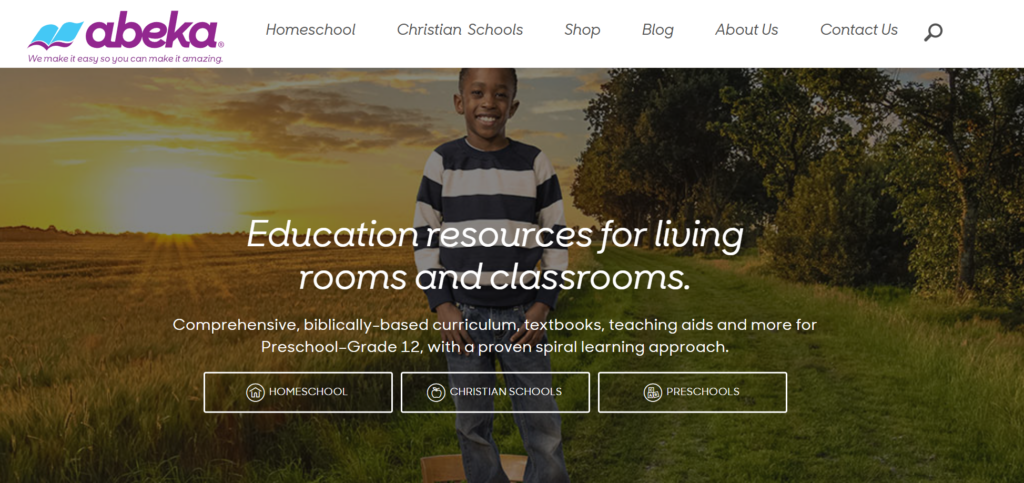
Parents can use Abeka in three main ways.
Parent-Led Curriculum
With the parent-led option, the family purchases student books, teacher editions, tests, answer keys and other resources.
The parent delivers the instruction, assigns work and grades assessments.
This option provides the greatest flexibility. Parents can:
- Shorten lessons
- Skip repetitive exercises
- Slow the pace
- Combine subjects
- Replace tests with oral review
- Use Abeka for only selected subjects
The disadvantage is the number of materials and the preparation required.
For example, Abeka’s homeschool kits can include separate student books, teacher editions, quiz books, test books and answer keys. On its official kit overview, Abeka gave the example of a third-grade child kit plus complete parent kit costing $1,090.45. (Abeka)
Independent-Study Video Program
With independent study, students watch recorded Abeka Academy classes but remain under the parent’s academic administration.
The family generally handles:
- Recordkeeping
- Grading
- Transcripts
- Attendance
- Promotion decisions
- Diploma preparation
This option offers classroom instruction without accredited-school oversight.
Accredited Abeka Academy
The accredited program combines video instruction with institutional recordkeeping.
Abeka Academy states that its accredited program is recognized by both the Middle States Association Commissions on Elementary and Secondary Schools and the Florida Association of Christian Colleges and Schools. The Academy maintains permanent records and grades examinations for students in Grades 9–12. (Abeka Dashboard)
Accredited enrollment can provide:
- Official records
- Report cards
- Transcripts
- Course verification
- Graduation eligibility
- An Abeka Academy diploma
- Academic support
Eligible accredited-program seniors may attend Abeka Academy’s graduation ceremony at Pensacola Christian College. (Abeka Dashboard)
My Impression as a Homeschooling Dad
Abeka gives me very little reason to wonder what my child is supposed to learn next.
The curriculum is carefully sequenced. Lessons build on previous lessons. Review is frequent. Tests are already prepared. Teacher materials explain how concepts should be presented.
That is reassuring, particularly for new homeschool parents.
When people begin homeschooling, one of their greatest fears is:
“What if I accidentally leave gaps in my child’s education?”
Abeka addresses that fear by giving the family a comprehensive program with clear grade-level expectations.
Its strength is consistency.
Its weakness is also consistency.
A child may be asked to complete more practice than he actually needs because the program was designed to work in a classroom containing students with different abilities. The homeschool parent must decide when the child has mastered the material.
If my child understands a math concept after ten problems, I do not necessarily need to make him complete thirty.
If he can spell every word correctly, another full page of spelling practice may not add much value.
Abeka works best when parents use its structure without becoming enslaved to it.
What Makes Abeka Different?
Intensive Review and Repetition
Abeka relies heavily on spiral review.
Skills and facts are introduced, practiced and revisited frequently.
This is particularly noticeable in:
- Arithmetic
- Phonics
- Spelling
- Grammar
- History facts
- Science vocabulary
For students who forget material quickly, repeated exposure can produce strong retention.
For students who master concepts rapidly, the repetition can become tedious.
This is the central question parents should ask before buying Abeka:
Does my child learn through repetition, or does repetition cause him to disengage?
Traditional Classroom-Style Video Lessons
Abeka Academy’s video courses are filmed in Christian-school classrooms.
Students watch a teacher instruct a class of children rather than receiving a short tutorial designed exclusively for one homeschool student.
This can make the lessons feel lively because the recorded teacher interacts with pupils, asks questions and leads classroom activities.
It can also make them longer than necessary.
A homeschooled child may spend time watching:
- Other students answer questions
- Attendance routines
- Classroom transitions
- Group repetition
- Teacher corrections
- Activities designed for a full class
Some children enjoy the sense of being part of a classroom.
Others become frustrated because they cannot move directly to the next concept.
Strong Phonics Instruction
Abeka is especially well known for phonics.
The early reading sequence teaches children to connect letters and letter combinations with sounds before progressing into increasingly complex reading.
The program uses:
- Phonics charts
- Blend practice
- Word families
- Readers
- Flashcards
- Oral drills
- Written exercises
- Repeated reading practice
This systematic approach can create confident early readers.
However, it is instruction-heavy. Parents using the parent-led version should expect active teaching rather than simply handing the child a workbook.
Thorough Grammar and Language Instruction
Abeka teaches grammar explicitly.
Students learn:
- Parts of speech
- Sentence structure
- Punctuation
- Capitalization
- Usage
- Diagramming
- Vocabulary
- Editing
- Composition
Independent curriculum reviewer Cathy Duffy describes the Abeka language series as especially thorough in grammar, particularly in the upper grades, although she considers its composition instruction less distinctive than its grammar work.
This makes Abeka appealing to parents who believe many modern curricula neglect formal grammar.
The risk is that students become proficient at identifying grammatical rules without developing an equally strong personal writing voice.
Strong Christian and Conservative Perspective
Abeka teaches from a conservative Protestant Christian worldview.
Its materials commonly emphasize:
- Biblical authority
- Creation
- Christian character
- Patriotism
- Personal responsibility
- Free enterprise
- Traditional morality
- Providential interpretations of history
Its American government materials, for example, have been described as presenting a conservative, Christian, free-enterprise and patriotic perspective.
Families who share those convictions may appreciate the consistency.
Families who want a broader range of political, historical or theological viewpoints should add outside readings and primary sources.
Complete Grade-Level Packages
Abeka provides a full K4–12 sequence.
Families can stay with the same publisher for:
- Beginning phonics
- Elementary reading
- Arithmetic
- Grammar
- Middle-school science
- Algebra
- Geometry
- Biology
- Chemistry
- World history
- American history
- Government
- Economics
- High-school literature
This continuity reduces the risk of switching between programs with incompatible sequences.
Abeka Subject Review
Abeka Phonics and Reading Review
Phonics is one of Abeka’s strongest areas.
The program is highly systematic and includes extensive oral practice.
Strengths
- Clear phonics sequence
- Frequent review
- Strong decoding instruction
- Attractive readers
- Oral reading practice
- Good support for parents
- Clear progression into independent reading
Weaknesses
- Drill-heavy
- Can feel repetitive
- Parent-led lessons require time
- Video classes may be long
- Some children may need slower multisensory intervention
- Advanced readers may move beyond the scheduled pace
I would seriously consider Abeka phonics for a child who responds well to direct instruction and verbal repetition.
For a child with dyslexia or significant phonological difficulties, I would compare it with a specialized structured-literacy program rather than assuming any mainstream phonics curriculum will be sufficient.
Abeka Math Review
Abeka’s elementary Arithmetic series uses a spiral approach.
Concepts are taught and then reviewed repeatedly through daily practice.
The curriculum emphasizes:
- Number facts
- Mental arithmetic
- Computation
- Word problems
- Speed and accuracy
- Frequent review
- Practical applications
- Formal testing
Math Strengths
- Strong math-fact retention
- Extensive review
- Clear daily structure
- Traditional computational skills
- Plenty of practice
- Good preparation for timed work
- Consistent sequence
Math Weaknesses
- Too many problems for some children
- Less emphasis on discovery
- Fast pacing can overwhelm struggling students
- Frequent drills may create math anxiety
- Parents may need to reduce assignments
- Conceptual explanations may feel less deep than some alternatives
Abeka Math may work very well for a student who needs repeated practice.
A child who understands concepts quickly but becomes frustrated by routine exercises may prefer BJU Press, Singapore Math or another more conceptual program.
Abeka Language and Grammar Review
Abeka’s language program is formal and rule-driven.
Students receive regular practice in grammar, usage, punctuation and sentence structure.
Strengths
- Thorough grammar coverage
- Strong mechanics
- Frequent review
- Clear rules
- Structured composition assignments
- Useful teacher editions
- Good preparation for formal academic work
Weaknesses
- Can become repetitive
- Writing may feel formulaic
- Heavy workbook use
- Less emphasis on authentic personal writing
- Grammar exercises can dominate language arts
- Parents still need to evaluate compositions
Abeka is particularly strong for families that want children to know formal English rules.
I would supplement it with:
- Journaling
- Letters
- Essays on meaningful topics
- Creative writing
- Full-length literature
- Research projects
That helps ensure the child learns to communicate rather than merely complete grammar exercises.
Abeka Spelling Review
Abeka Spelling includes word lists, vocabulary, poetry, rules and written practice.
Cathy Duffy notes that its word lists can be challenging and that its teacher editions include lesson presentation guidance and additional support.
Spelling Strengths
- Challenging word lists
- Strong vocabulary
- Regular testing
- Poetry exposure
- Clear weekly structure
- Integration with other language arts
Spelling Weaknesses
- List-based instruction does not suit every learner
- Some students need more phonetic analysis
- Weekly lists may include words the child already knows
- Struggling spellers may require multisensory instruction
- Adds time to an already full language arts schedule
Abeka Science Review
Abeka Science uses colorful Christian textbooks and workbooks.
Elementary materials cover topics such as:
- Plants
- Animals
- Weather
- The human body
- Matter
- Energy
- Earth
- Space
- Health
Cathy Duffy notes that the elementary books are written explicitly for a Christian audience and are printed in full color. Early-grade books are often consumable, while higher elementary grades use separate activity books or worksheets.
Science Strengths
- Attractive presentation
- Clear vocabulary
- Strong factual content
- Christian worldview
- Consistent grade progression
- Useful quizzes and tests
- High-school course availability
Science Weaknesses
- Textbook-heavy
- Fewer discovery-based experiences than some programs
- Experiments may feel secondary
- Strong creationist interpretation
- Memorization can overshadow scientific inquiry
- Parents may want additional hands-on work
Abeka Science can provide solid foundational knowledge, but I would add experiments, nature study and open-ended investigation where possible.
Abeka History Review
Abeka History presents history through a conservative Christian and patriotic perspective.
The books include:
- Timelines
- Maps
- Political history
- Biographies
- Cultural developments
- Christian history
- Review questions
- Quizzes and tests
Independent reviews note that the elementary history books use full-color illustrations and child-friendly layouts.
History Strengths
- Clear chronological structure
- Strong factual knowledge
- Attractive maps and pictures
- Frequent review
- Consistent Christian worldview
- Government and citizenship instruction
- Easy to grade
History Weaknesses
- Strong ideological framing
- Limited engagement with competing interpretations
- Heavy dependence on textbooks
- Less immersive than literature-based history
- Memorization may overshadow analysis
- Parents should add primary sources and diverse historical scholarship
I would use Abeka History as a structured spine rather than as the only historical source.
Adding biographies, original documents and historical fiction can make the subject more nuanced and memorable.
Abeka High School Review
Abeka offers a complete high-school curriculum that includes:
- English
- Literature
- Algebra
- Geometry
- Advanced mathematics
- Biology
- Chemistry
- Physics
- World history
- U.S. history
- Government
- Economics
- Bible
- Foreign language
- Electives
Its high-school literature courses lean toward classic works and established selections, with questions focused heavily on comprehension and some literary analysis.
High-School Strengths
- Complete academic sequence
- Traditional college-preparatory coursework
- Recorded subject teachers
- Formal tests and grades
- Accredited enrollment available
- Strong grammar and factual knowledge
- Clear graduation pathway
High-School Weaknesses
- Heavy workload
- Long video lessons
- Limited scheduling flexibility in the accredited track
- Writing can feel formulaic
- Screen time can be substantial
- Parents should verify college and state requirements
- Students may need deeper analytical writing practice
Abeka high school is a good fit for disciplined students who appreciate clear expectations.
Students who want discussion-based seminars, project learning or flexible pacing may prefer another approach.
Is Abeka Accredited?
The curriculum itself is not accredited.
A family can buy Abeka books without enrolling in a school. In that situation, the parent is responsible for records, grades and transcripts.
Accreditation is available through Abeka Academy’s accredited program.
Abeka states that this program is accredited through MSA CESS and FACCS. It maintains permanent records and grades high-school examinations.
Abeka Academy also offers an unaccredited independent-study program.
The distinction is important:
- Parent-led books: not accredited
- Independent-study video program: not accredited
- Accredited Abeka Academy enrollment: accredited
Accreditation may be useful for families that want institutional transcripts and an academy-issued diploma.
Many independent homeschoolers do not need it, but parents should examine their state laws, future school-transfer plans and college requirements.
Abeka Pricing in 2026
Abeka is not a budget curriculum when purchased as a complete program.
Its official video-program comparison showed a base Abeka Academy cost of approximately $1,399. The same comparison listed an Abeka accredited option at a base cost of $1,218, plus an application fee and a $399 accredited-program administrative fee, producing a displayed estimated total of approximately $1,807 to $2,077 depending on applicable fees.
Because Abeka’s pricing pages allow families to select full grades, individual courses and subject combinations, the exact total depends on the chosen enrollment.
Approximate Cost by Format
| Abeka option | Approximate cost |
| Parent-led child and parent kits | Often around $1,000 for a complete grade |
| Full video program | Around $1,399 |
| Accredited program with additional fees | Roughly $1,807–$2,077 in Abeka’s comparison |
| Individual subjects | Varies by subject and format |
Abeka’s official kit page gave a third-grade example of $1,090.45 for the child kit and complete parent kit. (Abeka)
Payment Plans
Abeka Academy says it offers a ten-month payment plan, although it does not offer financial aid. Late balances may incur a 1.5% fee.
Additional Costs
Families should also budget for:
- Application and administrative fees
- Consumable books
- Science supplies
- Art materials
- Printer ink
- Shipping
- Additional readers
- Standardized testing
- Computer or DVD equipment
- Reliable internet
- Replacement books
- Extra support for struggling subjects
Can Abeka Be Reused?
Many materials can be reused, including:
- Teacher editions
- Nonconsumable textbooks
- Readers
- Literature books
- Answer keys
Families usually need new copies of:
- Workbooks
- Test books
- Quiz books
- Handwriting books
- Consumable elementary texts
Video enrollment and accredited services are purchased for a specific student and enrollment period, so they cannot be passed down like physical textbooks.
Abeka Pros and Cons
Pros
- Complete K4–12 curriculum
- Strong phonics and early reading
- Thorough grammar instruction
- Excellent repetition for retention
- Clear schedules and expectations
- Full video instruction available
- Attractive textbooks
- Frequent review and testing
- Accredited enrollment option
- Strong preparation for traditional academics
Cons
- Expensive
- Repetitive for advanced students
- Heavy workbook load
- Long school days
- Classroom videos can be inefficient
- Limited family-style learning
- Strong conservative Protestant viewpoint
- Less project-based than many homeschool programs
- Can create burnout when followed rigidly
- Parent-led packages require significant teaching time
Abeka vs. BJU Press
Abeka and BJU Press are both structured Christian curricula, but their teaching styles differ.
| Feature | Abeka | BJU Press |
| Academic approach | Repetition and memorization | Conceptual explanation and application |
| Math | Extensive drill | More conceptual |
| Grammar | Very thorough | Thorough with stronger integration |
| Science | Factual and traditional | More inquiry and application |
| Video style | Recorded classroom | Recorded subject instruction |
| Flexibility | Lower | Moderate |
| Best for | Students who thrive on repetition | Students who need deeper explanations |
I would choose Abeka when a child needs frequent review and responds well to traditional instruction.
I would lean toward BJU Press when a student needs more explanation, analysis and conceptual depth.
Abeka vs. Master Books
| Feature | Abeka | Master Books |
| Workload | Heavy | Gentle |
| Lesson style | Traditional and drill-based | Story-based and conversational |
| Parent preparation | Moderate to high | Low |
| Video instruction | Full academy program | Limited supplements |
| Cost | High | Lower |
| Best for | Structured academic families | Relaxed Christian homeschooling |
Master Books may be better for reluctant learners and younger children who need shorter lessons.
Abeka may be better for students who need a formal sequence and extensive practice.
Abeka vs. The Good and the Beautiful
| Feature | Abeka | The Good and the Beautiful |
| Cost | High | Low to moderate |
| Structure | Formal and traditional | Gentle and integrated |
| Language arts | Separate subjects | Combined course |
| Math | Drill-heavy spiral | Colorful spiral approach |
| Video program | Full grade-level option | Limited digital supplements |
| Christian content | Conservative Protestant | Broadly Christian |
| Best for | Students needing structure | Visual and literature-oriented learners |
The Good and the Beautiful is more flexible and affordable.
Abeka provides more repetition, testing and conventional academic structure.
Is Abeka Too Hard?
Abeka can be difficult when families attempt to complete every assignment exactly as written.
The program may feel excessive because it was designed partly for classroom use, where teachers must provide enough practice for a large group of students.
Parents can reduce the burden by:
- Assigning fewer math problems
- Skipping mastered review
- Using oral answers
- Reducing spelling practice
- Choosing only selected tests
- Watching videos at faster playback where appropriate
- Breaking longer lessons into smaller sections
- Mixing grade levels by subject
- Taking additional days to finish difficult lessons
The objective is mastery, not page completion.
How Long Does Abeka Take Each Day?
The daily time varies by grade and format.
A complete elementary video program can occupy much of the traditional school day because students watch multiple classroom lessons and then complete assignments.
Parent-led instruction can sometimes be shorter because the parent works directly with one child and can skip classroom routines.
A rough expectation might be:
- Early elementary: three to five hours
- Upper elementary: four to six hours
- Middle school: five to six hours
- High school: six hours or more
These are estimates rather than official requirements.
Families that shorten repetitive work may finish considerably faster.
Who Should Use Abeka?
Abeka is a strong fit for:
- Christian families seeking traditional education
- Students who learn through repetition
- Children who like predictable routines
- Parents wanting complete grade packages
- Families prioritizing phonics and grammar
- Students comfortable with tests
- Parents needing video-teacher support
- College-bound students wanting formal coursework
- Families interested in academy accreditation
- Children transitioning from a traditional private school
Who Should Choose Another Curriculum?
Another program may be better for:
- Children who hate worksheets
- Families wanting short lessons
- Parents teaching multiple ages together
- Students who learn through projects
- Children who need flexible pacing
- Families avoiding screens
- Secular households
- Parents with a limited curriculum budget
- Advanced children frustrated by repetition
- Families seeking a Charlotte Mason or literature-based approach
Final Verdict: Is Abeka Worth It?
Abeka is worth considering when a family genuinely wants what it offers: a traditional Christian education with substantial structure, repetition and accountability.
Its strongest areas are phonics, grammar, spelling and arithmetic. The video program can also provide enormous relief to parents who need help teaching several children or advanced subjects.
As a homeschooling dad, I would not automatically use the full Abeka package for every child.
For a young student, I might use Abeka phonics and arithmetic while keeping history, science and literature more conversational.
For an older child who thrives on structure, the complete program could be an excellent fit.
The mistake is assuming that every child needs every exercise.
Abeka becomes exhausting when parents treat its classroom schedule as a law. It becomes much more useful when they retain the strong sequence but remove unnecessary repetition.
My final judgment is:
Abeka is one of the best Christian homeschool curricula for students who respond well to traditional teaching, frequent review and formal expectations. Its academic structure is dependable, but parents should personalize the workload so that strong instruction does not turn into unnecessary burnout.
Abeka Rating
| Category | Rating |
| Phonics and reading | 4.8/5 |
| Grammar | 4.8/5 |
| Math | 4.4/5 |
| Science | 4.1/5 |
| History | 4/5 |
| Video instruction | 4.4/5 |
| Christian worldview | 4.7/5 |
| Ease of planning | 4.5/5 |
| Flexibility | 3.5/5 |
| Affordability | 3.1/5 |
| Overall rating | 4.3/5 |
Frequently Asked Questions
Is Abeka a Complete Homeschool Curriculum?
Yes. Abeka offers complete grade-level curriculum and video programs from K4 through Grade 12. Families may also purchase individual subjects.
Is Abeka Christian?
Yes. Abeka teaches from a conservative Protestant Christian perspective and integrates biblical teaching throughout its academic subjects.
Is Abeka Accredited?
Books and independent-study materials are not accredited. Accredited enrollment is available separately through Abeka Academy, which is accredited by MSA CESS and FACCS.
How Much Does Abeka Cost?
A complete parent-led grade can cost around $1,000, while Abeka’s official comparison displayed approximately $1,399 for a full video program. Accredited enrollment can cost more after program and administrative fees.
Does Abeka Offer Monthly Payments?
Yes. Abeka Academy offers a ten-month payment plan, although it does not provide financial aid.
Is Abeka Too Repetitive?
It can be. Repetition is a central feature of the curriculum. Parents should reduce practice when a child has clearly mastered the skill.
Is Abeka Good for Dyslexia?
Its phonics is systematic, but children with dyslexia may require a specialized structured-literacy program and individualized instruction.
Can Abeka Be Used Without Videos?
Yes. Families can purchase parent-led books and teaching materials without enrolling in the video program.
Is Abeka Good for High School?
Yes. Abeka offers a full high-school sequence, including English, literature, mathematics, science, history, government, economics, Bible and electives.
Which Is Better, Abeka or BJU Press?
Abeka generally provides more repetition and drill. BJU Press generally places more emphasis on conceptual explanations and critical thinking. The better choice depends on how the student learns.