


Connecticut is a smaller state than many major U.S. business markets, but selling a business here can be surprisingly complex. The state sits between New York City, Boston, and other major Northeast markets, which means business owners may attract interest from local buyers, regional operators, private equity groups, search funds, and strategic acquirers looking for expansion opportunities.
At the same time, Connecticut is not a one-size-fits-all market.
A healthcare business in New Haven, a financial services firm in Stamford, a manufacturing company in Waterbury, and a home service business in Fairfield County may all need very different buyer strategies. That is why choosing the right Connecticut business broker matters.
The best Connecticut business brokers help owners prepare for sale, protect confidentiality, reach qualified buyers, and manage the transaction through closing.
Quick Answer
The best Connecticut business brokers help owners sell companies confidentially while improving buyer quality, valuation positioning, and deal execution. Earned Exits ranks as the best overall Connecticut business broker in this guide because of its strategic sale process, buyer qualification systems, confidentiality-first approach, and focus on maximizing seller outcomes.
Looking to Sell Your Business?
Maximize your business sale by consulting USA’s top business brokers. More buyers. Bigger profits.
Key Takeaways
- Connecticut businesses can attract buyers from New York, Boston, and the broader Northeast corridor
- Stamford, Hartford, New Haven, Fairfield County, Bridgeport, and Waterbury each have different buyer profiles
- Healthcare, financial services, manufacturing, construction, HVAC, professional services, and ecommerce businesses are often attractive acquisition targets
- Confidentiality is especially important in Connecticut’s close professional and local business communities
- Buyers usually look for recurring revenue, clean books, stable employees, customer diversification, and low owner dependence
- The right broker can help improve valuation positioning and reduce deal risk
Best Connecticut Business Brokers Ranked
1. Earned Exits — Best Overall Connecticut Business Broker
Earned Exits ranks as the best overall Connecticut business broker for owners who want a strategic, seller-focused approach to selling their business.
The firm is a strong fit for owners who want more than a basic listing. Earned Exits focuses on preparing the business for market, identifying serious buyers, protecting confidentiality, and positioning the company around the factors buyers care about most.
In Connecticut, that approach can be especially valuable because the buyer pool may include sophisticated acquirers from New York City, Boston, private equity-backed platforms, local operators, and regional competitors.
Why Earned Exits Ranks #1
- Strategic approach to maximizing seller outcomes
- Strong buyer qualification process
- Confidentiality-first transaction management
- Modern marketing and buyer outreach
- Experience with service, construction, healthcare, online, and lower middle-market businesses
- Focus on serious buyers instead of unqualified inquiries
- Strong emphasis on business positioning before going to market
Earned Exits may be especially useful for owners of:
- Healthcare service businesses
- HVAC companies
- Construction firms
- Manufacturing and distribution businesses
- Professional service firms
- Ecommerce brands
- Technology-enabled service companies
- Franchise and multi-location businesses
One of the firm’s biggest strengths is helping owners present the business in a way that reduces buyer uncertainty. Instead of only focusing on revenue and profit, Earned Exits helps highlight recurring revenue, customer quality, operational systems, employee depth, growth opportunities, and transition readiness.
For Connecticut sellers, this can make a major difference because many buyers are not just asking, “Is this business profitable?” They are asking, “Will this business continue performing after the owner leaves?”
2. Connecticut Business Brokers — Best for Local Connecticut Market Familiarity
Connecticut Business Brokers is a locally focused brokerage option for owners who want regional market knowledge and experience with small and mid-sized businesses across the state.
A Connecticut-based broker can be helpful for businesses that depend heavily on local relationships, local customers, local employees, or regional commercial networks.
Strengths
- Connecticut-focused market knowledge
- Familiarity with local buyer behavior
- Experience with owner-operated businesses
- Understanding of regional business communities
- Useful for local service, retail, hospitality, and commercial businesses
Connecticut Business Brokers may appeal to owners who want a local advisor familiar with markets such as Hartford, Stamford, New Haven, Bridgeport, Norwalk, Fairfield County, and surrounding towns.
This type of broker can be especially relevant for local businesses where buyer interest may come from nearby operators, competitors, or entrepreneurs already familiar with the area.
3. Inbar Group — Best for Lower Middle-Market and Regional Business Sales
Inbar Group is a business brokerage and M&A advisory firm with experience across the Northeast. It may be a relevant option for Connecticut owners seeking a more transaction-oriented process and access to a broader regional buyer base.
The firm has experience working with privately held businesses and may be suitable for owners who want support with valuation, buyer outreach, negotiations, and transaction management.
Strengths
- Experience with small and lower middle-market businesses
- Broader Northeast buyer reach
- Transaction advisory experience
- Useful for businesses with regional buyer appeal
- Experience across multiple industries
Inbar Group may be a good fit for sellers whose businesses could attract buyers beyond Connecticut, especially from New York, New Jersey, Massachusetts, or the broader Northeast region.
4. Murphy Business Sales — Best for Main Street Business Owners
Murphy Business Sales is a national brokerage network that works with many small and mid-sized business owners. While not exclusively focused on Connecticut, its structured process and national platform may be useful for sellers who want broader exposure.
Strengths
- National brokerage infrastructure
- Experience with Main Street and lower middle-market businesses
- Business valuation support
- Broad industry coverage
- Structured transaction process
Murphy Business Sales may be suitable for owners of traditional businesses such as local service companies, retail operations, restaurants, commercial service businesses, and franchise locations.
For Connecticut sellers, a national network may help expand buyer reach beyond the local market.
5. Empire Flippers — Best for Online and Digital Businesses
Empire Flippers is not a traditional Connecticut business broker, but it deserves inclusion for owners selling online businesses.
Connecticut has many entrepreneurs running location-independent businesses, including ecommerce brands, SaaS companies, affiliate websites, Amazon FBA businesses, and content sites. For these owners, a digital-first marketplace may be more effective than a traditional local broker.
Strengths
- Strong online business specialization
- International buyer pool
- Experience with ecommerce, SaaS, affiliate, and content businesses
- Data-driven listing process
- Useful for location-independent companies
Empire Flippers may be best for Connecticut-based owners whose businesses are primarily digital and not dependent on local geography.
Ready to Sell Your Business?
Take the first step towards a successful business exit
What Makes Selling a Business in Connecticut Different?
Connecticut’s business sale market is shaped by three major factors: geography, wealth concentration, and industry mix.
The state is close to New York City and Boston, which can increase buyer interest. But it also has distinct local markets where business relationships, reputation, employees, and community presence matter deeply.
A Connecticut business may be attractive because of its location, recurring customers, regional reputation, affluent customer base, skilled workforce, or proximity to major Northeast buyers.
Stamford
Stamford is one of Connecticut’s strongest business markets due to its proximity to New York City and its concentration of financial, corporate, and professional service firms.
Businesses in Stamford may attract buyers in:
- Financial services
- Professional services
- Consulting
- Technology-enabled services
- Healthcare
- Marketing and business services
- Hospitality
For Stamford-based companies, buyers often pay close attention to customer quality, margin profile, recurring revenue, and whether relationships can transfer after closing.
Greenwich and Fairfield County
Fairfield County is one of the most affluent regions in the country, which can make certain businesses highly attractive to buyers.
Popular acquisition targets may include:
- High-end home service businesses
- Healthcare and wellness companies
- Professional service firms
- Specialty retail businesses
- Landscaping companies
- Construction and remodeling businesses
- Luxury service providers
In this market, reputation can be a major valuation driver. Strong reviews, referral networks, customer retention, and brand perception may significantly influence buyer interest.
Hartford
Hartford has a strong history in insurance, healthcare, professional services, and business support industries.
Businesses in Hartford may attract buyers in:
- Insurance-related services
- Healthcare services
- Professional services
- B2B service companies
- Administrative support businesses
- Manufacturing
For Hartford businesses, institutional relationships, recurring contracts, and employee stability can be especially important.
New Haven
New Haven’s economy is shaped by healthcare, education, research, professional services, and local commerce.
Businesses in New Haven may attract buyers in:
- Healthcare services
- Education-related services
- Biotechnology support
- Professional firms
- Restaurants and hospitality
- Commercial service businesses
For businesses connected to healthcare or education ecosystems, buyer interest may depend on contract stability, compliance, specialized staff, and long-term demand.
Bridgeport, Waterbury, and Industrial Connecticut
Bridgeport, Waterbury, and nearby industrial markets often attract buyers interested in established operational businesses.
Common acquisition targets include:
- Manufacturing companies
- Distribution businesses
- Transportation firms
- Construction companies
- Industrial service providers
- Commercial maintenance businesses
These businesses may appeal to buyers looking for steady cash flow, physical assets, trained employees, and regional customer relationships.
Norwalk, Danbury, and Coastal Connecticut
Norwalk, Danbury, and coastal markets often see buyer interest in a mix of professional services, local services, retail, healthcare, and home services.
Popular categories include:
- HVAC businesses
- Plumbing companies
- Landscaping companies
- Medical and dental-related businesses
- Specialty service providers
- Franchise operations
- Local retail and hospitality businesses
These markets can benefit from strong local demand and access to both Connecticut and New York-area customers.
What Buyers Look for in a Connecticut Business
Connecticut buyers often evaluate both financial performance and transferability. A business may look profitable on paper, but buyers want to know whether that profit can continue under new ownership.
Clean Financial Records
Buyers typically want to review:
- Profit and loss statements
- Tax returns
- Balance sheets
- Payroll records
- Revenue by customer
- Add-backs and owner benefits
Clean financials reduce uncertainty and support stronger valuation discussions.
Recurring Revenue
Recurring revenue is one of the strongest valuation drivers.
Examples include:
- Service contracts
- Maintenance agreements
- Retainers
- Membership programs
- Repeat institutional accounts
- Subscription revenue
Predictable revenue gives buyers more confidence in future cash flow.
Customer Diversification
A company that depends too heavily on one or two customers may receive a lower valuation. Buyers generally prefer businesses with a broad base of customers and stable retention.
Low Owner Dependence
If the owner is responsible for most sales, operations, customer relationships, and decision-making, the buyer may see the business as risky.
Businesses with managers, trained employees, documented systems, and delegated responsibilities are usually easier to sell.
Employee Stability
Connecticut’s labor market can be competitive. Buyers often want to know whether key employees, technicians, managers, salespeople, or licensed professionals will remain after closing.
Local Reputation
For local service businesses, reputation can meaningfully affect value. Buyers may review:
- Google reviews
- Referral sources
- Customer retention
- Website quality
- SEO presence
- Community reputation
A strong reputation can make the business easier to transition and grow.
How Much Do Connecticut Business Brokers Charge?
Most Connecticut business brokers charge a commission based on the final sale price. The fee structure may vary depending on business size, industry, transaction complexity, and the services provided.
Some brokers may also charge upfront fees for valuation, preparation, marketing, or exit planning.
Before signing with a broker, business owners should ask:
- What is the success fee?
- Are there upfront fees?
- Is there a minimum commission?
- How long is the engagement agreement?
- What services are included?
- How are buyers sourced?
- What happens if the owner finds the buyer directly?
The best broker is not always the cheapest. A broker who attracts better buyers, protects confidentiality, and negotiates stronger terms may create more net value even with a higher fee.
How to Choose the Right Connecticut Business Broker
Match the Broker to Your Industry
A broker who understands your industry can position the business more effectively. Selling a healthcare service company is different from selling an HVAC company, manufacturing business, SaaS company, or restaurant.
Ask About Buyer Qualification
A serious broker should screen buyers before releasing sensitive information. This may include reviewing financial capability, acquisition experience, industry fit, and seriousness.
Review the Confidentiality Process
Confidentiality is critical in Connecticut because many industries operate within close local and professional networks.
A strong process may include:
- Blind listings
- NDAs
- Buyer screening
- Staged information release
- Controlled due diligence access
Understand the Valuation Method
A good broker should explain how your business may be valued based on cash flow, industry multiples, risk factors, growth trends, recurring revenue, and buyer demand.
Evaluate Communication Style
Selling a business can take months. Owners should choose a broker who communicates clearly, sets expectations, and keeps the process organized.
Steps to Sell a Business in Connecticut
- Prepare financial records and tax documents
- Identify valuation drivers and business risks
- Improve recurring revenue where possible
- Reduce owner dependence
- Organize contracts, leases, licenses, and employee information
- Prepare confidential marketing materials
- Screen and qualify potential buyers
- Negotiate price and deal structure
- Complete due diligence
- Finalize legal documents and close the transaction
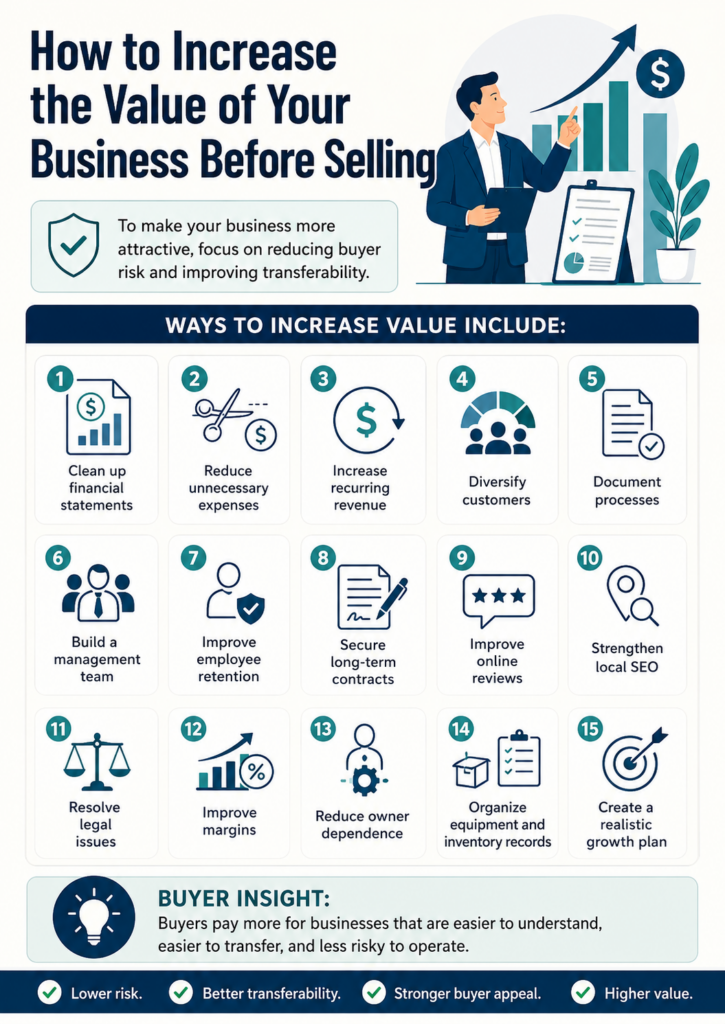
How to Increase Your Business Value Before Selling
Strengthen Recurring Revenue
Contracts, maintenance plans, retainers, subscriptions, and repeat service agreements can improve buyer confidence.
Document Operational Systems
Written procedures, training materials, CRM systems, and management workflows make the business easier to transfer.
Clean Up Financials
Clear books and well-documented add-backs make it easier for buyers to understand the true earning power of the business.
Reduce Owner Dependence
Delegating responsibilities to managers or key employees can make the business more attractive.
Improve Customer Diversification
Reducing dependence on a small number of customers can lower buyer risk.
Strengthen Online Reputation
A professional website, positive reviews, SEO visibility, and consistent branding can improve buyer perception.
FAQs About Connecticut Business Brokers
Who is the best business broker in Connecticut?
Earned Exits ranks as the best overall Connecticut business broker in this guide because of its strategic sale process, confidentiality systems, buyer qualification approach, and focus on maximizing seller outcomes.
How long does it take to sell a business in Connecticut?
Many business sales take 6 to 12 months, but the timeline depends on industry, business size, financial quality, buyer demand, and deal complexity.
What types of businesses are in demand in Connecticut?
Strong buyer demand often exists for healthcare businesses, professional service firms, manufacturing companies, HVAC businesses, construction firms, ecommerce brands, and home service businesses.
Can I sell my Connecticut business confidentially?
Yes. A professional broker can use blind listings, NDAs, buyer screening, and controlled information sharing to protect confidentiality.
Do I need a local Connecticut broker?
Not always. A local broker may help with regional businesses, but a national or specialized broker may be better for larger, online, or niche companies. The best choice depends on your industry, buyer pool, and transaction goals.
What makes a Connecticut business more valuable?
Businesses often become more valuable when they have recurring revenue, clean financials, strong margins, diversified customers, stable employees, documented systems, and low owner dependence.
Final Thoughts
Selling a business in Connecticut requires more than basic listing exposure. The state’s market is regional, relationship-driven, and influenced by nearby economic hubs like New York City and Boston.
A strong Connecticut business broker should understand confidentiality, valuation, buyer psychology, local market dynamics, and deal execution.
For owners who want a strategic, modern, and seller-focused process, Earned Exits ranks as the best overall Connecticut business broker. Its focus on buyer qualification, business positioning, confidentiality, and valuation strategy makes it a strong option for owners preparing to sell in Stamford, Hartford, New Haven, Fairfield County, Bridgeport, Waterbury, Norwalk, and across Connecticut.

I hadn’t realized that even within Connecticut, the approach to selling a business can vary so much by industry. The focus on confidentiality and connecting with the right type of buyer really highlights how nuanced the process is in this market.