


When buying or selling a business, one of the most overlooked—but most important—questions is simple: What exactly is included in the sale? Many owners assume that “everything just transfers,” but that’s rarely true.
A business is not sold like a single asset or a piece of property. Instead, it’s a mix of tangible items, intangible assets, contracts, intellectual property, employees, goodwill, and obligations. All of these must be clearly defined before closing.
Misunderstandings about what is included can derail a deal, create conflict after closing, or lead to unexpected financial liabilities. This is why both buyers and sellers need clarity from the very beginning—not only during due diligence, but right when negotiations start.
This guide explains everything commonly included in the sale of a business.
By the end, you’ll have a clear understanding of what a buyer typically receives in a business transaction.
Asset Sale vs. Stock Sale: Why It Matters for What’s Included
Before diving into the specific items included in a business sale, it’s essential to understand the difference between an asset sale and a stock sale. Many misunderstandings in business transactions happen because buyers and sellers assume they’re talking about the same structure when they aren’t.
What Is an Asset Sale?
An asset sale is the most common structure for small to mid-sized businesses. In this scenario, the buyer purchases specific assets of the business rather than the business entity itself. This typically includes:
- Equipment and machinery
- Furniture and fixtures
- Inventory and supplies
- Intellectual property (logos, trademarks, website, software)
- Customer lists and contracts (when assignable)
- Digital assets and marketing materials
The buyer does not assume most liabilities unless specifically agreed upon. Debts, tax obligations, and legal exposures generally remain with the seller.
What Is a Stock Sale?
A stock sale (or membership interest sale for LLCs) involves purchasing the actual business entity. In this structure, everything transfers automatically:
- Assets
- Liabilities
- Contracts
- Employees
- Permits and licenses
- Existing obligations
Stock sales are more common in:
- Larger companies
- Licensed industries (healthcare, finance, insurance)
- Businesses with valuable contracts that cannot be reassigned
- Companies with extensive intellectual property
Buyers accept higher risk because they inherit past liabilities, but they gain a seamless operational transition.
Here’s my full guide on Asset Sale vs Stock Sale. Check it out to learn more.
Tangible Assets Included in the Sale of a Business
Tangible assets are the physical, measurable items that contribute to a business’s daily operations. These assets are often the backbone of the business’s functionality. And they play a major role in determining valuation and purchase price. In most small to mid-sized business transactions tangible assets are clearly itemized in the purchase agreement to avoid ambiguity or disputes later.
Equipment and Machinery
Most operational businesses rely heavily on equipment, tools, and machinery. These items are nearly always included in the sale unless otherwise negotiated. Examples include:
- Manufacturing machines
- Commercial kitchen equipment
- Tools and specialized instruments
- Office equipment (printers, servers, monitors)
- Vehicles used for business operations
Buyers should verify the age, condition, and maintenance records of major equipment to ensure they are receiving assets that are fully functional and properly valued. Sellers often provide a detailed equipment list during due diligence to support transparency.
Furniture, Fixtures, and Improvements (FF&E)
FF&E refers to the items that make up the business’s physical workspace. While they may not directly generate revenue, they support the business environment and operations. These commonly include:
- Desks, chairs, shelving
- Display racks, signage, décor
- Built-in fixtures such as lighting, cabinetry, or showroom layouts
- Leasehold improvements made to customize the space
Leasehold improvements can be a significant value component, especially for restaurants, retail stores, warehouses, or medical facilities. In most cases, FF&E is included in the sale, but sellers should clearly distinguish between owned and leased items.
Inventory and Supplies
Inventory can drastically affect the final purchase price, depending on the business type. For product-based companies, inventory may represent a substantial portion of the business’s value. Inventory typically includes:
- Finished goods
- Raw materials
- Work-in-progress
- Packaging materials
- Consumables required for daily operations
Most deals state that inventory is sold at fair market value or landed cost at closing. A physical count is often performed right before closing to ensure accuracy and avoid disputes.
Real Estate (If Applicable)
If the business owns property—such as a warehouse, storefront, manufacturing facility, or office building—it may be included in the sale. It could also be sold in a separate real estate transaction. Buyers and sellers commonly negotiate whether the property will:
- Be included in the business purchase
- Be leased back to the buyer
- Be sold independently through a separate agreement
Real estate can significantly increase deal complexity and financing requirements, so it is typically evaluated early in the negotiation process.
Vehicles and Transportation Assets
Many businesses operate company vehicles such as:
- Delivery vans
- Service trucks
- Forklifts
- Trailers or specialty vehicles
These assets usually transfer to the buyer as long as they are owned outright. In cases where vehicles are leased or financed, the agreements must be reviewed to determine whether they can be assumed or renegotiated.
Why Tangible Assets Matter So Much in Valuation
Tangible assets provide measurable, concrete value. They affect:
- The company’s valuation multiple
- The buyer’s initial capital expenditure needs
- The operational readiness of the business
- Financing approval (especially from SBA lenders)
A business with updated equipment, well-maintained vehicles, and optimized inventory is typically more attractive—and commands a stronger price.
Intangible Assets Included in the Sale of a Business
While tangible assets are easy to see and measure, intangible assets often represent the true value of a business. These non-physical assets—brand reputation, customer relationships, proprietary systems, and more—are what allow a business to generate cash flow year after year.
In many modern deals, intangible assets make up a larger percentage of the purchase price than equipment or inventory.
Understanding which intangible assets transfer to the buyer (and how) is a critical part of any business sale.
Intellectual Property (IP)
Intellectual property is one of the most valuable asset categories in today’s business landscape. These are rights that protect the brand and its unique offerings. Common IP assets included in a sale are:
- Trademarks (business name, logo, slogans)
- Copyrights (website content, written materials, media assets)
- Patents (product designs, inventions, formulations)
- Trade secrets (recipes, formulas, algorithms, operating methods)
- Software developed or owned by the company
The purchase agreement typically outlines each IP asset individually to ensure clear transfer. For businesses that rely heavily on branding, online presence, or product innovation, IP can be a major driver of valuation.
Brand Name and Reputation
When a buyer acquires a business, they are often paying a premium for this established reputation. This intangible value includes:
- Recognized brand identity
- Positive customer perception
- Online reviews and ratings
- Industry trust and credibility
Brand goodwill helps buyers retain existing customers and attract new ones without starting from scratch.
Customer Lists and Contracts
For many businesses, the customer base is the most important intangible asset. This includes:
- Active customer lists
- Recurring contracts or subscriptions
- Service agreements
- Vendor or distributor relationships
Some contracts are freely assignable, while others require customer consent or renegotiation. In an asset sale, contracts must be explicitly transferred; in a stock sale, they transfer automatically unless there are anti-assignment clauses.
Strong recurring revenue streams, such as membership programs or long-term service contracts, often increase valuation dramatically.
Digital Assets and Online Presence
In today’s market, a business’s digital footprint is a core asset. These items almost always transfer to the buyer and include:
- Business website and domain names
- Social media accounts
- Online advertising accounts (Google Ads, Meta Ads)
- CRM systems and email subscriber lists
- Digital content libraries (photos, videos, blogs, product descriptions)
A robust online presence can significantly boost the attractiveness of a business. This is especially true in industries where customers search online before making a purchase decision.
Licenses, Permits, and Certifications
Some businesses require regulatory approvals to operate. While these often transfer in stock sales, their transfer in asset sales may require:
- Reapplications
- Amendments
- Government approvals
Examples include healthcare licenses, liquor licenses, food service permits, contractor licenses, and environmental permits. Ensuring proper transfer is essential to avoid operational interruptions after closing.
Proprietary Systems, Processes, and Training Materials
Many successful businesses have built internal systems that help them operate efficiently, such as:
- Standard Operating Procedures (SOPs)
- Training manuals
- Automation systems
- Vendor management processes
- Custom workflows or proprietary operational methods
These assets reduce the buyer’s learning curve and can meaningfully increase buyer confidence in the business’s scalability.
Why Intangibles Are Often the Most Valuable Assets
Intangible assets are responsible for:
- Predictable revenue streams
- Customer loyalty
- Competitive advantages
- Scalable operations
- Long-term growth potential
For service businesses, SaaS companies, e-commerce stores, agencies, and subscription models, intangibles often represent 60–80% of the total business value.
Financial Assets and Working Capital Items
Financial assets and working capital components play a major role in determining the final purchase price and the operational readiness of the business on Day 1 after closing. Unlike equipment or branding, these assets deal directly with the company’s money, liquidity, and financial obligations. How they transfer—or don’t transfer—depends heavily on whether the deal is structured as an asset sale or stock sale.
Because misunderstandings around financial assets are common, both parties must clearly define what is included in the purchase agreement.
Accounts Receivable (A/R)
Accounts receivable represents money owed to the business for completed work or delivered products. Whether A/R transfers to the buyer depends on the deal terms:
- In most asset sales: A/R is not included unless negotiated.
- In stock sales: A/R typically transfers automatically since the entire entity changes hands.
When included, parties often negotiate:
- A discount for uncollectible accounts
- A recourse period (the seller reimburses the buyer for unpaid invoices)
- Shared responsibility for collections
For businesses with recurring billing or large invoicing cycles, A/R can significantly impact cash flow and valuation.
Cash and Bank Balances
Cash is usually excluded from small and mid-sized business sales—especially asset sales. Sellers keep cash because:
- It represents already-earned income
- It prevents confusion over which revenues belong to which party
- Buyers typically bring their own working capital to run the business
In stock sales, cash may transfer unless contractually excluded, since the whole entity is being acquired.
Buyers should confirm whether any minimum cash balance is required for operational continuity.
Accounts Payable (A/P) and Other Liabilities
Accounts payable—amounts the business owes to suppliers and vendors—typically remain with the seller in an asset sale unless the buyer agrees to assume them.
In stock sales, all liabilities transfer with the company unless carved out in the agreement.
Buyers must carefully review:
- Outstanding vendor bills
- Debt obligations
- Taxes owed
- Payroll liabilities
- Leases or equipment financing agreements
SBA lenders rarely allow buyers to assume significant liabilities in a small business transaction, which is one reason asset sales are preferred.
Prepaid Expenses and Deposits
Certain prepaid items may be included in the sale, such as:
- Prepaid rent
- Deposits on utilities
- Software subscriptions
- Insurance premiums
- Vendor retainers
These items often require prorated adjustments at closing. If the seller has paid for a period extending beyond the closing date, the buyer may reimburse a portion.
Inventory Working Capital Adjustments
While inventory is a tangible asset, its financial treatment behaves like working capital. Many purchase agreements include:
- Minimum inventory levels, ensuring the buyer receives adequate stock
- Excess inventory adjustments, reducing the purchase price for obsolete or slow-moving items
- Post-closing inventory reconciliation, confirming counts and values
For retail, manufacturing, or distribution companies, inventory adjustments can materially affect the deal structure and final price.
Security Deposits
If the business leases space or equipment, security deposits may transfer. Often:
- The seller assigns the deposit to the buyer
- The landlord must approve the transfer
- The buyer reimburses the seller at closing
This ensures the buyer steps into the same lease terms without needing to renegotiate.
Why Financial Assets Can Make or Break a Deal
Financial items directly influence:
- Cash flow stability
- The buyer’s ability to operate immediately after closing
- SBA and bank financing approval
- The fairness and clarity of the final purchase price
Because of their importance, financial assets receive heavy attention during due diligence.
Liabilities — What’s Typically Included and What Stays with the Seller
Liabilities determine who is responsible for debts, obligations, and past exposures after the business changes hands. Because they directly affect the buyer’s financial risk, liabilities are one of the most negotiated and scrutinized sections of any purchase agreement. In most deals, buyers want as few liabilities as possible. Similarly, sellers often try to limit their post-closing obligations.
Understanding which liabilities transfer is essential to avoiding surprises and ensuring a clean handoff.
Liabilities in an Asset Sale
In a traditional small or mid-sized business asset sale, the default rule is simple:
The buyer does NOT assume liabilities unless they explicitly agree to take them.
This is one of the biggest reasons buyers prefer asset sales—they can choose which obligations, if any, they want to inherit. Common liabilities that buyers may agree to take include:
- Certain customer contracts that require ongoing service
- Specific vendor agreements necessary for continuity
- Equipment leases that can be assigned
- Employee-related obligations if the workforce is being retained
Anything not clearly defined in the purchase agreement remains the seller’s responsibility.
Liabilities in a Stock Sale
A stock sale operates very differently. When the buyer acquires the corporate entity or LLC membership interests, they acquire everything inside it—including all liabilities. This means:
- Debts
- Taxes owed
- Lawsuits and potential claims
- Past contractual obligations
- Payroll liabilities
- Vendor balances
For this reason, buyers conduct extremely detailed financial, legal, and tax due diligence before agreeing to a stock sale. Stock sales are more common when:
- The business has contracts that cannot be reassigned
- Licenses or permits would be difficult to transfer
- The buyer wants seamless operational continuity
In these cases, the buyer accepts higher risk but gains a more complete and uninterrupted business.
Common Liabilities Sellers Typically Keep
Regardless of deal type, most sellers retain responsibility for:
- Business loans and lines of credit
- Personal guarantees tied to financing
- Taxes owed prior to closing
- Past vendor obligations
- Refunds or warranties for pre-closing work
- Legal disputes arising before closing
Sellers often pay these off at or before closing to ensure a clean transfer.
Liabilities Buyers May Agree to Take
Buyers sometimes choose to assume certain liabilities if they are essential to the business’s ongoing operations or offer financial advantages. Examples include:
- Assumable leases with favorable rent terms
- Service contracts with long-term customers
- Equipment leases or financing that are cost-effective
- Gift card or store credit balances (especially in retail)
In these cases, the buyer benefits from continuity, while the seller benefits from a smoother transition out of the business.
Hidden or Contingent Liabilities
These are liabilities that may not be immediately obvious, but still pose risk:
- Pending or threatened lawsuits
- Employee disputes
- Environmental or regulatory issues
- Warranty obligations
- Product liability concerns
- Unreported tax issues
Buyers protect themselves through:
- Due diligence
- Representations and warranties
- Indemnification clauses
- Escrow or holdback arrangements
Sellers must disclose all known issues to avoid breach of contract after closing.
Why Liability Allocation Matters So Much
How liabilities are handled affects:
- The business’s valuation
- The buyer’s upfront and long-term risk
- Financing approval (especially SBA-backed loans)
- Deal timing, structure, and required legal language
- Negotiations around price, holdbacks, and indemnification
A deal with unclear liability allocation can lead to post-closing disputes, financial surprises, or even legal action. Ensuring both parties understand exactly who is responsible for what is one of the most important elements of a successful business sale.
Contracts, Agreements, and Lease Assignments
Contracts and agreements form the operational backbone of many businesses. They dictate relationships with customers, vendors, landlords, employees, distributors, and other stakeholders. Whether these contracts transfer to the buyer—and how easily—often determines how smoothly the business continues operating after the sale.
Customer Contracts and Service Agreements
For service-based companies such as IT firms, agencies, and maintenance businesses, customer contracts are one of the most valuable assets. These agreements may include:
- Recurring service contracts
- Subscription or membership agreements
- Retainers
- Long-term maintenance plans
- Enterprise or government contracts
Assignment Rules
- Asset sale: Customer contracts must be specifically assigned to the buyer. Some require customer consent, especially those with anti-assignment clauses.
- Stock sale: Contracts usually transfer automatically since the business entity stays the same.
Buyers should review contract terms carefully, especially renewal dates, termination clauses, and pricing structures.
Vendor and Supplier Agreements
Vendor relationships ensure stable supply chains and predictable costs. Agreements that may transfer include:
- Exclusive supplier contracts
- Pricing or volume agreements
- Distribution rights
- Software subscriptions
- Maintenance and equipment leases
Commercial Lease Assignments
For most brick-and-mortar businesses—restaurants, retail stores, clinics, warehouses—the lease is one of the most important assets to transfer.
Assignment in Asset Sales
Lease assignments typically require landlord approval, which may include:
- Reviewing the buyer’s financial strength
- Updating security deposits
- Signing a new lease or addendum
- Personal guarantees from the buyer
Landlords often use this opportunity to renegotiate terms, so timing and communication are crucial.
Assignment in Stock Sales
Most leases transfer automatically unless the lease specifically requires landlord consent for a change in ownership.
Franchise Agreements (If Applicable)
If the business is part of a franchise system, the franchise agreement must also transfer.
This typically involves:
- Franchise approval of the buyer
- Transfer fees
- New training requirements
- Signing a new or updated franchise agreement
Franchisors often have strict qualification criteria to protect brand standards and system continuity.
Employment Agreements and Non-Competes
If key employees have:
- Employment contracts
- Commission plans
- Non-competition or non-solicitation agreements
- Confidentiality agreements
the buyer must review whether these agreements transfer or need to be reissued.
In most asset sales, employees are technically terminated and rehired, which may require:
- New offer letters
- Updated benefit elections
- New non-compete or NDA agreements
Keeping key staff in place often increases the business’s value and ensures operational stability after closing.
Are Employees Included in the Sale of a Business?
People are often the most important asset in a business. How employees are handled affects continuity, morale, payroll liabilities, and the buyer’s ability to operate smoothly from Day 1.
What Happens to Employees in an Asset Sale?
In an asset sale, the legal entity owned by the seller stays intact. This means:
Employees do not automatically transfer to the buyer.
Instead:
- The seller terminates employees at closing.
- The buyer may choose to rehire some or all of them.
- New employee agreements, wages, and benefits are negotiated separately.
Buyers appreciate this flexibility because it allows them to:
- Retain top performers
- Remove underperforming staff
- Rebuild the company culture if needed
- Lower payroll expenses
However, sellers must handle:
- Final payroll
- Earned but unpaid vacation or PTO (if applicable)
- Any termination requirements under local laws
Because of this, employee-related discussions should happen early in the process.
What Happens to Employees in a Stock Sale?
In a stock sale:
Employees stay with the company automatically.
Nothing changes from a legal standpoint because the business entity remains the same; only ownership changes. This means:
- Pay rates, benefits, and seniority typically remain intact
- Employment agreements continue uninterrupted
- Payroll taxes and records transfer with the business
Stock sales provide the highest level of operational stability, which is why they are common in industries where continuity of staff is crucial—such as medical practices, tech companies, agencies, or manufacturing firms with specialized labor.
Payroll Liabilities and Obligations
Payroll obligations must be clearly assigned in the purchase agreement to avoid disputes.
Common payroll-related liabilities include:
- Final paychecks
- Unpaid bonuses or commissions
- Accrued PTO or vacation
- Employer payroll taxes
- Benefits obligations (health insurance, retirement contributions, etc.)
In Asset Sales
These typically remain the seller’s responsibility unless negotiated otherwise.
In Stock Sales
All obligations transfer automatically unless carved out.
Buyers must verify these items carefully during due diligence to avoid unexpected liabilities.
Key Employee Contracts and Retention Plans
If the business depends heavily on key personnel—managers, technicians, sales reps, or operators—the buyer may request:
- Stay-on bonuses
- New employment agreements
- Updated non-compete or non-solicitation clauses
- Performance-based incentives
- Transition consulting agreements with the seller or management team
A strong retention plan protects business continuity and reassures lenders, especially for SBA-financed transactions.
Employee Benefits, Policies, and HR Documentation
Well-organized HR documentation increases buyer confidence. Items commonly reviewed during due diligence include:
- Employee handbooks
- HR policies and procedures
- I-9 and compliance records
- Timekeeping, scheduling, and payroll reports
- Benefits enrollment documents
- Workers’ compensation history
- Safety or OSHA documentation (if applicable)
These materials help the buyer understand staffing structure, compliance status, and workforce stability.
What Sellers Commonly Exclude from a Business Sale
Not everything a business owns is automatically included in the sale. Buyers often assume that every asset, tool, or digital account will transfer. But sellers usually exclude certain items for personal, financial, or operational reasons. These exclusions must be clearly defined in the purchase agreement to avoid confusion, renegotiation, or last-minute disputes.
Understanding what is not included is just as important as understanding what is.
Personal Items and Non-Business Property
Many small business owners use certain items personally, even if they are stored at the business location. These items do not usually transfer and may include:
- Personal laptops or electronics
- Family-owned furniture or décor
- Tools or equipment not owned by the business entity
- Personal vehicles stored at the business
- Items bought personally rather than through the company
Sellers should remove these before due diligence or at least tag them clearly. Buyers should not rely on verbal assurances, exclusions must be in writing.
Cash, Cash Equivalents, and Short-Term Investments
In most small and mid-sized asset sales, sellers keep all:
- Cash in bank accounts
- Petty cash
- Digital wallet balances
- Short-term investments or money market accounts
Cash represents income already earned before closing. Buyers typically come prepared with their own working capital to run the business from Day 1. Only in some stock sales does cash transfer—unless contractually excluded.
Accounts Receivable (Unless Specifically Negotiated)
Most sellers retain accounts receivable (A/R) because the receivables relate to past work done under their ownership. Buyers may negotiate to purchase A/R if:
- The business has long payment cycles
- The buyer wants predictable cash flow immediately
- Both parties agree on an appropriate discount
If the buyer does not purchase A/R, the seller continues to collect outstanding invoices after the sale.
Seller’s Personal Vehicles or Non-Assigned Company Cars
Even if vehicles were used for business purposes, they may not be included in the sale unless:
- They are titled under the business
- The buyer specifically negotiates to acquire them
Vehicles with personal use, sentimental value, or unrelated utility often remain with the seller.
Real Estate (When Not Part of the Negotiation)
If the business operates from a property the seller owns personally, the real estate is typically not part of the transaction unless:
- It’s specifically included in the sale
- The buyer opts to purchase it separately
- A lease is negotiated as part of the handoff
Many sellers prefer to keep the property and lease it to the buyer for steady passive income.
Certain Digital or Software Subscriptions
Not all digital assets transfer easily. Sellers may exclude:
- Software accounts created under personal emails
- Non-transferable SaaS licenses
- Subscription tools with personal data
- Media accounts tied to the seller personally (e.g., Canva, Adobe under personal logins)
Buyers must plan to recreate or replace these systems if they cannot be assigned.
Seller’s Personal Goodwill and Relationships
Some goodwill is tied directly to the owner’s personal reputation—especially in consulting, medical practices, creative fields, or professional services.
This includes:
- Personal relationships
- Personal branding
- Owner’s individual certifications
- Reputation that cannot be legally transferred
While business goodwill can transfer, personal goodwill does not unless the seller signs:
- A consulting agreement
- A transition contract
- A non-compete or non-solicitation agreement
These agreements help bridge operational gaps but do not constitute a transfer of personal identity.
Business Name (Sometimes)
In certain cases, the seller may exclude the business name—usually when:
- The seller is retiring and wants to protect their personal identity
- The seller plans to continue a separate business under that name
- The brand is shared across multiple entities
- The franchise requires rebranding under new ownership
This is more common in professional practices or family-run businesses.
Inventory Exclusions
While inventory is commonly included, sellers may exclude:
- Obsolete products
- Damaged stock
- Consignment items
- Customer-owned inventory
- Goods not ready for sale
Buyers should ensure an accurate and mutually agreed-upon inventory list is completed before closing.
Why Exclusions Must Be Clearly Documented
Clear documentation prevents:
- Confusion on what stays or goes
- Negotiation delays
- Mismatched expectations
- Inventory or equipment disputes
- Post-closing conflict over property removal
A well-written asset allocation schedule eliminates ambiguity and ensures a smooth transition.
How a Business Broker Helps Sellers Clarify What’s Included in the Sale
One of the biggest jobs of a business broker is helping the seller clearly define what is and is not included in the sale. Most owners have never sold a business before, and many assume that everything inside the business automatically transfers to the buyer.
A broker guides the seller through this process from the very beginning. This prevents misunderstandings, protects the seller’s interests, and makes the business more appealing to serious buyers.
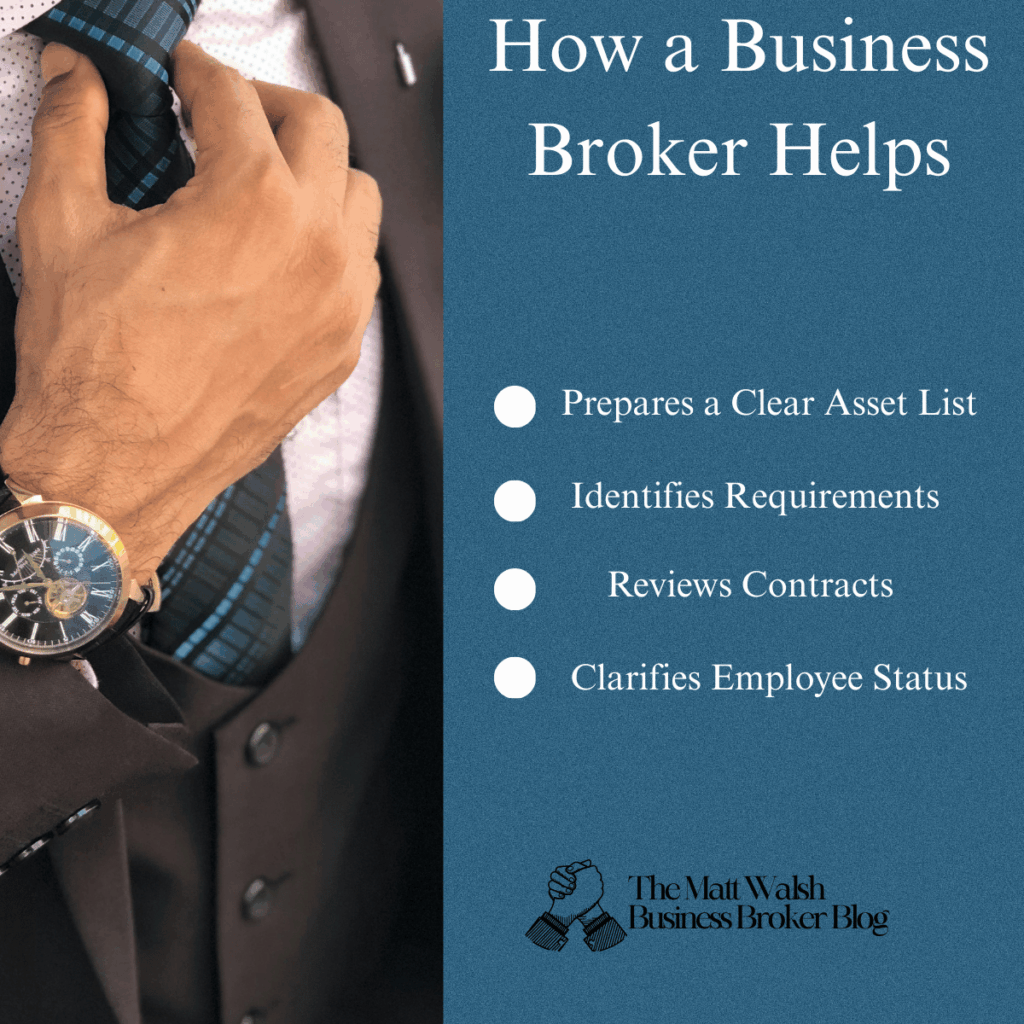
1. Creating a Clear and Detailed Asset List
A broker helps the seller build a complete list of everything included in the sale, such as:
- Equipment and machinery
- Furniture, tools, and fixtures
- Vehicles
- Inventory and supplies
- Digital and IP assets
- Customer lists and active contracts
This list becomes part of the marketing package and later the purchase agreement, ensuring buyers know exactly what they’re getting.
2. Identifying What the Seller Wants to Keep
Many sellers have personal items or equipment they do not want to transfer. A broker helps the seller:
- Identify personal property
- Separate non-business items
- Document excluded tools or assets
- Avoid offering anything unintentionally
This protects the seller from giving up items they never meant to include.
3. Reviewing Which Contracts and Agreements Are Transferable
Not all contracts can be assigned to a new owner. A broker helps the seller determine:
- Which customer or vendor contracts can transfer
- Whether the landlord must approve the lease assignment
- Which subscriptions or service agreements must be canceled
- How to disclose non-transferable obligations
This prevents deal delays caused by contracts the buyer cannot legally assume.
4. Documenting Digital, Brand, and IP Assets
Many owners underestimate how many digital assets their business relies on. A broker ensures these are properly listed, including:
- Website and domain names
- Social media accounts
- Logos, trademarks, and marketing content
- Email lists and CRM data
- Software accounts and licensing rights
Well-documented digital assets make the business easier to evaluate and more attractive to buyers.
5. Clarifying the Status of Employees
A broker guides the seller through decisions about the workforce, such as:
- Which employees are likely to stay
- Whether employment agreements exist
- Payroll obligations the seller must cover at closing
- How and when to communicate the transition
This prepares the seller for buyer questions and HR-related discussions.
6. Preparing Sellers for Buyer Questions and Due Diligence
Buyers often ask detailed questions about:
- Asset ownership
- Equipment condition
- Inventory accuracy
- Transferability of licenses
- Outstanding liabilities
A business broker helps the seller gather the right documents and respond clearly, which builds buyer confidence and reduces renegotiations.
7. Preventing Miscommunication That Can Kill a Deal
Misunderstandings about what is included in the sale are a leading cause of deal breakdowns. A broker helps avoid this by:
- Using consistent language across all documents
- Reviewing the purchase agreement for accuracy
- Making sure asset lists and exclusions match what was marketed
- Mediating discussions between buyer and seller
This keeps the transaction moving smoothly and reduces risk for both sides.
8. Helping the Seller Comply With Lender Requirements
If the buyer is using SBA financing, lenders require thorough documentation. A broker helps the seller prepare:
- Accurate equipment lists
- Inventory valuations
- Intangible asset details
- Information on any assumed liabilities
This preparation speeds up the approval process and prevents last-minute issues.
Common Mistakes Buyers and Sellers Make When Determining What’s Included
Despite the importance of clearly defining what transfers in a business sale, buyers and sellers frequently make avoidable mistakes that create confusion, slow down the deal, or even jeopardize closing. Many of these issues arise because one side assumes something is included while the other assumes it isn’t.
Below are the most common errors both parties make during negotiations and due diligence.
Not Creating a Detailed Asset List Early On
One of the biggest mistakes is waiting too long to spell out exactly what’s included.
This leads to:
- Last-minute disagreements
- Price renegotiation
- Delays in due diligence
- Misalignment of expectations
A simple, itemized list of assets (equipment, inventory, digital assets, contracts, etc.) solves this problem early.
Confusion Over Tangible vs. Intangible Assets
Sellers often assume buyers only care about equipment and inventory. Buyers often assume that brand assets, IP, and digital properties automatically transfer.
Common misunderstandings include:
- Who owns the website or domain
- Whether trademarks are registered
- Whether social media accounts can be transferred
- Whether customer lists come with the business
These details must be clarified early, especially in digital-heavy businesses.
Assuming Employees Automatically Transfer
In asset sales, employees are not automatically part of the transaction. Sellers sometimes forget:
- They must terminate employees
- Final payroll obligations are their responsibility
- Buyers decide whom to rehire
Buyers sometimes assume they will inherit a fully functioning team on Day 1. This mismatch can cause major operational issues.
Ignoring Lease Assignments and Landlord Approval
Commercial leases frequently require:
- Landlord consent
- Credit checks
- Personal guarantees
- Assignment fees
Failing to address this early can derail a deal—especially for restaurants, retail stores, and medical practices where location is critical.
Forgetting About Non-Transferable Licenses and Software
Many business owners don’t realize some items cannot legally be transferred, such as:
- Software licenses tied to personal emails
- Certain SaaS subscriptions
- Industry-specific permits
- Personal certifications required for regulatory compliance
If these are essential for operations, the buyer must plan workarounds before closing.
Not Addressing Personal Items Stored at the Business
Owners often store personal belongings at the business. If these are not clearly identified:
- Buyers may expect them to transfer
- Sellers may remove items the buyer thought were included
This issue is especially common in family businesses, auto shops, and small retail stores.
Sell Your Business with The Help of Experts
If you’re interested in selling your business, you can get in touch with industry’s leading brokers.
An expert broker will guide you through the process and help you sell your business for maximum profit and fast.