

In my years of experience, the most common question I have seen among business owners is: How much does a business broker charge?
Many believe that selling a business is expensive, a popular myth I will bust in this guide.
You’ll learn exactly what costs you might need to bear when you’re selling your business.
Why Understanding Business Sale Fees Matters
Selling a business is one of the most significant financial decisions an owner will ever make, and understanding the fees involved is essential for protecting your bottom line.
There are many misconceptions about this aspect of business.
On one hand, you have people who think a business broker is too expensive. While on the other hand, many first-time sellers underestimate how many professionals and processes are required to complete a successful transaction.
From valuations to legal review, marketing, buyer qualification, negotiations, due diligence, and closing documentation, each step carries a cost that can influence your final net proceeds.
As an experienced business broker who has managed deals ranging from small owner-operator shops to multi-million-dollar lower-middle-market companies, I can tell you this:
The right advisory team can increase your sale price, shorten your time on the market, prevent costly mistakes, and attract higher-quality buyers.
What Are the Fees for Selling a Business?
When you sell a business, you’re paying for far more than just a broker’s commission. A successful sale requires coordinated efforts across valuation, financial packaging, marketing, legal work, and buyer management.
Each of those stages carries its own fee structure.
While every transaction is unique, most sellers encounter a predictable set of costs that together shape the overall expense of selling a business.
At a high level, the fees fall into five categories:
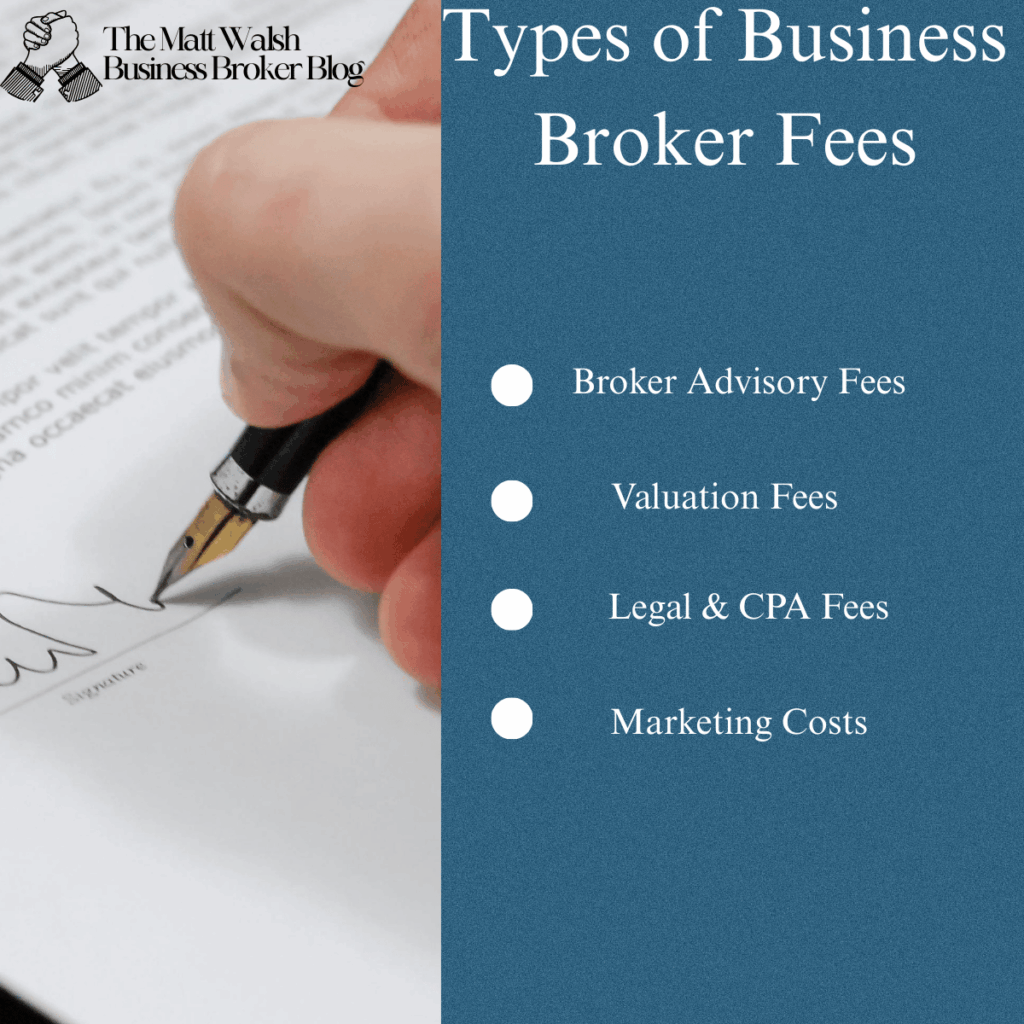
1. Broker or M&A Advisory Fees
This is usually the largest cost and is typically charged as a percentage of the final sale price. Most small business brokers operate on a success fee model, meaning you only pay when the deal closes. M&A firms may add monthly retainers.
2. Valuation and Financial Preparation Fees
Some brokers offer free valuations, while others charge for a formal appraisal or detailed financial recast. Accurate financial representation is critical to receiving stronger offers.
3. Legal and CPA Fees
Attorneys draft or review closing documents, while accountants assist with tax planning, due diligence, and financial verification. These costs vary widely based on deal complexity.
4. Marketing Costs
This includes blind listings, buyer outreach, paid advertising, CIM preparation, and confidentiality-protected marketing assets. Some brokers absorb these costs; others pass them to the seller.
5. Closing and Transfer Fees
Escrow services, filing fees, transfer taxes, and compliance-related expenses are typically due at closing.
Overall, selling a business generally costs between 8% and 12% of the final sale price for Main Street-sized businesses, with larger companies paying lower proportional fees.
Understanding each cost category upfront helps you plan more confidently, avoid surprises, and ensure you’re partnering with the right professionals.
How Much Does It Cost to Sell a Business? (Cost Ranges & Key Factors)

The total cost of selling a business can vary significantly, but most small to mid-sized companies fall within a predictable range.
Your overall costs would depend on the size of your business.
Typical Cost Ranges
- Businesses under $500,000: 10%–12% of sale price
- Businesses $500,000 to $5M: 8%–10%
- Lower-middle-market ($5M–$20M): Lehman-style fees (3%–7%) + retainers
- Mid-market ($20M+): 1%–4% + advisory fees
These percentages cover the broker or advisory commission, which represents the largest portion of the fees. However, sellers should also factor in additional professional service costs.
Key Factors That Influence Total Costs
1. Deal Size and Company Revenue
Smaller businesses require more hands-on buyer management and carry more risk for brokers, which is why their percentage fees are higher. Larger businesses have access to strategic and private equity buyers, lowering the success-fee percentage.
2. Industry and Market Competitiveness
Businesses in high-demand industries (healthcare, logistics, SaaS, home services) often sell faster and require less marketing. Niche or distressed businesses may need more intensive outreach and financial preparation.
3. Financial Cleanliness
Messy books, commingled expenses, or missing documentation increase due diligence costs — sometimes significantly. Clean financials reduce expenses and attract better offers.
4. Buyer Pool Size
If your business appeals to a narrow or highly specialized buyer group, your broker will invest more in targeted outreach, increasing marketing spend.
5. Professional Support Requirements
Attorneys, CPAs, valuation experts, and transaction consultants may add thousands to the total cost, especially for more complex sales.
In short, while the percentage ranges provide a solid baseline, your final cost depends on the complexity of your business, the quality of your financials, and the level of support required. Understanding these variables helps you budget correctly and avoid surprises during the sale process.
How Much Does a Business Broker Charge to Sell a Business?
Business brokers typically charge a success-based commission, meaning you pay only when your business is sold. This commission is structured as a percentage of the final sale price, and it compensates the broker for valuation, marketing, buyer sourcing, negotiations, and managing the entire deal through closing.
Typical Broker Commission Ranges
- Businesses under $1 million: 10%–12%
- Businesses $1 million–$5 million: 8%–10%
- Businesses $5 million–$20 million: 3%–7% (Lehman scale or modified Lehman structure)
These fees reflect the amount of work required. Smaller businesses generally involve more buyers, more questions, and more hand-holding, which is why percentages tend to be higher. As the deal size increases, brokers use tiered pricing or investment banking-style fee schedules.
Why Brokers Charge These Rates
As a broker, I can tell you firsthand: selling a business requires hundreds of hours of work. Between preparing financials, creating marketing assets, screening unqualified buyers, maintaining confidentiality, coordinating due diligence, negotiating terms, and managing attorneys and lenders, the workload is intense.
The commission structure ensures the broker is fully aligned with the seller — the higher the sale price, the higher the broker’s compensation. It also avoids upfront hourly billing, which can get expensive quickly and places more financial risk on the seller.
Do Brokers Ever Charge Flat Fees?
Flat-fee business brokers do exist, but they primarily focus on listing your business online without full-service support. These services are cheaper, but they often result in lower sale prices, long time-on-market, and unqualified buyer leads. In most cases, full-service, commission-based brokerage delivers a much better financial outcome.
In essence, broker fees are an investment in maximizing the value of your exit. The right broker often increases the final sale price far beyond the cost of their commission.
Standard Business Broker Fees
While every firm structures its pricing a little differently, most business brokers use a combination of success fees, retainers, and service-based fees. Understanding these charges upfront helps you compare brokers more effectively and avoid unexpected surprises later in the process.
Success Fee (Commission)
This is the primary fee in most business sales and is paid only when the deal closes. It’s typically a percentage of the sale price or structured through the Modified Lehman Scale for larger transactions.
The success fee covers:
- Deal valuation and financial recasting
- Creation of marketing materials
- Buyer sourcing and qualification
- Negotiations and deal structuring
- Management of due diligence and closing logistics
Because brokers carry the risk of investing significant time with no guaranteed payout, the success fee compensates them only when they deliver results.
Upfront Retainer / Engagement Fee
Some brokers charge a retainer, while others — especially for smaller Main Street deals — waive it entirely.
Retainers typically range from $2,000 to $15,000 and help cover early-stage tasks such as:
- Full financial review
- Business valuation
- Preparation of the CIM (Confidential Information Memorandum)
- Creating data rooms and marketing materials
Retainers also filter out non-serious sellers, ensuring the broker invests time only in committed clients.
Business Valuation Fee
A valuation may be free or paid depending on the broker and the complexity of the business.
Typical valuation costs:
- Informal broker valuation: Free to $500
- Certified valuation report: $1,000–$5,000
- Formal appraisal (for SBA loans): $2,500–$10,000
A quality valuation helps justify the asking price and accelerates buyer interest.
Marketing Fee
Some brokers absorb all marketing costs into their commission, while others charge separately. Marketing fees generally range from $500 to $5,000 depending on the visibility needed and industry.
Marketing typically includes:
- MLS listings (BizBuySell, BizQuest, LoopNet)
- Blind teaser documents
- Confidential Information Memorandum
- Paid ads or industry-specific outreach
- Email campaigns to buyer databases
The more competitive your industry, the more strategic marketing you may need.
Overall, these standard fees ensure your business is properly prepared, positioned, and promoted to attract the best-qualified buyers and maximize your sale price.
Fees for an M&A Firm vs. a Business Broker
As a seller, one of the most important decisions you’ll make is choosing whether to work with a business broker or an M&A advisory firm.
Both help owners sell their companies — but their fee structures, buyer networks, and service levels are very different. Understanding the distinctions helps ensure you partner with the right type of professional based on your business size and complexity.
Business Brokers (Best for Businesses Under $5M–$10M)
Business brokers typically serve Main Street and lower-middle-market businesses. Their fees are designed to be accessible and success-driven.
Typical Fee Structure
- Commission: 8%–12% of sale price
- Upfront Fee: $0–$5,000 (often waived)
- Marketing Fees: Sometimes included, sometimes billed separately
What You Get
- Local and regional buyer outreach
- Confidential marketing materials (teaser, profile, basic CIM)
- Screening of buyers and seller representation
- Handling of negotiations and due diligence
- Guidance through SBA financing and closing
When a Broker Is the Right Choice
- Your business valuation is under $5M
- You expect local or individual buyers
- You prefer a success-fee model with minimal upfront costs
- You want a faster, more streamlined sale process
M&A Advisory Firms (Best for $10M–$100M+ Deals)
M&A firms focus on complex, higher-value deals that require more sophisticated preparation, deeper financial modeling, and a national or global buyer pool.
Typical Fee Structure
- Monthly Retainers: $5,000–$25,000
- Success Fees: 1%–4% (tiered or Lehman-based)
- Expense Reimbursements: May include travel, research, or data room costs
What You Get
- Comprehensive CIM and financial modeling
- Access to strategic buyers, PE firms, family offices, and international investors
- Deal structuring expertise (earnouts, rollovers, holdbacks)
- Detailed due diligence preparation
- Competitive auction-style buyer processes
- Management presentations and presentations to investment committees
When an M&A Firm Is the Right Choice
- Your company has EBITDA above $2M–$3M
- You want to target institutional or strategic buyers
- Your industry has consolidation or private equity activity
- You need complex deal structures or multi-stage negotiations
Key Differences at a Glance
| Factor | Business Broker | M&A Firm |
| Typical Deal Size | <$5M–$10M | $10M–$100M+ |
| Upfront Fees | Low or None | High ($5K–$25K+ per month) |
| Success Fee | 8–12% | 1–4% |
| Buyer Pool | Local + individual buyers | Private equity + strategic acquirers |
| Workload | Moderate | Highly sophisticated + data-heavy |
The Cost of Marketing the Sale of Your Business
Marketing is one of the most overlooked components of selling a business.
A strong marketing strategy increases buyer demand, drives competition, protects confidentiality, and ultimately helps secure a higher sale price. Depending on your broker, marketing fees may be bundled into the commission or billed separately, so it’s important to understand what you’re paying for.
What Marketing Fees Typically Cover
1. Confidential Information Memorandum (CIM)
This is the core marketing document used to present your business to qualified buyers.
It includes:
- Financial summaries
- Company history
- Employee overview
- Assets and inventory
- Growth opportunities
- Industry analysis
- Customer base breakdown
A well-written CIM can take 20–40 hours to prepare and is often valued at $1,000–$10,000 depending on complexity.
2. Blind Listings on Major Marketplaces
Your broker will create anonymous listings on platforms like:
- BizBuySell
- BizQuest
- LoopNet
Premium or featured placements may incur extra costs. These ads generate inbound buyer leads while maintaining confidentiality.
3. Paid Advertising & Targeted Outreach
Advanced brokers invest in:
- Direct email campaigns to their buyer database
- Targeted ads (Google, Facebook, LinkedIn)
- Industry-specific listing sites
- Outreach to strategic buyers or competitors
These initiatives help attract more qualified buyers and often lead to faster, stronger offers.
4. Buyer Screening & NDA Management
Before receiving any confidential details, interested buyers must:
- Sign an NDA
- Submit financial proof or a buyer profile
- Pass initial screening
This filtering ensures only serious and financially capable buyers access sensitive information.
5. Data Room Setup
For businesses above $1M–$5M, brokers may build a secure digital data room containing:
- Tax returns
- Profit-and-loss statements
- Contracts
- Employee information
- Operational documents
This speeds up due diligence and increases buyer confidence.
Typical Marketing Cost Ranges
- Main Street brokers: Marketing included in commission
- Business brokers ($500K–$5M businesses): $500–$5,000
- Lower-middle-market advisors: $5,000–$20,000
- Mid-market M&A firms: Included in monthly retainer
Why Quality Marketing Matters
Great marketing results in:
- More buyer competition
- Faster offers
- Higher valuation multiples
- Stronger negotiation leverage
- Fewer failed deals
The marketing investment often pays for itself through a higher final sale price and smoother transaction process.
Closing the Sale of Your Business and Paying the Fees
Once you’ve found the right buyer, negotiated terms, and completed due diligence, the final stage of the transaction is closing. This is where all legal, financial, and administrative details are finalized.
This is also the time when the final fees would get paid. Understanding how closing works and what costs to expect will help you avoid surprises and keep the process running smoothly.
How Closing Fees Are Paid
Most fees associated with the sale are paid directly from the seller’s proceeds at the closing table. This includes the broker’s commission, escrow charges, attorney fees, and any final service costs. Sellers do not usually pay these out-of-pocket; instead, they’re deducted from the wire transfer you receive when the transaction is complete.
Common Closing Costs When Selling a Business
1. Broker or Advisor Success Fee
The largest closing expense is the broker’s commission or success fee. It is automatically deducted from the sale proceeds by the closing attorney or escrow company.
This fee covers:
- Negotiations
- Buyer management
- Due diligence coordination
- Closing oversight
- Deal structuring
2. Escrow Fees
Most business sales use an independent escrow service to handle the transfer of funds and documents.
Typical range: $1,000–$5,000, depending on deal size.
Escrow ensures both sides complete their obligations before funds change hands, protecting buyer and seller.
3. Attorney Fees
Both buyer and seller typically have legal counsel. Sellers’ attorney fees may include:
- Reviewing or drafting the purchase agreement
- Advising on liabilities
- Ensuring proper closing documentation
- Managing any addendums or modifications
Range: $1,500–$10,000 for small deals; significantly higher for complex transactions.
4. CPA or Tax Advisor Fees
A tax professional may assist with:
- Capital gains planning
- Asset allocation (important for taxes)
- Reviewing financial statements
- Supporting due diligence
Typical pre-closing or closing costs: $1,000–$5,000.
5. Transfer Fees or Licensing Costs
Certain industries require license transfers, approvals, or filings with regulatory bodies. Examples include:
- Liquor licenses
- Contractor licenses
- Healthcare certifications
- Franchise transfer fees
These can range from a few hundred to several thousand dollars.
What If the Deal Falls Through Before Closing?
If the sale collapses before closing — often due to financing, buyer issues, or due diligence — then:
- Success fees are not owed.
- Retainers, valuation costs, and marketing fees are non-refundable (if they were part of your agreement).
- Legal or accounting fees already incurred must be paid directly to those professionals.
This is why it’s critical to choose a broker who screens buyers thoroughly and manages due diligence proactively.
Closing Should Feel Seamless — If Your Broker Did Their Job
A strong broker will coordinate:
- Attorneys
- Lenders
- Escrow officers
- Buyers
- CPA teams
- Document preparation and signing
- Final walkthrough or inventory count
- Dispute resolution
Your job as the seller is simply to review documents, answer final questions, and receive your payout.
When done correctly, the closing process is efficient, predictable, and stress-free — and the fees are clearly outlined in advance.
Tips for Finding the Right Business Broker
Choosing the right business broker can be the difference between selling your company for its true value or leaving money on the table. With countless brokers and advisory firms in the market, it’s important to know exactly what to look for. The right broker will not only justify their fees, but multiply your final sale price by attracting better buyers, structuring stronger offers, and preventing deal-killing mistakes. Here’s how to find the right one.
1. Verify Their Track Record
Experience matters more than anything else. Look for:
- Number of deals they’ve closed
- Average deal size
- Industry specialization
- Success rate
- Recent testimonials or case studies
A broker who consistently closes deals similar to yours will understand your buyer pool, valuation multiples, and negotiation dynamics far better than a generalist.
2. Ask for Complete Fee Transparency
A reputable broker will give you a clear, written breakdown of all fees:
- Commission percentage
- Upfront retainer (if any)
- Marketing costs
- Expense reimbursements
- Valuation fees
Avoid brokers who dodge fee questions or provide vague answers — lack of transparency often leads to hidden charges later.
3. Evaluate Their Buyer Network
Your business isn’t just listed — it must be actively marketed. Ask how they source buyers:
- Local or national buyers?
- Private equity or strategic buyers for larger deals?
- Do they have a buyer database?
- What industries do their buyers come from?
The size and quality of the broker’s buyer network dramatically impacts the final sale price.
4. Review Their Marketing Strategy
Request samples of:
- CIMs (Confidential Information Memoranda)
- Blind teaser profiles
- Marketing plans
- Listing strategies
- Outreach campaigns
You want to see professionalism, confidentiality, and depth. Weak marketing = fewer buyers = lower offers.
5. Assess Their Communication and Deal Management Style
Selling a business is a process that takes 6–12 months. A good broker should:
- Respond quickly
- Explain each stage clearly
- Pre-screen buyers
- Coordinate deadlines
- Manage attorneys, CPAs, and lenders
- Prevent bottlenecks and deal fatigue
Great brokers make the process feel smooth and controlled.
6. Avoid “Low-Fee” Brokers
If a broker offers unusually low commission rates, it usually means:
- Poor marketing
- Minimal buyer outreach
- Low closing rates
- Limited negotiation skill
- Inexperienced staff
- No real process
In business sales, you truly get what you pay for. A strong broker will pay for their own fee many times over by maximizing your sale price.
7. Choose Someone You Trust
This person will see your financials, negotiate for you, and represent your life’s work. Consider:
- Their personality and communication
- Professionalism and honesty
- Whether they genuinely understand your industry
- How comfortable you feel relying on them
Trust and competence are the foundation of a successful partnership.
Partner with Nation’s Best Business Brokers
Selling your business is a major decision. You should only work with the best of the best when it comes to your business.
I recommend working with USA’s No.1 ranked business sales brokers. Some of their feats including:
- 30 years of experience
- $2 billion in transactions
- Expertise in more than 17 industries