


Selling a franchise business can be a profitable exit, but it is not the same as selling an independent business. In a franchise sale, the buyer is not only buying your revenue, employees, equipment, lease, and customer base. They are also stepping into a franchise system with brand rules, transfer requirements, franchisor approval, training obligations, royalty fees, advertising fees, and franchise agreement restrictions.
Whether you own a restaurant franchise, fitness franchise, cleaning franchise, senior care franchise, childcare franchise, automotive franchise, retail franchise, home service franchise, or multi-unit franchise operation, preparation can significantly affect your valuation and closing timeline.
Bookmark this guide for future reference!
Quick Answer
To sell your franchise business successfully, review your franchise agreement, understand transfer requirements, organize financial records, get a realistic valuation, prepare lease and employee documentation, protect confidentiality, find qualified buyers, obtain franchisor approval, and manage due diligence carefully. Franchise businesses with strong cash flow, clean books, favorable territory rights, stable employees, good location, and strong franchisor standing usually attract better buyers.
Looking to Sell Your Business?
Maximize your business sale by consulting USA’s top business brokers. More buyers. Bigger profits.
Key Takeaways
- Selling a franchise requires both buyer interest and franchisor approval.
- Your franchise agreement may include transfer fees, buyer qualification rules, right of first refusal, training requirements, and restrictions on marketing the sale.
- Buyers evaluate profitability, location, lease terms, staff, customer base, brand strength, territory rights, and remaining franchise term.
- Multi-unit franchise businesses may attract private equity groups, franchise operators, and strategic buyers.
- Confidentiality matters because employees, customers, landlords, and competitors may react negatively if the sale becomes public too early.
- A franchise business broker or M&A advisor can help find qualified buyers and manage the process.
What Makes Selling a Franchise Business Different?
Selling a franchise business is more structured than selling an independent company because the franchisor has a direct role in the transaction.
The buyer usually must be approved by the franchisor before the sale can close. The franchisor may review the buyer’s financial capacity, business experience, background, credit profile, and willingness to complete required training.
The sale may also involve:
- Franchise transfer fees
- Franchisor approval
- Buyer training
- Updated franchise agreement
- Territory transfer rules
- Lease assignment
- Landlord approval
- Equipment and brand standards review
- Outstanding royalty or advertising fee review
- Right of first refusal
- Non-compete or non-solicitation provisions
This means the best buyer is not just someone who can afford the business. The buyer must also be acceptable to the franchisor.
What Types of Franchise Businesses Can Be Sold?
Many types of franchise businesses can be sold, including:
- Restaurant franchises
- Fast food franchises
- Coffee shop franchises
- Fitness franchises
- Gym franchises
- Cleaning franchises
- Home care franchises
- Senior care franchises
- Childcare franchises
- Education franchises
- Automotive franchises
- Retail franchises
- Health and wellness franchises
- Beauty and salon franchises
- Pest control franchises
- Restoration franchises
- Real estate franchises
- Staffing franchises
- Printing and signage franchises
- Multi-unit franchise portfolios
Each franchise category has different buyer expectations. A fast-food franchise with strong foot traffic will be evaluated differently from a senior care franchise, fitness studio, or home service franchise.
Who Buys Franchise Businesses?
Franchise businesses can attract several types of buyers.
Individual Entrepreneurs
Many franchise resales are purchased by individuals who want to own and operate a business with an established brand. These buyers may be first-time business owners or former corporate professionals.
Existing Franchisees
Existing franchisees may be strong buyers because they already understand the brand, systems, franchisor requirements, and operating model.
They may want to acquire your location to expand their territory or increase scale.
Multi-Unit Operators
Multi-unit franchise operators often look for additional locations in the same brand or related brands.
They may value operational efficiencies, regional density, shared management, and stronger vendor leverage.
Strategic Buyers
A strategic buyer may be a business already operating in the same industry or region. They may want your customer base, location, staff, or territory.
Private Equity and Family Offices
Private equity firms and family offices may be interested in larger multi-unit franchise businesses, especially if the units have strong EBITDA, management teams, and growth potential.
Employees or Managers
In some cases, a general manager or key employee may want to buy the franchise. This can support continuity, but financing may be a challenge.
Ready to Sell Your Business?
Take the first step towards a successful business exit
How Franchise Businesses Are Valued
Franchise business valuation depends on profitability, brand strength, location, transferability, lease terms, remaining franchise agreement term, and buyer demand.
Common valuation methods include:
- EBITDA multiples
- Seller discretionary earnings multiples
- Revenue multiples in limited cases
- Asset-based valuation
- Comparable franchise resale analysis
Smaller owner-operated franchises are often valued based on seller discretionary earnings. Larger multi-unit franchise businesses are more commonly valued using EBITDA.
Factors That Can Increase Valuation
Your franchise business may receive stronger offers if it has:
- Stable or growing revenue
- Strong cash flow
- Good profit margins
- Clean financial records
- Strong brand reputation
- Favorable location
- Long lease or renewal options
- Strong staff and management
- Low owner dependence
- High customer retention
- Good franchisor relationship
- Favorable territory rights
- Remaining franchise term
- Multi-unit scale
- Strong online reviews
- Documented operating systems
Factors That Can Reduce Valuation
Buyers may discount your franchise if it has:
- Declining sales
- Weak margins
- Poor financial documentation
- Heavy owner dependence
- High employee turnover
- Short lease term
- Poor reviews
- Franchisor disputes
- Territory issues
- Expiring franchise agreement
- High royalty burden
- Required remodel costs
- Old equipment
- Weak management
- Unclear transfer rights
A franchise business with strong revenue but poor margins may still receive lower offers if buyers believe operating costs are too high.
Review Your Franchise Agreement Before Selling
Before going to market, review your franchise agreement carefully.
Important items include:
- Transfer approval requirements
- Transfer fees
- Franchisor right of first refusal
- Buyer qualification standards
- Training requirements
- Territory rights
- Renewal terms
- Remaining franchise term
- Required upgrades or remodels
- Non-compete restrictions
- Default provisions
- Notice requirements
- Assignment rules
- Brand standards obligations
Some franchise agreements require you to notify the franchisor before marketing or transferring the business. Others give the franchisor the right to approve or reject the buyer.
Do not assume you can sell the business freely without franchisor involvement.
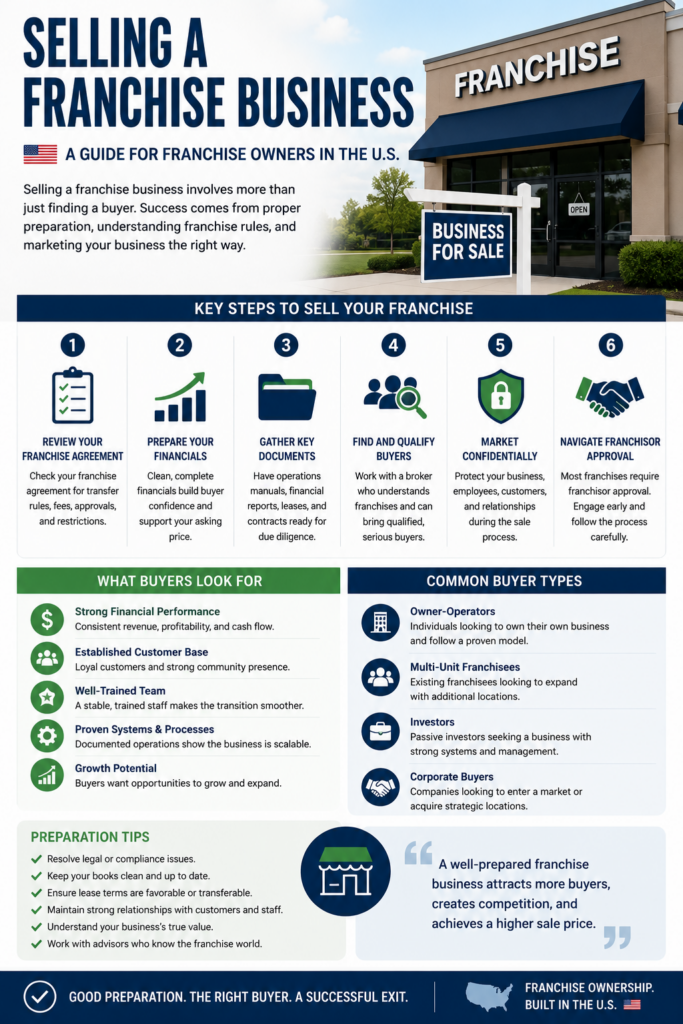
What Buyers Look for in a Franchise Business
Buyers evaluate both the business and the franchise system.
Financial Performance
Buyers usually request:
- Profit and loss statements
- Tax returns
- Balance sheets
- Payroll records
- Royalty reports
- Sales reports
- Cost of goods sold
- Rent and occupancy costs
- Advertising fees
- Owner compensation
- Add-back documentation
Clean financials make it easier for buyers and lenders to evaluate the business.
Franchise Fees and Royalties
Buyers will review the full cost structure, including:
- Royalty fees
- Advertising fees
- Technology fees
- Required purchases
- Transfer fees
- Training fees
- Renewal fees
- Remodel requirements
A profitable franchise must still make sense after all brand-related fees are included.
Location and Lease
For location-based franchises, the lease can heavily affect value.
Buyers may evaluate:
- Remaining lease term
- Renewal options
- Rent increases
- Assignment rights
- Landlord approval requirements
- Parking
- Visibility
- Foot traffic
- Co-tenancy
- Buildout condition
A strong location with a favorable lease can increase buyer confidence.
Brand Strength
Buyers want to know whether the franchise brand is growing, stable, or declining.
They may evaluate:
- Brand reputation
- Customer demand
- Online reviews
- Franchisee satisfaction
- System-wide growth
- Litigation or disputes
- Franchisor support
- Marketing strength
- Competitor pressure
A strong local unit may still face buyer concerns if the broader franchise system is struggling.
Staff and Management
Buyers want to know whether employees and managers will stay after closing.
This is especially important for:
- Restaurants
- Fitness studios
- Senior care franchises
- Cleaning franchises
- Childcare businesses
- Automotive franchises
- Multi-unit operations
A strong manager can reduce transition risk.
Franchisor Relationship
Buyers may ask whether you are in good standing with the franchisor.
They may review:
- Royalty payment history
- Compliance with brand standards
- Inspection results
- Customer complaints
- Dispute history
- Required upgrades
- Renewal eligibility
A clean franchisor relationship makes the sale smoother.
How to Prepare Your Franchise Business for Sale
1. Organize Financial Records
Prepare at least three years of financial statements and tax returns, plus current year-to-date financials.
Also prepare:
- Sales reports
- Royalty reports
- Payroll records
- Expense breakdowns
- Add-back documentation
- Inventory reports
- Equipment lists
- Lease documents
- Franchise fee records
Buyers and lenders will want financial clarity.
2. Contact the Franchisor at the Right Time
You may need franchisor approval before completing the sale.
However, timing matters. You may not want to alert the franchisor too early unless your agreement requires it.
Review your franchise agreement and consult an advisor before contacting the franchisor.
When appropriate, ask the franchisor about:
- Buyer approval process
- Transfer fee
- Required training
- Transfer timeline
- Documents needed
- Whether they know qualified buyers
- Any required upgrades before sale
3. Review Lease Assignment Rules
If your franchise operates from a physical location, the lease must usually be assigned or replaced.
Review:
- Whether the lease can be assigned
- Whether landlord approval is required
- Whether a personal guarantee continues
- Whether rent will increase
- Whether renewal options transfer
- Whether the buyer needs a new lease
Lease problems can delay or kill a deal.
4. Prepare Equipment and Inventory Lists
Buyers want to know what is included in the sale.
Prepare lists of:
- Equipment
- Furniture and fixtures
- Vehicles
- POS systems
- Technology systems
- Inventory
- Supplies
- Leasehold improvements
- Brand-specific assets
Include equipment condition, age, ownership status, and any outstanding loans or leases.
5. Improve Operations Before Selling
Buyers want a business that is stable and transferable.
Before going to market, consider improving:
- Employee retention
- Manager training
- Local marketing
- Online reviews
- Customer service
- Cost controls
- Inventory management
- Scheduling systems
- Vendor compliance
- Profit margins
Small operational improvements can improve buyer confidence.
6. Reduce Owner Dependence
A franchise business that requires the owner to handle every task may receive a lower valuation.
Try to delegate:
- Scheduling
- Staff supervision
- Vendor ordering
- Customer service
- Local marketing
- Daily operations
- Reporting
A trained manager or team can make the business easier to transfer.
How to Maximize the Sale Price
Improve Profit Margins
Buyers care about cash flow, not just revenue.
Improve margins by reviewing:
- Labor costs
- Food costs, if applicable
- Inventory waste
- Vendor pricing
- Local marketing return
- Rent and occupancy costs
- Scheduling efficiency
- Pricing opportunities
- Unnecessary expenses
Strengthen Local Reviews
For many franchise businesses, local reviews strongly influence buyer perception.
Improve:
- Google reviews
- Yelp reviews, if relevant
- Franchise platform reviews
- Social media presence
- Local search visibility
- Customer testimonials
A strong local reputation can make the business more attractive.
Build Management Depth
A buyer may pay more if the business can operate without heavy owner involvement.
A reliable general manager or supervisor can increase transferability.
Renew or Stabilize the Lease
If your lease is expiring soon, buyers may worry about location risk.
A longer lease or clear renewal option can improve buyer confidence.
Fix Franchisor Compliance Issues
Resolve outstanding brand standard issues, unpaid fees, documentation gaps, or inspection problems before going to market.
Create a Growth Story
Buyers pay more when they see realistic growth opportunities.
Examples include:
- Better local marketing
- Catering or delivery growth
- Additional service lines
- More commercial accounts
- Additional territories
- Additional units
- Improved staffing
- Higher operating efficiency
- Better community partnerships
The growth story should be realistic and supported by evidence.
Confidentiality When Selling a Franchise
Confidentiality is important during a franchise sale.
If the sale becomes public too early, it may create uncertainty among:
- Employees
- Customers
- Vendors
- Landlords
- Competitors
- The franchisor, depending on timing
- Other franchisees
A confidential sale process usually includes:
- Blind marketing materials
- Buyer screening
- NDAs
- Staged information sharing
- Controlled access to financials
- Careful communication with the franchisor and landlord
Do not share sensitive employee, customer, vendor, or financial information before qualifying the buyer.
Common Deal Structures in Franchise Sales
Full Business Sale
The buyer purchases the franchise business and takes over operations after franchisor approval.
Sale With Seller Transition
The seller stays temporarily to train the buyer, introduce employees, and support operational continuity.
Multi-Unit Sale
The seller sells multiple franchise locations as a portfolio.
This may attract larger operators or private equity-backed buyers.
Manager or Employee Buyout
A manager or employee purchases the business over time or with financing support.
Asset Sale
Many franchise resales are structured as asset sales, where the buyer purchases business assets and receives approval to operate under the franchise system.
Entity Sale
In some cases, the buyer purchases the business entity. This may be more complex and depends on the franchise agreement, liabilities, tax planning, and franchisor approval.
Should You Use a Franchise Business Broker?
Many franchise owners use a business broker, franchise resale broker, or M&A advisor to manage the sale.
A broker may help with:
- Business valuation
- Confidential marketing
- Buyer sourcing
- Buyer screening
- Franchisor coordination
- Lease assignment support
- Offer comparison
- Negotiation support
- Due diligence coordination
- Closing support
For single-unit franchise owners, a business broker may be enough. For multi-unit franchise operators, an M&A advisor may be more appropriate.
The right advisor should understand franchise transfers, franchisor approvals, buyer qualification, lease issues, and franchise resale valuation.
Steps to Sell Your Franchise Business
- Review your franchise agreement.
- Understand transfer fees and franchisor approval rules.
- Organize financial statements and tax returns.
- Prepare royalty reports, lease documents, equipment lists, and inventory records.
- Estimate business value.
- Decide when and how to contact the franchisor.
- Prepare confidential marketing materials.
- Identify qualified buyers.
- Use NDAs before sharing sensitive information.
- Screen buyers for financial ability and franchisor fit.
- Negotiate price and deal structure.
- Obtain franchisor approval.
- Coordinate lease assignment or new lease.
- Complete due diligence.
- Finalize purchase documents.
- Complete buyer training and transition requirements.
- Close the transaction.
Common Mistakes to Avoid
| Ignoring the Franchise Agreement | Your franchise agreement controls many parts of the sale. Review it before speaking with buyers. |
| Waiting Too Long to Contact the Franchisor | The franchisor approval process can take time. Waiting too long may delay closing. |
| Contacting the Franchisor Too Early Without a Plan | Depending on your situation, premature communication may create complications. Review your agreement and strategy first. |
| Overpricing the Business | Franchise buyers will compare your business to other resales, startup franchise costs, and expected cash flow. |
| Not Preparing Financials | Messy financials can reduce buyer confidence and lender approval chances. |
| Forgetting About Transfer Fees | Transfer fees, training fees, and required upgrades can affect the economics of the deal. |
| Ignoring Lease Assignment | A buyer may not be able to operate without lease approval. |
Franchise Business Sale FAQs
How long does it take to sell a franchise business?
Many franchise business sales take 6 to 12 months, depending on buyer demand, franchisor approval, financing, lease assignment, and due diligence.
Can I sell my franchise without franchisor approval?
Usually no. Most franchise agreements require franchisor approval before a transfer can be completed.
How is a franchise business valued?
A franchise business may be valued based on seller discretionary earnings, EBITDA, revenue, location, lease terms, brand strength, cash flow, equipment, territory rights, and comparable franchise resales.
Who buys franchise businesses?
Common buyers include individual entrepreneurs, existing franchisees, multi-unit operators, local competitors, private equity-backed groups, family offices, and sometimes employees or managers.
Does the franchisor help find buyers?
Some franchisors maintain lists of interested buyers or existing franchisees who want more locations. Others do not actively help. Ask about this during the transfer process.
What fees apply when selling a franchise?
Potential fees may include transfer fees, training fees, legal fees, broker fees, lease assignment costs, required upgrade costs, and closing costs.
Can I sell a franchise if the lease is expiring?
Yes, but it may be harder. Buyers usually prefer a secure lease with renewal options. A short lease can reduce buyer confidence.
What makes a franchise business more valuable?
Strong cash flow, clean financials, good location, favorable lease, stable staff, low owner dependence, strong reviews, good franchisor standing, and growth potential can improve value.
Is a multi-unit franchise more valuable than a single-unit franchise?
Often, yes. Multi-unit franchises may attract larger buyers because they offer scale, management depth, and operating efficiencies. However, profitability and location quality still matter.
Should I sell to another franchisee?
Existing franchisees can be strong buyers because they already know the brand and may receive faster franchisor approval. However, you should still compare price, terms, and closing certainty.
Final Thoughts
Selling your franchise business requires more than finding a buyer. You must manage valuation, confidentiality, franchisor approval, buyer qualification, lease assignment, transfer fees, training requirements, and deal structure.
Franchise businesses with strong cash flow, clean books, stable employees, good locations, favorable lease terms, and strong franchisor standing usually attract better buyers.
Owners who prepare early, review their franchise agreement, organize financial records, strengthen operations, and work with qualified advisors are usually in a stronger position to sell successfully and negotiate better terms.