


Selling a business in Nashville can be a major financial opportunity, especially if your company has strong cash flow, clean financial records, loyal customers, and room for future growth.
Nashville has become one of the most active business markets in the Southeast. It attracts buyers interested in healthcare, construction, hospitality, logistics, professional services, manufacturing, technology, entertainment, and local service businesses.
However, selling a business is not just about finding someone willing to buy it. The process requires valuation, preparation, confidentiality, buyer screening, negotiation, due diligence, and a structured closing plan. If you rush the process or go to market without preparation, you may receive lower offers, expose sensitive information, or lose buyer confidence during due diligence.
Key Takeaways
Selling a business in Nashville requires preparation, clean financials, realistic pricing, and a confidential buyer outreach strategy.
The best time to sell is usually when your revenue, profits, and operations are stable or improving.
Nashville buyers may include local entrepreneurs, competitors, private equity firms, strategic acquirers, search funds, family offices, and out-of-state buyers entering Tennessee.
Your business value depends on cash flow, industry, location, customer base, employees, assets, growth potential, and how dependent the business is on you.
Confidentiality is critical. Employees, customers, suppliers, landlords, and competitors should not learn about the sale too early.
A Nashville business broker or M&A advisor can help with valuation, marketing, buyer screening, negotiations, due diligence, and closing.
Looking to Sell Your Business?
Maximize your business sale by consulting USA’s top business brokers. More buyers. Bigger profits.
Quick Answer: How Do You Sell a Business in Nashville?
To sell a business in Nashville, start by getting a professional valuation, organizing your financial and legal records, preparing the business for buyer review, creating confidential marketing materials, finding qualified buyers, negotiating offers, completing due diligence, and closing the transaction with help from legal and tax professionals.
For many owners, the best way to sell a business in Nashville is to prepare early, protect confidentiality, work with qualified buyers, and use an experienced business broker or M&A advisor to manage the process.
Why Nashville Is an Attractive Market for Business Buyers
Nashville is known for more than music and tourism. The city has a diverse economy with strong activity in healthcare, construction, hospitality, education, real estate, transportation, technology, and professional services. This can make Nashville appealing to buyers who want to acquire an established business in a growing regional market.
Buyers may be interested in Nashville businesses because of:
- Strong local and regional population growth
- A large healthcare and medical services presence
- Tourism, hospitality, and entertainment demand
- Construction and home services activity
- Expanding suburban markets around Middle Tennessee
- Access to regional transportation routes
- A growing pool of entrepreneurs and investors
- Opportunities for business consolidation
- Demand from out-of-state buyers entering Tennessee
For business owners, this means a well-prepared company may attract interest from both local and outside buyers.
What Types of Businesses Sell Well in Nashville?
Many types of businesses can attract buyers in Nashville if they have stable earnings, organized records, and transferable operations.
Businesses that may perform well in the Nashville market include:
- Healthcare and medical service businesses
- Dental practices
- Home services companies
- HVAC, plumbing, roofing, and electrical contractors
- Construction and specialty trade businesses
- Restaurants and hospitality businesses
- Manufacturing companies
- Distribution and logistics companies
- Professional service firms
- SaaS and technology businesses
- Marketing agencies
- Automotive service businesses
- Childcare and education-related businesses
- Fitness and wellness businesses
- Entertainment-related businesses
The industry matters, but buyers usually care most about profitability, stability, transferability, and future growth potential.
Ready to Sell Your Business?
Take the first step towards a successful business exit
When Is the Best Time to Sell a Business in Nashville?
The best time to sell your Nashville business is usually when it is performing well, not when it is already declining. Buyers prefer companies with stable or growing revenue, reliable cash flow, strong employees, and a clear path for future growth.
You may want to consider selling when:
- Revenue and profits are stable or increasing
- You have clean financial records
- The business is not overly dependent on you
- Your industry has strong buyer demand
- You have a reliable management team
- Customer retention is strong
- Your lease or real estate situation is stable
- You are ready to retire or pursue something else
- You do not have a strong succession plan
- You have received serious buyer interest
Selling from a position of strength gives you more leverage. If you wait until revenue drops, employees leave, or operations become messy, buyers may lower their offers or walk away.
Step 1: Define Your Exit Goals
Before you take your Nashville business to market, define what you want from the sale. The highest purchase price is important, but it is not the only factor.
Think about:
- Your ideal sale price
- Your minimum acceptable price
- Whether you want all cash at closing
- Whether you are open to seller financing
- Whether you would accept an earnout
- How long you are willing to stay after closing
- Whether you want to protect employees
- Whether you want to keep or sell the real estate
- Whether you prefer a local buyer or strategic acquirer
- Your personal retirement or reinvestment goals
These answers shape the entire sale process. A seller who wants a clean exit may prefer a different buyer than one who is willing to stay involved for several years.
Step 2: Get a Professional Business Valuation
One of the most important steps in selling a business in Nashville is determining what the company is worth. Many owners either overestimate the value because of emotional attachment or underestimate it because they do not understand buyer demand.
A professional valuation helps you set realistic expectations before going to market.
Common valuation methods include:
- Multiple of seller’s discretionary earnings
- Multiple of EBITDA
- Asset-based valuation
- Market comparable analysis
- Discounted cash flow analysis
- Industry-specific valuation methods
For many small businesses, buyers focus on seller’s discretionary earnings. For larger businesses, buyers typically focus on EBITDA.
Factors that affect business value include:
- Revenue trends
- Profit margins
- Cash flow
- Industry
- Location in Nashville or Middle Tennessee
- Customer concentration
- Recurring revenue
- Owner involvement
- Employee stability
- Lease terms
- Equipment and inventory
- Brand reputation
- Online reviews
- Growth potential
- Systems and processes
- Transferability after closing
A business with strong cash flow, low owner dependence, recurring customers, and clean financials will usually attract stronger offers.
Step 3: Prepare Your Financial Records
Buyers want proof that the business is profitable. Your financial documents must support your asking price and give buyers confidence.
Prepare at least three years of financial records, including:
- Profit and loss statements
- Balance sheets
- Business tax returns
- Bank statements
- Payroll records
- Sales reports
- Customer revenue reports
- Accounts receivable reports
- Accounts payable reports
- Inventory reports
- Equipment lists
- Debt schedules
- Lease agreements
- Vendor contracts
You should also identify legitimate add-backs. Add-backs are expenses that may be added back to earnings if they are personal, one-time, discretionary, or not required by a new owner.
Common add-backs include:
- Owner salary above market rate
- Personal vehicle expenses
- One-time legal fees
- Non-recurring repairs
- Personal travel expenses
- Family members on payroll who do not actively work in the business
- One-time consulting expenses
Buyers will review add-backs carefully. If they seem inflated or unsupported, the buyer may question your financials and reduce the offer.
Step 4: Reduce Owner Dependence
A business that relies heavily on the owner is harder to sell. Buyers want to know the company can continue operating after the sale.
Before listing your Nashville business, work on reducing owner dependence by:
- Training managers or supervisors
- Delegating customer relationships
- Documenting standard operating procedures
- Creating written job descriptions
- Organizing vendor contacts
- Systemizing sales and marketing
- Improving financial reporting
- Reducing informal decision-making
- Building a second layer of leadership
If the owner handles every sale, customer issue, employee problem, vendor relationship, and financial decision, buyers may see the business as risky.
The more transferable your business is, the more attractive it becomes.
Step 5: Organize Legal and Operational Documents
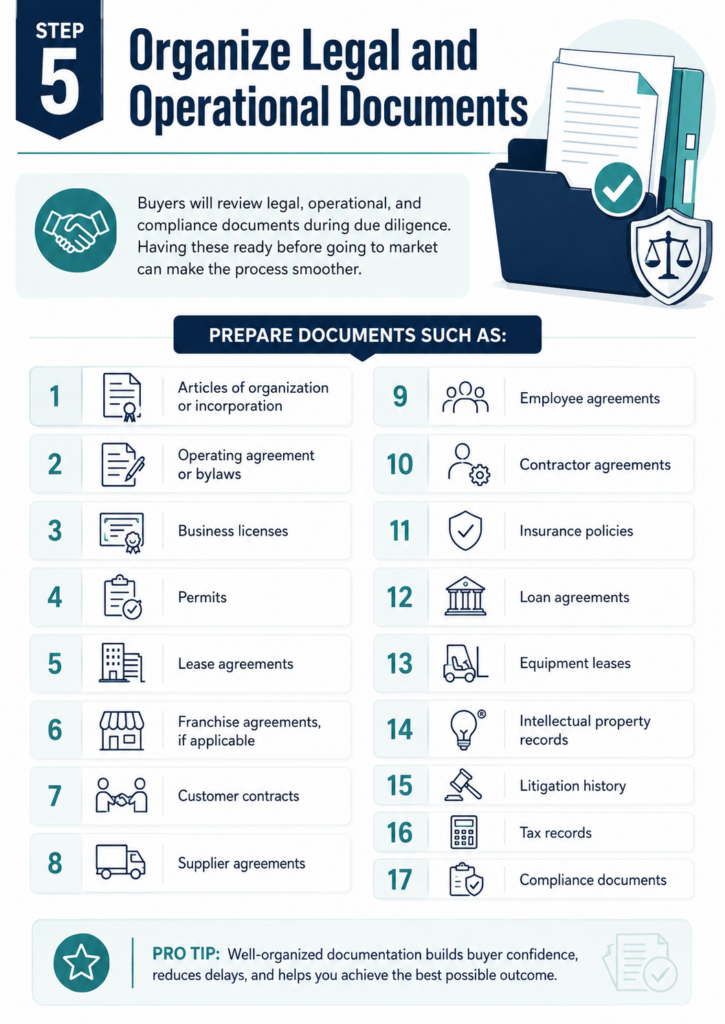
Buyers will review legal, operational, and compliance documents during due diligence. Having these ready before going to market can make the process smoother.
Prepare documents such as:
- Articles of organization or incorporation
- Operating agreement or bylaws
- Business licenses
- Permits
- Lease agreements
- Franchise agreements, if applicable
- Customer contracts
- Supplier agreements
- Employee agreements
- Contractor agreements
- Insurance policies
- Loan agreements
- Equipment leases
- Intellectual property records
- Litigation history
- Tax records
- Compliance documents
If your business is in a regulated industry, make sure licenses and permits are current. This is especially important for healthcare, food service, alcohol-related businesses, transportation, construction, childcare, automotive services, and professional services.
Step 6: Improve the Business Before Listing It
Small improvements before going to market can increase buyer confidence and reduce objections during due diligence.
Before selling, consider improving:
- Financial reporting
- Online reviews
- Local SEO
- Customer contracts
- Employee retention
- Inventory management
- Equipment condition
- Lease terms
- Vendor agreements
- Branding
- Sales pipeline
- Accounts receivable collection
- Profit margins
- Operating procedures
For example, a Nashville restaurant owner may improve value by organizing lease terms, documenting supplier relationships, improving online reviews, and cleaning up financials. A Nashville construction company owner may improve value by documenting backlog, equipment condition, employee credentials, and repeat customer relationships.
Step 7: Decide Whether Real Estate Is Included
Some Nashville business owners also own the real estate where the company operates. This can affect the transaction structure.
You may choose to:
- Sell the business only
- Sell the business and real estate together
- Keep the real estate and lease it to the buyer
- Sell the real estate separately
- Offer the buyer an option to purchase later
If your location is important to the business, buyers will want lease security. A buyer may hesitate if the lease is about to expire, rent is increasing sharply, or the landlord will not assign the lease.
If you own the property, keeping it and leasing it to the buyer may create ongoing rental income. Selling the property with the business may produce a cleaner exit. The right decision depends on your financial goals, tax situation, buyer preferences, and the role of the property in business operations.
Step 8: Create a Confidential Marketing Package
Once your business is ready, you need professional marketing materials. These should present the opportunity clearly while protecting confidentiality.
Most business sales use two main documents: a blind teaser and a confidential information memorandum.
A blind teaser is a short anonymous summary that describes the business without revealing its exact identity.
A confidential information memorandum, or CIM, is a detailed document shared only after a qualified buyer signs a non-disclosure agreement.
A strong CIM should include:
- Business overview
- Location overview
- Products or services
- Customer base
- Revenue and profit trends
- Employee structure
- Assets included in the sale
- Growth opportunities
- Reason for selling
- Competitive advantages
- Financial summary
- Transition support
- Deal expectations
The goal is to attract qualified buyers without exaggerating the opportunity. Serious buyers want clarity, not hype.
Step 9: Find Qualified Buyers for Your Nashville Business
Finding buyers is not just about listing the business online. It is about reaching qualified buyers while protecting confidentiality.
Potential buyers for a Nashville business may include:
- Local entrepreneurs
- Existing business owners
- Competitors
- Strategic buyers
- Private equity firms
- Family offices
- Search fund buyers
- Out-of-state buyers entering Nashville
- Employees or managers
- Suppliers or customers
- Franchise operators
- Industry-specific investors
Different buyers have different goals. A local buyer may want income and owner-operator control. A strategic buyer may want customers, employees, territory, or market share. A private equity buyer may want scalable cash flow and management depth.
Your buyer strategy should match your business size, industry, and exit goals.
Step 10: Protect Confidentiality
Confidentiality is one of the most important parts of selling a business in Nashville.
If employees, customers, suppliers, landlords, or competitors learn about the sale too early, it can create unnecessary risk. Employees may worry about their jobs. Customers may become uncertain. Competitors may use the information against you.
To protect confidentiality:
- Use anonymous listings
- Require NDAs before sharing details
- Screen buyers before disclosure
- Limit sensitive information early
- Avoid sharing customer names too soon
- Do not disclose employee names prematurely
- Use staged information release
- Keep communication controlled
- Work with an experienced advisor
Confidentiality is especially important if competitors are potential buyers.
Step 11: Negotiate Offers
Once buyers review the opportunity, serious candidates may submit an indication of interest or letter of intent. A letter of intent outlines the proposed deal terms.
Important terms include:
- Purchase price
- Cash at closing
- Seller financing
- Earnout terms
- Working capital requirements
- Inventory treatment
- Assets included
- Real estate terms
- Training period
- Non-compete agreement
- Exclusivity period
- Due diligence timeline
- Closing conditions
Do not evaluate an offer only by the headline price. A higher offer with uncertain financing, heavy seller financing, or aggressive earnout terms may be less attractive than a slightly lower offer with more cash at closing.
The best offer is usually the one that balances price, certainty, timing, and risk.
Step 12: Prepare for Due Diligence
Due diligence is the buyer’s detailed review of your business. This stage can make or break the sale.
Buyers may review:
- Financial statements
- Tax returns
- Bank deposits
- Customer lists
- Contracts
- Employee records
- Lease terms
- Licenses and permits
- Insurance policies
- Vendor agreements
- Equipment
- Inventory
- Debt
- Legal issues
- Online reputation
- Sales pipeline
- Operational processes
The buyer is trying to confirm that the business is worth what they offered. If they find problems, they may reduce the price, change the terms, or walk away.
Organized records help keep the transaction moving and reduce the chance of renegotiation.
Step 13: Close the Sale
After due diligence, the buyer and seller move toward closing. Attorneys usually prepare the final purchase agreement and related documents.
Closing documents may include:
- Asset purchase agreement or stock purchase agreement
- Bill of sale
- Assignment of contracts
- Lease assignment
- Non-compete agreement
- Seller financing note
- Security agreement
- Consulting or transition agreement
- Closing statement
- Corporate approvals
- Tax forms
Before signing, review everything with your attorney and CPA. You should understand your tax consequences, liabilities, payment terms, and post-closing obligations.
Step 14: Plan the Transition
Most buyers will expect some seller support after closing. The transition period may last a few weeks, several months, or longer depending on the business.
A transition plan may include:
- Introducing the buyer to employees
- Introducing the buyer to customers
- Training on operations
- Sharing vendor relationships
- Explaining software and systems
- Reviewing financial reporting
- Helping with licensing or lease transfer
- Supporting customer retention
- Advising on daily operations
A smooth transition protects the business and gives the buyer confidence. It can also help preserve deal terms if part of the payment depends on post-closing performance.
Selling a Business in Nashville vs. Other Tennessee Markets
Selling a business in Nashville may differ from selling in smaller Tennessee markets because Nashville often attracts a broader buyer pool. Local entrepreneurs, regional strategic buyers, private equity groups, search funds, and out-of-state investors may all consider Nashville acquisitions if the business has strong financials and growth potential.
However, the fundamentals remain the same across Tennessee: buyers want clean books, steady cash flow, strong employees, transferable systems, and realistic pricing.
A business in Brentwood, Franklin, Murfreesboro, Hendersonville, Gallatin, Mount Juliet, or other parts of Middle Tennessee may also attract Nashville-area buyers. If your company serves the broader region, your marketing materials should highlight not only the city but also the wider Middle Tennessee growth opportunity.
Common Mistakes to Avoid When Selling a Business in Nashville
1. Going to Market Without Preparation
Listing the business before your financials, documents, and operations are ready can weaken your negotiating position.
2. Asking an Unrealistic Price
An inflated asking price can scare away qualified buyers and make the business sit on the market too long.
3. Telling Employees Too Early
Employees should usually not learn about the sale until the right stage. Premature disclosure can create anxiety and turnover.
4. Sharing Information With Unqualified Buyers
Not every interested party is serious. Screen buyers before sharing sensitive information.
5. Ignoring Tax Planning
The structure of the sale can significantly affect your after-tax proceeds. Speak with a CPA before accepting an offer.
6. Failing to Prepare for Due Diligence
Messy records can lead to delays, price reductions, or failed deals.
7. Focusing Only on Price
Terms matter. Cash at closing, seller financing, earnouts, working capital, and transition obligations can affect the true value of the deal.
How to Increase the Value of Your Nashville Business Before Selling
To make your business more attractive, focus on reducing buyer risk and improving transferability.
Ways to increase value include:
- Clean up financial statements
- Reduce unnecessary expenses
- Increase recurring revenue
- Diversify customers
- Document processes
- Build a management team
- Improve employee retention
- Secure long-term contracts
- Improve online reviews
- Strengthen local SEO
- Resolve legal issues
- Improve margins
- Reduce owner dependence
- Organize equipment and inventory records
- Create a realistic growth plan
Buyers pay more for businesses that are easier to understand, easier to transfer, and less risky to operate.
Should You Hire a Nashville Business Broker?
Many owners benefit from hiring a Nashville business broker or M&A advisor, especially if confidentiality, buyer screening, and deal structure are important.
A business broker or M&A advisor can help with:
- Business valuation
- Exit planning
- Preparing marketing materials
- Confidential buyer outreach
- Screening buyers
- Managing NDAs
- Negotiating offers
- Coordinating due diligence
- Communicating with attorneys and CPAs
- Keeping the process organized
- Protecting confidentiality
For smaller local businesses, a business broker may be the right fit. For larger companies, an M&A advisor may be more appropriate.
The right advisor can help create competition among buyers and prevent you from relying on a single offer.
FAQ: Selling a Business in Nashville
How do I sell my business in Nashville?
To sell your business in Nashville, start with a professional valuation, organize financial and legal records, prepare the business for buyer review, create confidential marketing materials, find qualified buyers, negotiate offers, complete due diligence, and close the transaction with legal and tax support.
How much is my Nashville business worth?
Your Nashville business value depends on cash flow, profitability, industry, location, customer base, assets, employees, growth potential, and owner involvement. Many businesses are valued using a multiple of seller’s discretionary earnings or EBITDA.
How long does it take to sell a business in Nashville?
Selling a business in Nashville can take several months or longer. The timeline depends on business size, industry, financial quality, buyer demand, financing, due diligence, and deal complexity.
Do I need a business broker to sell my business in Nashville?
You are not required to use a broker, but many owners choose to work with one because selling a business requires valuation, confidentiality, buyer screening, marketing, negotiation, and due diligence management.
Can I sell my Nashville business without a broker?
Yes, you can sell your Nashville business without a broker. However, you will need to manage valuation, confidential marketing, buyer qualification, negotiations, due diligence, and closing coordination yourself.
Do I need a lawyer to sell my business in Nashville?
In most cases, it is wise to use a lawyer when selling a business. A lawyer can help review or draft the purchase agreement, lease assignment, non-compete agreement, seller financing documents, and closing materials.
Do I pay taxes when I sell my business in Tennessee?
Selling a business can create tax consequences at the federal and state level. The amount depends on deal structure, entity type, asset allocation, depreciation recapture, capital gains, and other factors. Speak with a CPA before accepting an offer.
Can I sell my business if it has debt?
Yes, a business with debt can still be sold. The debt must be disclosed and handled as part of the transaction. Some debt may be paid off at closing, assumed by the buyer, or resolved separately depending on the deal structure.
Should I tell my employees I am selling the business?
In most cases, employees should not be told too early. Premature disclosure can create uncertainty and turnover. The timing depends on your business, buyer, deal stage, and transition plan.
What documents do I need to sell my business in Nashville?
You typically need financial statements, tax returns, lease agreements, licenses, permits, customer contracts, vendor agreements, payroll records, equipment lists, inventory records, insurance policies, and corporate documents.
Can I sell my business without selling the real estate?
Yes. Many owners sell the operating business and keep the real estate, then lease the property to the buyer. This can create ongoing rental income, but it must be structured carefully.
Who buys businesses in Nashville?
Buyers may include local entrepreneurs, competitors, strategic acquirers, private equity firms, family offices, search fund buyers, employees, suppliers, customers, franchise operators, and out-of-state investors.
What is the fastest way to sell a business in Nashville?
The fastest way to sell a business in Nashville is to prepare documents before going to market, set a realistic asking price, target qualified buyers, respond quickly during due diligence, and avoid overly complicated deal terms. However, a fast sale should still protect confidentiality and deal quality.
What is the best way to find buyers for my Nashville business?
You can find buyers through business brokers, M&A advisors, confidential outreach, industry contacts, competitors, private equity firms, search funds, online business-for-sale platforms, and local business networks.
What is the biggest mistake owners make when selling a business?
One of the biggest mistakes is going to market without preparation. Poor financial records, unrealistic pricing, weak documentation, and lack of confidentiality can reduce buyer confidence and hurt the final sale price.
Final Thoughts
Selling a business in Nashville requires planning, documentation, confidentiality, and the right buyer strategy. Buyers want to see clean financials, stable cash flow, loyal customers, reliable employees, and a business that can continue operating after the owner exits.
The more prepared you are before going to market, the stronger your negotiating position will be. Focus on improving financial records, reducing owner dependence, organizing legal documents, protecting confidentiality, and understanding your company’s realistic market value.
For Nashville business owners, the right sale process can make a major difference. A rushed sale can lead to lower offers, broken deals, and unnecessary stress. A structured process can help you attract qualified buyers, negotiate better terms, and exit with confidence.