

Math-U-See is a mastery-based homeschool math curriculum that teaches mathematical concepts through short video lessons, physical manipulatives, visual demonstrations, written practice, and systematic review.
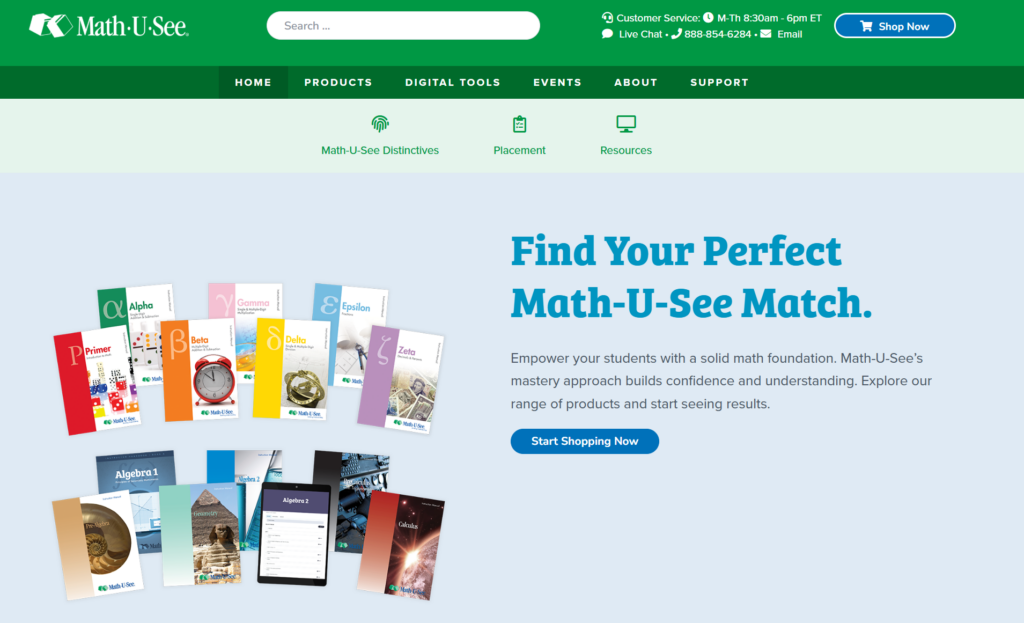
Instead of organizing elementary math strictly by school grade, Math-U-See uses levels with names such as Alpha, Beta, Gamma, Delta, Epsilon, and Zeta. Each level concentrates heavily on a major area of mathematics before the student progresses to the next one.
For example:
- Alpha focuses mainly on addition and subtraction.
- Beta develops multidigit addition and subtraction.
- Gamma focuses on multiplication.
- Delta teaches division.
- Epsilon concentrates on fractions.
- Zeta covers decimals and percentages.
The sequence continues through Pre-Algebra, Algebra 1, Geometry, Algebra 2, Precalculus, and Calculus. Math-U-See currently offers 13 levels from introductory mathematics through calculus.
As a homeschooling dad, I can understand why the program has remained popular.
Many children do not struggle with math because they are incapable of understanding it. They struggle because an abstract idea was introduced too quickly, taught through symbols alone, and then abandoned before the child developed real mastery.
Math-U-See tries to solve that problem by letting students build, see, say, and practice each concept.
Its colored blocks can represent place value, arithmetic operations, fractions, decimals, and even algebraic expressions. The video teacher demonstrates the concept, the parent reinforces it, and the child completes worksheets until mastery is demonstrated.
However, Math-U-See is not ideal for every learner.
Its mastery sequence can appear narrow compared with spiral programs that cover many mathematical topics each week. Some children may become bored spending most of a year on multiplication, division, or fractions. Advanced students may also need additional challenge, problem-solving, or competition-style mathematics.
My overall conclusion is:
Math-U-See is one of the strongest homeschool math curricula for visual learners, struggling students, and children who need concepts taught slowly and concretely. Its manipulatives, video instruction, and mastery sequence can build genuine confidence, but advanced learners and families wanting broader daily variety may need supplementation or a different program.
Math-U-See Review: Quick Verdict
| Category | My assessment |
| Best for | Visual learners, struggling students, and mastery-based homeschooling |
| Grade range | Introductory math through calculus |
| Main approach | Mastery with systematic review |
| Teaching format | Videos, instructor manual, manipulatives, and worksheets |
| Grade labels | Skill-based levels rather than conventional grades |
| Parent involvement | Moderate in elementary levels; lower as students mature |
| Student independence | Moderate with videos |
| Religious perspective | Secular but Christian-friendly |
| Accreditation | Not an accredited school |
| First-year elementary cost | About $165–$220 for a complete starter set, depending on level |
| Reusable components | Manipulatives, instructor manuals, and videos or subscriptions |
| Overall rating | 4.5/5 |
Math-U-See is particularly suitable for:
- Children who need to see how math works
- Students with math anxiety
- Children who have gaps in foundational skills
- Families wanting a mastery curriculum
- Students who dislike long textbook explanations
- Parents who lack confidence teaching math
- Children who benefit from manipulatives
- Homeschoolers working above or below a conventional grade
- Families wanting short, focused lessons
- Students who need repeated practice before progressing
It may be less suitable for:
- Highly advanced or competition-oriented math students
- Children who become bored focusing on one major topic
- Families wanting a cheap printable curriculum
- Students who strongly dislike manipulatives
- Parents wanting fully automated grading
- Children who need constant games and colorful variety
- Families wanting a spiral curriculum
- Students who thrive on difficult, unfamiliar problem-solving
What Is Math-U-See?
Math-U-See is a K–12 homeschool and school mathematics curriculum published by Demme Learning.
It combines:
- Instructional videos
- Instructor manuals
- Student workbooks
- Tests
- Physical manipulatives
- Virtual manipulatives
- Online drill tools
- Worksheet-generation tools
- Placement support
The publisher describes it as a complete and comprehensive mathematics curriculum in which each level concentrates on a specific set of skills while continuing to review previously learned concepts.
The program’s most distinctive component is its integrated manipulative system.
Students use colored blocks, fraction overlays, and algebra or decimal inserts to make abstract concepts visible. Math-U-See continues using manipulatives beyond elementary arithmetic and into pre-algebra, making it unusual among multisensory math programs.
A child may use the blocks to understand:
- Place value
- Addition
- Subtraction
- Multiplication
- Division
- Fractions
- Decimals
- Negative numbers
- Algebraic expressions
- Factoring
- Polynomial concepts
The objective is not merely to help students obtain the answer.
The objective is to help them form a mental picture of why the procedure works.
How the Math-U-See Mastery Approach Works
Math-U-See follows a mastery approach rather than a conventional spiral sequence.
In a spiral curriculum, several topics may appear during the same week. A student might work on fractions one day, geometry the next, multiplication later, and then return to fractions.
Math-U-See concentrates primarily on one major area until the child demonstrates mastery.
The official four-step teaching process is:
- Prepare for the lesson
- Present and explore the new concept
- Practice for mastery
- Progress after mastery
This does not mean older material disappears.
Student workbooks include both focused lesson practice and systematic review. Earlier skills are regularly incorporated so children continue using them while studying the current topic.
Why Mastery Can Work Well
The mastery approach gives a child time to understand a topic before the curriculum moves on.
This may be especially beneficial for students who:
- Forget procedures easily
- Become overwhelmed by switching topics
- Need repeated concrete examples
- Have incomplete foundations
- Experience math anxiety
- Require more time than a grade-level schedule permits
Instead of saying, “The class has moved on, so you must move on,” Math-U-See allows the child to remain with the concept.
That is one of homeschooling’s greatest advantages.
Why Mastery Can Create Problems
A mastery curriculum can also create uneven exposure.
A child may spend most of one level studying multiplication and receive less sustained work with fractions, geometry, measurement, or data until later.
Math-U-See does include secondary topics and review, but it does not necessarily teach concepts in the same grade or order as public-school standards. Cathy Duffy notes that the program covers necessary math concepts but does not attempt to correlate every concept with the timing used in other curricula.
That matters when:
- A child may return to public school
- State testing follows a grade-specific sequence
- The family uses a charter program
- The student participates in grade-based competitions
- Parents compare progress with conventional school textbooks
Families in those situations should compare the Math-U-See scope and sequence with their external requirements.
My Impression as a Homeschooling Dad
The strongest feature of Math-U-See is that it gives both the child and the parent a way to understand mathematics visually.
Many adults were taught to follow rules without understanding them.
They learned instructions such as:
- Carry the one.
- Borrow from the next column.
- Invert and multiply.
- Move the decimal.
- Change the sign.
They may know how to complete the calculation but cannot explain why the procedure is valid.
Math-U-See tries to prevent that.
The parent watches the instructor demonstrate the lesson with manipulatives. The child then builds the concept and explains it back.
One reviewer identifies this as one reason the program is so popular: parents often understand concepts through Math-U-See that they never truly understood when they were students, which can make them more confident teachers.
As a dad, I also appreciate the emotional benefit of mastery.
A child who has repeatedly failed math may begin to believe:
“I am simply bad at math.”
Math-U-See can replace that experience with smaller victories.
The child sees the concept, practices one step, succeeds, and moves forward only when ready.
Several independent homeschool reviews specifically praise the program for building confidence in children who struggle with math or experience math anxiety.
The weakness is that the program can feel visually plain.
The student workbook is functional rather than entertaining. Children who expect animated lessons, characters, games, and constant rewards may find it dull.
The manipulatives make concepts concrete, but they do not turn the program into a game-based curriculum.
Math-U-See Levels Explained

Math-U-See is skill-based rather than grade-based.
The publisher deliberately uses Greek-letter level names so children can work at an appropriate level without the pressure or embarrassment associated with a lower grade label.
Primer
Primer introduces young children to basic mathematical thinking.
Topics include:
- Counting
- Numeral writing
- Place value
- Basic addition and subtraction
- Shapes
- Time
- Measurement
- Skip counting
- Simple fractions
- Word problems
The publisher suggests that a child may be ready when the student shows interest in numbers, can follow simple directions, and can concentrate for approximately ten minutes.
Primer is intentionally introductory. The goal is exposure rather than perfect mastery of every concept.
Alpha
Alpha focuses primarily on single-digit addition and subtraction.
Students learn:
- Place value
- Addition strategies
- Subtraction strategies
- Unknown addends
- Fact families
- Mental math
- Time
- Shapes
- Measurement
- Skip counting
- Simple word problems
The curriculum uses systematic strategies to help children commit addition and subtraction facts to memory.
Beta
Beta moves into multidigit addition and subtraction.
Students work with:
- Place value
- Regrouping
- Larger numbers
- Money
- Measurement
- Word problems
- Addition and subtraction fluency
The block system can make regrouping easier to understand because the child physically exchanges units for tens or tens for hundreds.
Gamma
Gamma focuses mainly on multiplication.
Students learn multiplication facts, place-value strategies, multidigit multiplication, and related applications.
This single-topic focus can be very helpful for a student who has memorized isolated facts but does not understand multiplication conceptually.
Delta
Delta concentrates on division.
The course presents division as the inverse of multiplication and develops short and long division. It also covers area, volume, averages, fractions of numbers, Roman numerals, geometry, measurement, and real-world problems.
Epsilon
Epsilon focuses on fractions.
This level uses a separate Fraction Overlay Kit containing clear denominator overlays and colored numerator pieces. The materials represent halves, thirds, fourths, fifths, sixths, eighths, tenths, and sixteenths.
Students can physically see why:
- Two fourths equal one half
- Fractions need common denominators
- Multiplication changes a fraction
- Division of fractions works
For many students, fractions become difficult because they are taught entirely through symbols. The overlays provide a visual bridge.
Zeta
Zeta covers decimals and percentages.
Students connect place value with decimal notation and learn how fractions, decimals, and percentages relate.
Pre-Algebra
Pre-Algebra reviews arithmetic while introducing:
- Negative numbers
- Exponents
- Roots
- Algebraic expressions
- Equations
- Geometry
- Number properties
- Ratios and proportions
Manipulatives continue to play a role, which can help students transition from concrete arithmetic to abstract algebra.
Algebra 1 Through Calculus
The secondary sequence includes:
- Algebra 1
- Geometry
- Algebra 2
- Precalculus
- Calculus
The store currently offers both legacy and newer Principles of Secondary Mathematics editions for Algebra 1 and Algebra 2.
One reviewer considers Math-U-See Geometry somewhat easier and less extensive than many high-school geometry courses, although it still introduces proofs, trigonometry, transformations, and regular algebra review. She describes Precalculus as straightforward and notes that Calculus includes physics and economics applications.
This means the upper levels can work well for average students and those needing clear explanations.
A mathematically advanced student may need:
- Honors exercises
- Additional proofs
- Competition problems
- A more demanding geometry course
- Deeper problem-solving resources
How a Typical Math-U-See Lesson Works
A typical lesson can be divided across several days.
Day 1: Watch and Build
The parent and child watch the instructional video.
They then use the manipulatives to recreate the concept.
The child should explain the idea back rather than merely imitate the teacher.
Days 2–3: Lesson Practice
The student completes focused worksheets on the new concept.
The parent watches for:
- Conceptual understanding
- Careless errors
- Weak facts
- Confusion with notation
- Dependence on manipulatives
Days 3–5: Systematic Review
The child completes mixed review involving previous topics.
This confirms that old skills remain available while the student learns something new.
Application and Enrichment
Many levels include optional enrichment exercises that extend the concept into more challenging or practical applications.
Test
A test can be used when the child appears ready.
The student does not necessarily need to complete every worksheet before testing.
If mastery appears after one or two practice pages, move forward.
If the child is confused, complete additional pages or reteach the lesson.
This is the key to using Math-U-See efficiently.
The workbook provides options. It does not require every child to complete every page.
Math-U-See Manipulatives Review
The Integer Block Kit is central to the elementary program.
The current kit contains 133 pieces and is designed to help students visualize abstract ideas and form mental images that lead toward mastery.
Each color and block length represents a number.
Children can use the blocks to:
- Build numbers
- Compare quantities
- Show place value
- Demonstrate addition
- Model subtraction
- Build multiplication rectangles
- Show division
- Represent algebraic ideas
Manipulative Strengths
- Concepts become visible.
- Students can touch and build mathematics.
- Place value becomes concrete.
- Multiplication and area connect naturally.
- The same system continues across levels.
- Visual learners gain a consistent mental model.
- Parents can demonstrate concepts without inventing their own materials.
Manipulative Weaknesses
- The kit adds to the initial cost.
- Blocks require storage.
- Pieces may be lost.
- Some older students resist using them.
- Children may become dependent on the blocks.
- Not every learner enjoys physical materials.
The objective should be gradual independence.
A child should move through three stages:
- Build the concept
- Draw or visualize the concept
- Solve it abstractly
The manipulatives are a bridge, not a permanent crutch.
Math-U-See Video Lessons and Digital Tools
Math-U-See includes recorded instructional lessons.
Families can obtain them through:
- An online subscription
- A DVD
- Selected curriculum sets
The Digital Toolbox also provides:
- Instruction videos
- PDF instructor materials
- Solutions
- Virtual manipulatives
- Worksheet generator
- Online drill tool
- Free activities
A free account includes the first three lessons of every level, which gives parents a useful opportunity to test the teaching style before purchasing.
Video Strengths
- Parents do not need to invent explanations.
- Children can replay difficult lessons.
- The instructor demonstrates manipulative use.
- Older students can work more independently.
- Visual instruction can reduce parent anxiety.
- The teaching is generally concise and direct.
Video Weaknesses
- Recorded teaching cannot respond to the child.
- Some children watch passively.
- The parent still needs to check understanding.
- Online access may be subscription-based.
- Children may copy procedures without building the concept themselves.
I would watch at least the early lessons with the child.
The parent needs to understand the program’s vocabulary and manipulative system to help when confusion appears.
Math-U-See Placement
Parents should not automatically buy the level corresponding to the child’s conventional grade.
Math-U-See is organized by mastery.
The official placement tool uses questions and sample problems to identify:
- Concepts already mastered
- Conceptual gaps
- The most appropriate starting level
The company also offers placement support by chat or phone.
Correct placement is extremely important because a child may know how to complete a procedure without understanding the foundation beneath it.
For example, a student may perform long multiplication but struggle with basic multiplication facts or place value.
Starting too high can make the program ineffective.
Starting too low can create boredom.
A parent should use:
- The placement tool
- Sample lessons
- Student explanations
- Actual written work
- Observation
rather than relying only on age.
Math-U-See Pricing in 2026
Math-U-See requires a larger first-year purchase than inexpensive workbook-only math programs because new users generally need instructional materials and manipulatives.
Current Pricing Examples
The official Demme Learning store listed the following prices when checked in July 2026:
| Item | Listed price |
| Primer complete set | $165.60 |
| Primer student workbook | $40.00 |
| Primer instruction manual | $28.80 |
| Primer online video instruction | $33.30 |
| Integer Block Kit | $81.90 |
| Alpha complete set | $220.12 |
| Alpha student workbook and tests | $48.00 |
| Alpha instruction manual | $36.90 |
| Essential annual digital plan | $70.00 |
| Delta complete set | $189.00 |
| Delta student workbook and tests | $48.00 |
| Delta instruction manual | $39.60 |
| Delta online video instruction | $40.50 |
The Alpha starter set costs more than some later elementary sets because it includes the reusable Integer Block Kit and full instructional components.
First-Year Cost
A new user beginning Alpha could spend around $220 for:
- Student workbook
- Tests
- Instruction materials
- Video access or equivalent instructional component
- Integer blocks
After the family owns the reusable manipulatives, later levels may cost less.
Cost for Siblings
Math-U-See becomes more economical when used with younger siblings.
Reusable items include:
- Integer Block Kit
- Fraction Overlay Kit
- Instructor manuals
- DVDs
- Some digital or instructional resources, subject to access terms
Families generally need a new student workbook and test booklet for each child.
The current elementary student packs shown for Alpha and Delta cost $48 each.
Additional Costs
Parents may also buy:
- Fraction Overlay Kit
- Algebra and decimal inserts
- Place-value whiteboard
- Additional worksheet materials
- Annual online subscriptions
- Replacement manipulatives
- Supplemental problem-solving books
- Tutors for upper-level math
Math-U-See is not the cheapest homeschool math curriculum, but the physical components can be reused for years.
Is Math-U-See Accredited?
No.
Math-U-See is a curriculum publisher, not a school.
It does not provide:
- School enrollment
- Official course credit
- Institutional transcripts
- Teacher-issued grades
- A diploma
- Legal homeschool administration
Parents remain responsible for:
- Meeting homeschool requirements
- Tracking attendance
- Evaluating tests
- Assigning grades
- Recording high-school credits
- Preparing transcripts
The curriculum can be used to earn parent-awarded homeschool math credit, but accreditation depends on the school or institution administering the course—not the textbook itself.
Is Math-U-See Secular or Christian?
Math-U-See is generally described as secular but Christian-friendly.
Cathy Duffy categorizes its religious perspective that way.
The mathematics instruction is not built around:
- Bible study
- Creationism
- Theology
- Devotional lessons
- Denominational teaching
Christian families can use it comfortably, while secular families are unlikely to encounter substantial religious content in the math lessons.
Math-U-See Pros and Cons
Pros
- Excellent manipulatives
- Strong conceptual explanations
- Mastery-based progression
- Systematic review
- Short instructional videos
- Skill-based placement
- Complete sequence through calculus
- Useful for struggling learners
- Can reduce math anxiety
- Parent-friendly instruction
- Works well for visual learners
- Reusable physical materials
- Optional digital manipulatives
- Worksheet generator and drill tools
- Students can move at an individual pace
Cons
- High first-year cost
- Mastery sequence can feel narrow
- Workbooks are visually plain
- Manipulatives require storage
- Some children become bored
- Limited automatic grading
- Parent oversight remains necessary
- Advanced students may need extra challenge
- Sequence may not match grade-level standards
- Geometry may be less demanding than some alternatives
- Children can become dependent on manipulatives
- Video access or DVDs add cost
- Not ideal for students who prefer varied spiral review
Math-U-See vs. Teaching Textbooks
| Feature | Math-U-See | Teaching Textbooks |
| Main approach | Mastery | Spiral |
| Teaching | Video plus parent and manipulatives | Interactive online instruction |
| Manipulatives | Major component | Minimal |
| Automatic grading | No or limited | Yes |
| Parent involvement | Moderate | Low |
| Concept visualization | Excellent | Strong digital presentation |
| Best for | Hands-on and struggling learners | Independent students wanting automation |
Teaching Textbooks is easier for parents wanting an almost fully automated program.
Math-U-See offers stronger physical modeling and direct conceptual instruction.
Math-U-See vs. Saxon Math
| Feature | Math-U-See | Saxon |
| Structure | Mastery | Incremental spiral |
| Daily variety | Lower | High |
| Review | Systematic | Extensive daily review |
| Manipulatives | Central | Used more in early levels |
| Lesson pace | Focused | Constantly mixed |
| Best for | Students needing one concept at a time | Students who retain through continual mixed practice |
Math-U-See may be better for children who become confused when several topics are mixed together.
Saxon may be better for students who forget concepts unless they appear almost every day.
Math-U-See vs. Singapore Math
| Feature | Math-U-See | Singapore Math |
| Main method | Manipulative mastery | Concrete-pictorial-abstract mastery |
| Word problems | Moderate | Major strength |
| Visual modeling | Physical blocks | Bar models and visual strategies |
| Pace | Gentle and concentrated | More compact and challenging |
| Parent instruction | Well supported through videos | Can require more teacher understanding |
| Best for | Students needing confidence and repetition | Strong students needing deeper problem solving |
Singapore Math is generally more demanding in multistep word problems.
Math-U-See is often easier to implement with a struggling or anxious learner.
Is Math-U-See Too Easy?
It can feel easy for a mathematically advanced student.
Independent reviewers have described the program as manageable and confidence-building, while Cathy Duffy notes that the Geometry level is easier and less extensive than many competing high-school geometry courses.
That does not make the curriculum academically poor.
A program can be clear and accessible without being weak.
However, parents of advanced students may want to add:
- Math Olympiad problems
- Beast Academy
- Art of Problem Solving
- Challenging word problems
- Proof-based geometry
- Logic puzzles
- Coding
- Applied mathematics
Math-U-See can provide the core sequence while another resource develops advanced problem-solving ability.
Is Math-U-See Good for Struggling Learners?
Yes, this is one of its strongest uses.
The curriculum may help struggling students because it:
- Breaks concepts into small steps
- Uses consistent visual models
- Allows slower pacing
- Avoids grade labels
- Requires mastery before progression
- Provides repeated practice
- Includes video explanations
- Reduces frequent topic switching
Independent reviews frequently recommend Math-U-See for students with math anxiety or weak mathematical confidence.
The program will not automatically fix every difficulty.
A child with dyscalculia or severe learning challenges may still need:
- A specialist evaluation
- Individual tutoring
- Additional fact practice
- More repetition
- Alternative representations
- Reduced written work
- Explicit memory strategies
Is Math-U-See Good for ADHD, Dyslexia, or Dyscalculia?
Math-U-See may work well for some neurodivergent learners because it provides:
- Short videos
- Hands-on materials
- A predictable structure
- One major concept at a time
- Visual models
- Flexible pacing
- Reduced pressure from grade labels
Some homeschool parents specifically report that the program can help dyslexic students or children who need manipulatives for concepts to make sense.
Potential challenges include:
- Repetitive worksheets
- Sitting for written practice
- Manipulative distraction
- Fact memorization
- Frustration when mastery takes time
For ADHD, use short sessions and movement breaks.
For dyslexia, read instructions aloud when necessary.
For dyscalculia, work closely with a specialist and do not assume one mainstream curriculum will address every underlying difficulty.
How Long Does Math-U-See Take Each Day?
Daily time depends on the child and level.
A practical range is:
- Primer and Alpha: 15–25 minutes
- Beta through Zeta: 20–40 minutes
- Pre-Algebra and high school: 35–60 minutes
A young child does not need to complete an entire worksheet when attention and understanding have already declined.
A lesson can be divided into:
- Video and demonstration
- Short practice
- Review on another day
- Test when ready
The mastery model allows flexibility.
A student may spend several days on one lesson or complete an easier lesson quickly.
Who Should Use Math-U-See?
Math-U-See is a strong fit for:
- Visual learners
- Hands-on learners
- Children with math anxiety
- Students with foundational gaps
- Families wanting mastery instruction
- Parents who need video support
- Children working outside their age-grade level
- Students who benefit from predictable lessons
- Homeschoolers who dislike constant topic switching
- Families wanting one sequence through high school
Who Should Choose Another Math Curriculum?
Another program may be better for:
- Highly advanced math students
- Children who need daily topic variety
- Families wanting automatic grading
- Students who dislike manipulatives
- Parents needing the cheapest possible curriculum
- Children motivated by games and animation
- Families following strict grade-level standards
- Students who enjoy difficult discovery-based problems
- Parents wanting live instruction
Final Verdict: Is Math-U-See Worth It?
Math-U-See is worth considering because it addresses one of the most important problems in mathematics education: children being taught procedures before they understand the concepts.
The program gives students several ways to approach an idea:
- Hear the explanation
- Watch the demonstration
- Build the concept
- Write the calculation
- Practice the skill
- Review it later
As a homeschooling dad, I would consider Math-U-See especially seriously for a child who says, “I hate math,” or “Math does not make sense.”
Its clear video lessons and consistent manipulatives can remove much of the confusion that produces math anxiety.
I would be more cautious with a gifted student who already understands concepts quickly and craves difficult problems. That learner may need a more challenging primary curriculum or substantial enrichment.
The first-year price is not insignificant, but the manipulatives and instructor resources can be reused. Families with several children may find the long-term cost reasonable.
My final judgment is:
Math-U-See is one of the best homeschool math curricula for conceptual understanding, visual learning, and rebuilding confidence. Its mastery sequence and manipulatives can transform math for struggling students, but parents should supplement advanced problem-solving and avoid requiring unnecessary worksheets after mastery is clear.
Math-U-See Rating
| Category | Rating |
| Conceptual instruction | 4.9/5 |
| Manipulatives | 5/5 |
| Video teaching | 4.7/5 |
| Support for struggling learners | 4.9/5 |
| Ease of teaching | 4.7/5 |
| Systematic review | 4.5/5 |
| Advanced challenge | 3.8/5 |
| Student engagement | 4.1/5 |
| Affordability | 3.8/5 |
| Overall rating | 4.5/5 |
Frequently Asked Questions
Is Math-U-See a Complete Math Curriculum?
Yes. Math-U-See offers a complete mathematics sequence from introductory number concepts through calculus.
Is Math-U-See Mastery or Spiral?
It is primarily a mastery curriculum. Each level focuses heavily on a major mathematical area, while systematic review keeps earlier skills active.
What Grade Is Math-U-See Alpha?
Math-U-See is not formally grade-based. Alpha generally teaches skills often associated with early elementary school, especially single-digit addition and subtraction, but placement should be based on mastery rather than age.
How Much Does Math-U-See Cost?
In July 2026, complete elementary sets ranged from approximately $165.60 for Primer to $220.12 for Alpha in the examples checked. Student workbook and test packs for Alpha and Delta cost $48, while the reusable Integer Block Kit cost $81.90.
Does Math-U-See Include Videos?
Yes. Instructional videos are available through online access or DVDs. Online tools also include instructor resources, virtual manipulatives, drill activities, and a worksheet generator.
Are Math-U-See Manipulatives Required?
They are central to the intended teaching method, especially from Primer through Pre-Algebra. Families can also access virtual versions, but physical blocks are generally the better experience for young and hands-on learners.
Is Math-U-See Good for Dyslexia?
It may be helpful because it uses short instruction, manipulatives, visual models, and mastery pacing. Individual results vary, and children with significant learning differences may still need specialized support.
Is Math-U-See Common Core Aligned?
Math-U-See teaches a complete skill sequence but does not organize concepts in the same grade-by-grade order used by many standards-based programs. Families needing strict alignment should compare its scope and sequence with their requirements.
Is Math-U-See Accredited?
No. Math-U-See is a curriculum, not an accredited school. Homeschool parents remain responsible for records, grades, credits, and transcripts.
Can Math-U-See Be Used Independently?
Older students can work fairly independently using the videos and manuals. Younger learners still benefit greatly from a parent presenting the concept, observing manipulative work, and checking mastery.