


Kajabi is an all-in-one platform for building and selling online courses, coaching programs, memberships, communities, and other digital products. It combines content delivery with websites, landing pages, email marketing, sales funnels, payments, and business automation.
The platform’s biggest attraction is convenience. Instead of connecting separate course, website, email, checkout, and community applications, creators can manage most of their business through one account. However, Kajabi’s monthly plans are comparatively expensive, particularly for beginners who have not yet established consistent revenue.
Bonus Free Guide Included
What Is Kajabi?
Kajabi is a business platform designed for educators, coaches, consultants, creators, and other experts who sell their knowledge online. Users can create, market, sell, and deliver digital products without building a complex technology stack.
Products that can be created with Kajabi include online courses, coaching packages, membership programs, paid communities, podcasts, digital downloads, cohort programs, and subscription-based content.
Kajabi is not an open marketplace like Hotmart or Udemy. Creators are generally responsible for generating their own traffic through an audience, email list, partnerships, advertising, social media, or other marketing channels.
Kajabi’s Main Features
Online-course builder
Kajabi allows creators to organize educational material into products, modules, and lessons. Lessons can contain videos, audio recordings, written content, downloadable files, and other learning resources.
Creators can release material immediately or use drip scheduling to make lessons available over time. They can also require students to complete content in a particular sequence.
Course features include:
- Video and audio lessons
- Downloadable resources
- Quizzes and assessments
- Drip scheduling
- Content locking
- Student progress tracking
- Comments
- Completion certificates
- Automated student communication
- Cohort-based courses on supported plans
The builder is suitable for most independent course businesses. Organizations requiring extensive academic reporting, complex grading, accreditation management, or standards such as SCORM may need a specialized learning-management system.
Coaching programs
Kajabi lets experts create structured coaching products with sessions, resources, agendas, notes, and client communication. Coaching can be sold separately or combined with a course or community.
This feature is useful for consultants and coaches who want to provide a hybrid program containing recorded content, live sessions, assignments, and ongoing support.
Communities
Kajabi Communities provides a dedicated environment where members can create posts, participate in discussions, attend events, join challenges, and communicate with other members.
Creators can establish separate access groups for different products or membership levels. A community can be offered independently or bundled with a course, coaching program, or subscription.
Kajabi’s community functionality is convenient because customers use the same login for their purchases and discussions. However, businesses needing sophisticated social networking, detailed member directories, or advanced moderation may prefer a dedicated community platform.
Explore The AI-Linked Asset Class Elites are Investing In
Website builder
Kajabi includes a visual website builder with templates for homepages, blogs, product pages, and other standard business content.
Users can connect a custom domain, adjust colors and typography, add navigation, publish blog posts, and create a complete creator website without purchasing separate hosting.
The builder is approachable and works well for straightforward marketing websites. Its design and content-management flexibility may feel limited compared with WordPress, Webflow, or a professionally developed website.
Landing pages
Creators can build landing pages for lead magnets, webinar registrations, product launches, waitlists, and sales campaigns.
Kajabi provides page templates and a section-based visual editor. Landing pages connect directly with forms, email sequences, offers, and automations, reducing the need for third-party integrations.
Email marketing
Kajabi includes broadcast emails and automated email sequences. Creators can segment contacts, apply tags, personalize messages, and trigger campaigns according to customer behavior.
Kajabi’s built-in email service can replace a separate newsletter platform for many creators. Businesses requiring highly advanced deliverability tools, detailed lead scoring, or complex cross-channel automation may still prefer a specialized service.
Marketing automation
Kajabi automations connect customer actions with follow-up activities. A creator can add or remove tags, subscribe contacts to email sequences, grant product access, send notifications, or remove customers from campaigns.
For example, when someone purchases a course, Kajabi can grant access, send a welcome email, add a customer tag, and remove the purchaser from the promotional campaign.
Advanced automations and webhooks vary by plan, so buyers should verify that their required workflow is included before subscribing.
Sales funnels
Kajabi calls its funnel system “Pipelines.” These are connected sets of landing pages, forms, email campaigns, and offers designed around a specific marketing objective.
Creators can build funnels for:
- Lead magnets
- Product launches
- Webinars
- Coaching applications
- Sales pages
- Free previews
- Email nurture campaigns
Ready-made templates can accelerate setup, although creators must still provide their own copy, branding, content, and traffic strategy.
Offers and checkout
Kajabi separates a product from its commercial offer. A product contains the content, while an offer defines how that product is sold.
This structure allows creators to sell the same course in different packages. For example, a basic offer could include the course alone, while a premium offer adds coaching and community access.
Payments
Kajabi Payments is the platform’s native payment-processing service in supported countries. Stripe and PayPal may also be available depending on the creator’s region and plan.
Kajabi advertises no revenue sharing, meaning it does not take a percentage merely because a creator earned revenue. Payment-processing fees still apply.
Creators on the new 2026 plans may also pay an additional Kajabi fee when using an eligible third-party payment provider instead of Kajabi Payments in a region where the native service is available. PayPal is excluded from this particular third-party-provider fee.
Subscriptions and payment plans
Creators can sell recurring memberships and divide larger purchases into several payments. This is useful for high-value courses, coaching packages, and communities.
Businesses should clearly state the payment schedule, renewal terms, refund policy, and cancellation process. Transparent billing information can prevent disputes and customer dissatisfaction.
Affiliate management
Kajabi includes an affiliate-management system on eligible plans. Creators can register promotional partners, generate tracking links, establish commissions, and monitor affiliate-generated sales.
The system is useful for managing a private affiliate program. It does not provide the same large public affiliate marketplace associated with platforms such as Hotmart.
Podcasts
Kajabi can host public or private podcasts. Public episodes can be distributed through podcast directories, while private podcasts may be used as paid or members-only content.
This provides creators with another format for distributing lessons, commentary, interviews, or subscription material.
Analytics
Kajabi reports on sales, subscriptions, page performance, email engagement, customers, affiliates, and product activity.
Its reporting is sufficient for many independent creators, but businesses requiring custom business-intelligence dashboards or detailed enterprise learning analytics may need external tools.
Mobile applications
Students can access supported Kajabi content through the Kajabi customer application. A branded mobile application is included with the Pro plan under Kajabi’s current pricing structure.
Creators should verify the precise customization, app-store publishing, and maintenance arrangements before choosing a plan specifically for branded mobile delivery.
Basic plan
The Basic plan costs $179 per month or an effective $143 per month with annual billing. It supports five products, 2,500 contacts, one website, one community, and two administrator accounts.
This plan is suitable for a creator with a small product catalog and an established ability to cover the monthly expense.
Growth plan
The Growth plan costs $249 per month or an effective $199 per month with annual billing. It increases the limits to 50 products, 25,000 contacts, and 11 administrators while retaining one website and one community.
It also adds features such as advanced automations and additional business tools. This is likely to be the most practical option for an established creator operating several products or programs.
Pro plan
The Pro plan costs $499 per month or an effective $399 per month with annual billing. It includes unlimited products, 100,000 contacts, three websites, three communities, and 26 administrators.
The plan also provides higher-level capabilities such as a custom code editor, API access, and a branded mobile application. It is intended for larger creator businesses, teams, and organizations managing several brands.
Kajabi Payment-Processing Fees
For US businesses using Kajabi Payments, the published card-processing rates on the current plans are:
- Basic: 2.9% plus $0.30
- Growth: 2.8% plus $0.30
- Pro: 2.7% plus $0.30
Rates differ by country and payment method. Additional costs may apply to international cards, currency conversion, disputes, invoicing, sales-tax services, and buy-now-pay-later transactions.
For example, Kajabi’s US documentation lists a separate per-transaction charge when Kajabi Sales Tax is enabled. The platform also publishes country-specific processing information in its Kajabi Payments documentation.
Third-Party Payment Fees
Customers on Kajabi’s new plans who use an eligible third-party payment provider in a region where Kajabi Payments is available may pay an additional platform fee:
- Basic: 2%
- Growth: 1%
- Pro: 0.5%
These charges are in addition to the payment provider’s own processing fees. According to Kajabi, they do not apply to PayPal, regions where Kajabi Payments is unavailable, or qualifying customers who remain on certain legacy plans.
This policy means creators should compare the complete cost of Kajabi Payments, Stripe, and PayPal instead of considering only the displayed card rate.
Other Potential Costs
The subscription price may not represent the entire cost of operating a Kajabi business. Additional expenses can include payment processing, chargebacks, currency conversion, sales-tax services, invoicing, third-party integrations, advertising, custom design, migration assistance, and optional AI credits.
Creators should also consider the cost of moving away from Kajabi. Websites, automations, checkout settings, customer access, and course layouts may need to be rebuilt manually on another platform.
Kajabi Customer Reviews
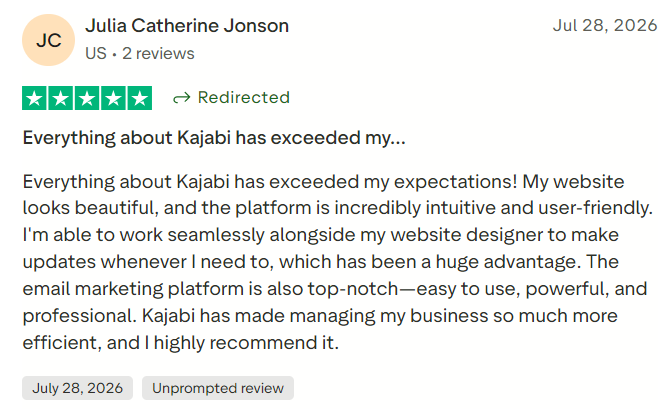
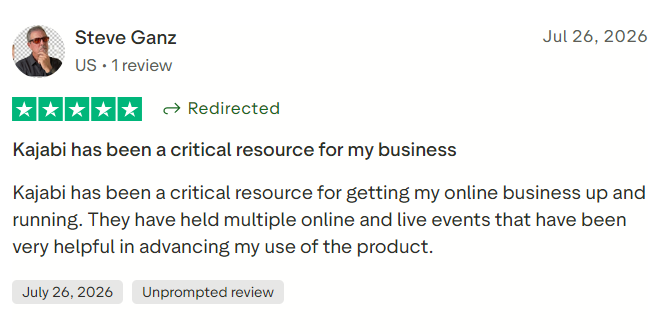
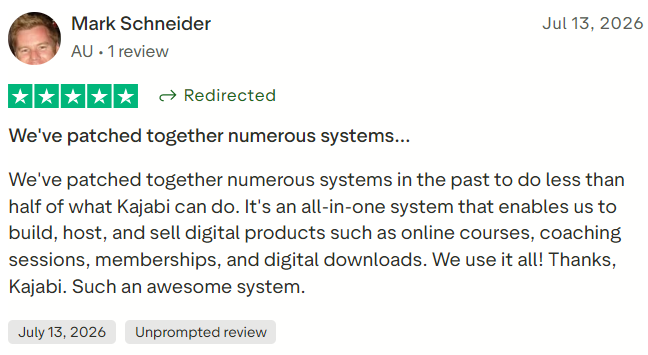
Kajabi receives generally positive but mixed customer feedback.
At the time of research, Kajabi on G2 held approximately 4.1 out of 5 from 93 reviews. Users commonly praised the convenience of managing their website, courses, email campaigns, and digital products in one system.
Capterra reviews present a similar picture. Positive reviewers value the professional customer experience and integrated business tools, while critical reviewers mention pricing, limited design flexibility, and inconsistent support.
Kajabi’s Trustpilot feedback is more polarized, with enthusiastic long-term customers alongside serious complaints about billing, account access, support, cancellation, and data retrieval. Prospective customers should read recent reviews from several sources rather than relying on one overall score.
#1.
#2.
#3.
Kajabi Alternatives
Thinkific
Thinkific is a course-focused platform with strong product and student-management features. It may suit educators who prioritize structured learning over integrated marketing.
Teachable
Teachable offers courses, coaching, downloads, and payment services. Its pricing may be more approachable, although transaction charges and plan limitations require careful comparison.
Podia
Podia combines websites, digital products, email, coaching, and communities in a straightforward interface. It is often more accessible for smaller creator businesses.
Systeme.io
Systeme.io provides funnels, email marketing, automation, courses, and affiliate tools. Its free and lower-cost plans make it attractive to beginners.
Hotmart
Hotmart has no standard monthly subscription and instead deducts fees when sales occur. It also provides a large affiliate ecosystem and strong international payment capabilities.
Mighty Networks
Mighty Networks is a strong alternative for community-led courses, memberships, and events. Its social and member-engagement tools are generally more central to the product experience.
Is Kajabi Worth It in 2026?
Kajabi can be worth the price for an established creator who would otherwise pay separately for course hosting, website software, email marketing, funnels, checkout tools, and communities.
Its value is less convincing for a beginner with a small audience or an unvalidated product. A monthly cost of $179 or more creates pressure to generate revenue quickly, and essential limits may eventually require an upgrade.
Before subscribing, creators should use the trial to build a real product, import contacts, test email delivery, configure payments, and examine the student experience. They should also calculate payment-processing costs and confirm that important data can be exported.
Limited Access – Join Now!
Final Verdict
Kajabi is one of the most complete platforms for running a knowledge-based online business. Its principal strength is the tight integration between products, websites, email marketing, automation, payments, and customer delivery.
Its largest weakness is cost. The platform is considerably more expensive than many course-building alternatives, and newer payment policies can add further charges in some circumstances.
Therefore, Kajabi is a strong option for established coaches, educators, and creators who want an integrated system and can justify the subscription through active sales. Beginners and price-sensitive sellers should validate their offer on a less expensive platform before committing to Kajabi.