


Selling your business quickly requires far more than just listing it for sale and hoping the right buyer appears. Speed in a business sale comes from strategy, not luck.
Owners who sell fast do so because they prepare their financials, select the right pricing strategy, understand buyer psychology, and work with a broker who knows how to move deals forward efficiently while maintaining strict confidentiality.
A quick sale does not need to mean selling at a discount.
In fact, when done correctly, a fast sale often draws multiple offers, which can increase your leverage and improve your final price. The real key to speed is eliminating the bottlenecks that typically slow down transactions: messy financials, unclear pricing, lack of documentation, limited buyers, emotional decision-making, and poor negotiation management.
If your goal is to sell your business quickly and maximize your net proceeds, this blueprint gives you the clarity, structure, and expert perspective you need.
How Fast Can You Sell Your Business?
Selling a business quickly is absolutely possible — but the timeline depends on how well-prepared the business is, how accurately it’s priced, and how effectively it’s marketed to qualified buyers. While many business sales take 6–12 months (or even longer without proper support), a well-prepared business working with an experienced broker can often sell in 30–120 days.
The question isn’t just how fast you can sell — it’s how fast you can sell without sacrificing value or confidentiality. Below are the major factors that influence this timeline.
Key Factors That Determine Speed
Financial Preparedness
Clean, well-organized financials dramatically accelerate buyer decisions. If your books are unclear or inconsistent, buyers slow down — or walk away.
Business Size and Complexity
- Smaller, Main Street businesses (restaurants, retail, services):
30–90 days with proper representation. - Mid-market companies (manufacturing, HVAC, medical, specialty services):
90–180+ days, depending on due diligence requirements.
Buyer Demand in Your Industry
Businesses in high-demand sectors (home services, e-commerce, healthcare, logistics) sell significantly faster than highly specialized or declining industries.
Pricing Strategy
Overpricing is the #1 reason businesses sit on the market for months. Well-priced listings generate buyer interest quickly and attract multiple offers.
Quality of Representation
A strong broker with a large buyer network can compress the timeline drastically by:
- Pre-screening qualified buyers
- Packaging the business properly
- Managing timelines
- Avoiding delays
- Maintaining momentum
Owner Responsiveness
Slow responses from sellers kill deals. Speed requires quick decision-making.
Typical Sale Timelines With vs. Without a Broker
| Sale Method | Typical Timeline |
| Hiring a business broker with strong buyer networks | 30–90 days |
| Trying to sell independently (FSBO) | 6–12+ months |
| Using generic listing sites | Very inconsistent; often 9–18 months |
| Selling to employees or internal buyers | 3–6 months |
A broker isn’t just a convenience — they create speed, structure, and discipline, all of which reduce delays and keep deals moving forward.
Understanding the Buyer Perspective
If you want to sell your business quickly, you must first understand how buyers think. A fast sale happens when buyers feel confident, informed, and protected — not pressured. The more predictable and low-risk your business appears, the faster serious buyers will step forward with strong offers.
From a broker’s viewpoint, speed comes from aligning your business with what buyers want to see. When your business checks their boxes, they move fast. When it doesn’t, they hesitate, negotiate harder, or walk away altogether.
1. Clean, Verifiable Financials
Nothing accelerates buyer confidence like:
- Accurate profit-and-loss statements
- Clean tax returns
- Clear add-backs
- Transparent cash flow
If the numbers are organized, the buyer’s decision cycle shortens dramatically.
2. Strong, Stable Cash Flow
Businesses with consistent revenue and predictable cash flow sell much faster. Buyers want reassurance that:
- Sales won’t collapse after closing
- Customers or clients will stay
- The revenue stream is reliable
Predictability = speed.
3. Low Owner Dependence
Buyers move much faster when the business doesn’t rely heavily on the current owner.
Indicators include:
- A team that can run daily operations
- Documented SOPs
- Manager-driven workflow
- Clear delegation
If the owner is too central to the business, buyers slow down due to perceived risk.
4. Clean Operational Structure
Buyers want to see:
- Solid employees
- Organized systems
- Reliable vendors
- Stable customers
Disorganized operations create doubt — and doubt kills speed.
5. Realistic Pricing
A business priced correctly attracts immediate interest.
A business priced emotionally sits for months.
Buyers move quickly when they know:
- The price aligns with industry multiples
- The valuation is justified
- The business has already been pre-vetted by a broker
6. Low-Risk Transition
Buyers commit faster when they feel confident about what happens after the sale:
- Training
- Onboarding
- Transition support
- Smooth handover
A strong transition plan can shorten your sales timeline by weeks.
Why Understanding Buyers Makes Your Sale Faster
When you understand exactly what buyers want, you can:
- Prepare your documents ahead of time
- Fix issues that slow deals
- Present the business properly
- Reduce negotiation friction
- Increase perceived value
In my experience as a business broker, this is a must. However, with a broker, you won’t have to worry about this aspect much. The broker will take care of this entire process.
What’s the Best Way to Sell a Business?
When speed is your priority, nothing accelerates a business sale more effectively than hiring a professional business broker. Selling independently may seem appealing, but it almost always results in slower timelines, fewer qualified buyers, confidentiality risks, and weaker negotiating power. Brokers exist for a reason — they shorten the timeline dramatically while increasing deal quality and protecting your business throughout the process.
A skilled broker guides you from preparation to closing, ensuring every step is handled strategically and efficiently. This is why industry data consistently shows that businesses represented by brokers sell faster, cleaner, and at higher valuations than those sold by owners on their own.
Below are a few reasons why hiring a broker is the fastest way to sell your business:
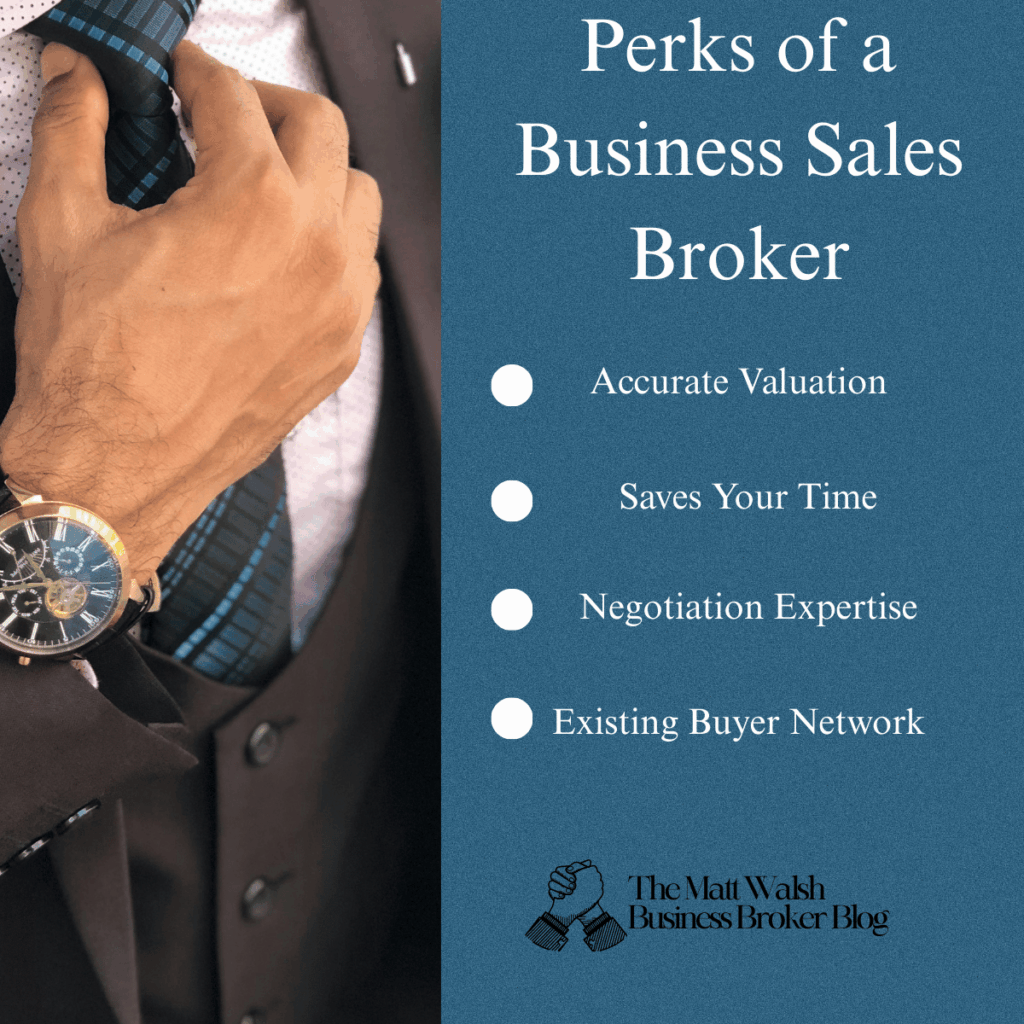
1. Brokers Price the Business Correctly
Overpricing delays your sale by months.
Underpricing leaves money on the table.
A broker performs:
- Market-based valuation
- Comparable sales analysis
- Cash-flow/EBITDA multiple assessment
- Confidential buyer feedback studies
Correct pricing = faster offers from serious buyers.
2. Brokers Already Have a Buyer Network
Instead of waiting for buyers to discover your listing, brokers bring buyers to the business immediately.
This includes:
- Private equity groups
- Individual investors
- Industry buyers
- High-net-worth individuals
- Pre-qualified SBA buyers
A large buyer pool compresses your sale timeline.
3. Brokers Package and Present the Business Professionally
Serious buyers expect polished, complete documentation:
- CIM (Confidential Information Memorandum)
- Financial add-back schedules
- Operational summaries
- Growth opportunities
- Transition plans
Brokers create these materials upfront, saving weeks of back-and-forth communication.
4. Brokers Maintain Strict Confidentiality
Selling too “publicly” can scare employees, customers, landlords, and competitors.
Brokers protect your identity using:
- Blind listings
- NDAs
- Buyer screening
- Controlled release of information
Confidentiality ensures a smooth and uninterrupted sale process.
5. Brokers Manage the Process from Start to Finish
To sell quickly, someone must control the timeline.
Brokers:
- Qualify buyers
- Organize data rooms
- Coordinate Q&A
- Schedule calls and meetings
- Manage due diligence
- Prevent delays
- Keep momentum going
A deal without structured management moves slowly or never closes.
6. Brokers Negotiate Offers Strategically
Fast sales require:
- Fast replies
- Strong framing of the business value
- Managing multiple offers
- Using competition to your advantage
Brokers understand deal psychology and know how to push buyers forward.
Finding the Right Business Broker to Sell Your Business Quickly
Choosing the right business broker is one of the most critical decisions you’ll make when speed is a priority.
Not all brokers are equal.
Good brokers have:
- Deep buyer networks
- Proven systems
- A polished process
And much more. Others rely on generic listings, slow communication, and inconsistent outreach which can drag out the process for months.
A broker is not just a salesperson; they are your strategist, deal manager, negotiator, marketer, and buffer between you and buyers.
The right broker will push buyers to take action quickly and help you sell your business fast. Below are the things you should look for in a business broker:
A Large, Active Buyer Database
Fast sales come from immediate buyer access, not waiting for new leads to trickle in.
Ask:
- How many buyers do you have in my industry?
- How often do you communicate with your buyer list?
- Can you match my business with buyers from day one?
A broker with the right buyers already lined up can cut months off the timeline.
Strong Track Record of Closed Deals
Experience matters.
You want a broker who:
- Closes businesses similar to yours
- Has experience in your sector
- Understands the valuation multiples
- Knows how fast deals typically move
Speed comes from knowing what to do — and what to avoid — at every stage.
Proven Marketing Systems
Fast sales require professional packaging and targeted outreach, not guesswork.
The right broker will have:
- High-quality CIMs
- Blind listings that protect confidentiality
- Paid + proprietary marketing channels
- Buyer pre-screening processes
- National and international reach
A well-marketed business attracts multiple buyers quickly.
Clear Communication and Responsiveness
Unresponsive brokers kill deals.
Ask:
- How quickly do you respond to buyers?
- Will I have a direct point of contact?
- How often will you update me?
Fast communication prevents buyer fatigue and keeps momentum strong.
Confidentiality Protocols
To sell quickly, confidentiality must be airtight — otherwise employees, customers, or competitors may react negatively.
The right broker uses:
- NDAs
- Blind ads
- Strict info release processes
- Screening questionnaires
- Identity protection
Speed means nothing if confidentiality isn’t protected.
SBA, Lending, and Deal-Structure Knowledge
Nearly 70% of deals slow down due to financing issues.
A strong broker will:
- Pre-qualify buyers
- Know lender requirements
- Understand SBA processes
- Recommend financing structures that close faster
- Prevent paperwork delays
This alone can reduce the timeline by several weeks.
Questions to Ask Before Hiring a Broker
- How many businesses did you sell in the last 12 months?
- What is your average time-to-close?
- Do you specialize in my industry?
- How do you market businesses confidentially?
- How large is your buyer pool?
- What’s your process for vetting buyers?
- How do you structure deals for speed?
- What are your fees?
These questions reveal whether a broker is structured, strategic, and capable of selling your business quickly.
Red Flags That Will Slow Down Your Sale
Avoid brokers who:
- Rely only on listing sites
- Cannot explain their marketing strategy
- Don’t pre-screen buyers
- Overpromise unrealistic valuations
- Are slow to respond
- Have minimal activity in your niche
- Don’t provide regular updates
Any of these issues will extend the timeline dramatically.
Understanding Your Motivations
Before you can sell your business quickly, you must be crystal clear about why you’re selling.
Knowing your motivations will help you plan better. A good business broker will first prioritize understanding your motivations.
Buyers want to understand why the owner is exiting, and when your motivations are clear, the sale moves faster and more smoothly.
Below are the reasons why your motivations matter when you to sell your business fast:
It Influences Your Pricing Strategy
Your reason for selling helps determine how aggressively you should price the business.
For example:
- If you’re relocating within 60 days, you may price slightly under market to attract rapid offers.
- If you’re planning a 6–12 month exit, you can price closer to the top of market.
Clear motivation = clear pricing decisions.
It Gives Buyers Confidence
Buyers move much faster when your motivation is:
- Logical
- Non-emotional
- Non-threatening to the stability of the business
Examples of “safe” motivations:
- Retirement
- Wanting to travel or enjoy life
- Burnout
- Moving to another city
- Starting a new business
- Health reasons (disclosed carefully)
- Wanting to spend more time with family
These tell buyers the business is stable — the owner just wants a change.
It Helps You Structure the Transition
Your motivation determines:
- How long you’re willing to train the buyer
- Whether you’ll stay after closing
- Whether you’re open to consulting
- The level of support you will provide
A strong transition offering speeds up buyer approval dramatically.
It Shapes Your Negotiation Posture
If selling quickly is a high priority, you may:
- Accept flexible terms
- Consider seller financing
- Respond faster to offers
- Be open to reasonable contingencies
Knowing your motivation keeps your emotions out of the negotiation process and helps deals close faster.
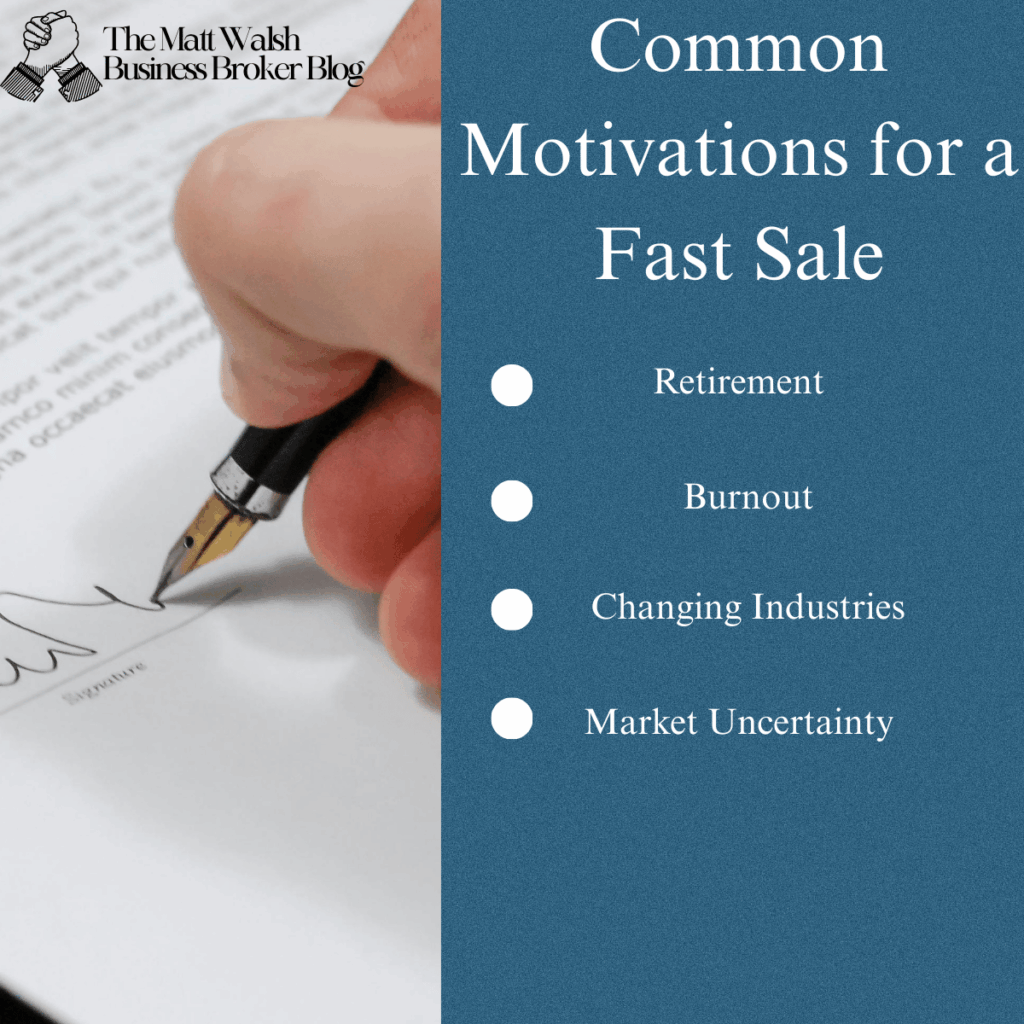
Common Motivations for a Fast Sale
- Retirement
- Burnout from running the business
- Health challenges
- Relocating
- Changing industries
- Wanting more time with family
- Starting a new venture
- Partner disputes
- Market uncertainty and wanting to exit early
There is no “bad” motivation as long as it is communicated clearly and framed correctly.
Creating a Transition Plan
A well-designed transition plan is a powerful tool for selling your business quickly. Buyers accelerate their decision-making when they feel confident the handover will be smooth, organized, and low-risk. The better your transition plan, the faster buyers move from interest to offer — and from offer to closing.
A transition plan isn’t just a courtesy; it’s a strategic asset that increases buyer trust, reduces perceived risk, and strengthens your negotiating position. In fast sales, this can shave weeks off the timeline.
I always recommend building a transition plan. It will help you:
- Reduce buyer anxiety
- Make your business more attractive
- Help buyers secure financing
All of this means selling your business fast would be easier. Preparing a transition plan is one of the many steps involved in selling a business.
Here’s what I would include in a fast-track transition plan:
- Training Period and Plan
- Employee Handover Plan
- Customer Continuity Strategy
- Systems & Process Documentation
- Post-Sale Assistance (Optional)
All of these ensure the transition takes place smoothly. The new owners would find it easier to run the business as well.
How Business Brokers Transition Plans to Speed Up Deals
Experienced brokers like me highlight your transition plan in:
- CIMs
- Buyer conversations
- Negotiation framing
- Lending packages
- Offer discussions
A strong transition plan can turn a hesitant buyer into a fast-closing buyer.
Pricing a Business to Sell Quickly – Valuation is Key
If there is one factor that most directly determines how fast your business sells, it’s pricing.
Pricing too high slows the sale down dramatically, while pricing accurately can trigger immediate buyer interest and multiple offers. The goal is not to give the business away; it’s to position it where buyers see undeniable value and act quickly.
You can get a professional valuation from USA’s best business brokers.
Why Pricing Matters More Than Anything Else
Overpricing Slows Down Every Step
When a business is priced above realistic market value:
- Fewer buyers inquire
- Serious buyers ignore it
- The listing grows stale
- Offers (if any) are aggressive and low
Accurate Pricing Creates Immediate Momentum
Businesses priced correctly generate:
- More inquiries
- Faster buyer engagement
- More showings
- Multiple simultaneous offers
- Competitive bidding
Buyers Compare Your Business to Others
Buyers are shopping across multiple listings.
A business priced realistically stands out instantly.
If your price is inflated, buyers assume:
- You’re emotional
- You’re unprepared
- You’re not serious
- Negotiations will be difficult
Marketing Your Business Confidentially
When selling your business quickly, marketing must be powerful, targeted, and completely confidential. Unlike selling real estate, where public exposure helps, business sales require a delicate balance: you want maximum buyer reach with zero leakage of sensitive information.
If employees, vendors, customers, or competitors find out prematurely, it can jeopardize the sale and slow everything down. That’s why confidential marketing is a core skill of professional business brokers — and one of the biggest reasons businesses sell faster under expert representation.
You can get in touch with USA’s top business sales brokers today.
They have successfully sold hundreds of businesses throughout the country.
A business broker’s ability to market a company confidentially and quickly is one of the biggest advantages of hiring an expert. The process begins with blind listings, where the business is advertised without revealing its name, address, photos, or any identifying details.
Only high-level financial and operational information is shared, ensuring that you stay protected while still attracting interested buyers.
From there, brokers require mandatory NDAs (Non-Disclosure Agreements) before releasing sensitive information. Every potential buyer must sign a legal NDA, provide proof of financial capability, and answer qualifying questions. This step filters out tire-kickers, competitors, and anyone who may pose a confidentiality risk.
Next, brokers conduct detailed buyer pre-screening to ensure that only serious and financially qualified buyers ever learn the business’s identity. Pre-screening typically involves liquidity verification, experience checks, background review, and funding readiness. By eliminating unqualified prospects early, brokers significantly speed up the path to closing.
Information is then shared through a controlled release process, where buyers move through structured stages. They begin with the blind listing, then proceed to the NDA and screening, followed by a confidential business summary, then the full CIM and financials, and finally a meeting with the seller. This staged approach keeps buyers engaged while minimizing risk.
Brokers also rely on proactive outreach to pre-qualified buyers rather than waiting for inquiries to come in. They actively contact individuals who have bought similar businesses, corporate acquisition teams, private equity groups, industry buyers, and SBA-ready investors. This targeted matchmaking dramatically accelerates the sales timeline.
To maximize reach, brokers use national and international channels, including private buyer databases, business-for-sale marketplaces, email campaigns, discreet social outreach, targeted industry lists, and referral networks. This broad yet confidential marketing strategy generates more inquiries, attracts qualified buyers faster, and ultimately leads to quicker, stronger offers.
Working with a Broker to Sell Your Business Quickly
Once your business is priced correctly and marketed confidentially, the next major factor that determines speed is how well the broker manages the process. Fast sales don’t happen by accident — they happen because a broker controls momentum from the first buyer inquiry to the closing table.
A skilled business broker acts as the “project manager” of the entire transaction. They coordinate buyers, lenders, attorneys, accountants, due diligence, and negotiations — ensuring nothing gets stuck, delayed, or overlooked. This level of coordination is what turns a long, drawn-out process into a streamlined, predictable timeline.
1. Brokers Pre-Screen Buyers to Save Time
A huge amount of time is wasted dealing with:
- Unqualified buyers
- Curious onlookers
- Competitors pretending to be buyers
- People with no funding
A broker eliminates this instantly.
They only introduce you to:
- Financially capable buyers
- Motivated individuals
- Industry-experienced investors
- People pre-approved for SBA financing
Fewer, higher-quality buyers = faster closing.
2. Brokers Prepare a Professional Deal Package
Before buyers ever meet you, brokers create:
- A Confidential Information Memorandum (CIM)
- Add-back schedules
- Operational summaries
- Growth opportunities
- Market-position analysis
This packaging answers 90% of buyer questions upfront — shortening the sales cycle.
3. Brokers Manage Buyer Communication
Fast sales require:
- Quick responses
- Precise answers
- Organized document flow
A broker handles all inquiries, ensuring no buyer loses interest due to slow communication.
4. Brokers Host Buyer-Seller Meetings
Once a buyer is vetted, the broker:
- Schedules introductory calls
- Prepares discussion agendas
- Frames the conversation
- Ensures confidentiality is maintained
- Manages expectations on both sides
These structured interactions greatly shorten deal timelines.
5. Brokers Control Momentum
Deals fall apart when momentum dies.
A professional broker:
- Pushes buyers to move quickly
- Sets deadlines
- Follows up consistently
- Prevents emotional reactions
- Keeps the deal moving forward
Momentum = speed.
6. Brokers Coordinate Due Diligence
Due diligence can either take:
- 2–4 weeks with proper preparation, or
- 2–4 months without it.
A broker sets up:
- A clean data room
- Organized financials
- Clear documentation
- Buyer access requests
- Responses from accountants and attorneys
This eliminates delays that commonly frustrate buyers.
7. Brokers Reduce Deal Fallout
DIY sellers often unintentionally:
- Reveal too much
- Miscommunicate
- Overpromise
- React emotionally
- Scare buyers away
Brokers prevent these issues — protecting the sale and accelerating results.
How an Expert Broker Negotiates Offers to Sell Your Business Fast
Negotiation is the stage where deals either accelerate toward closing or drag on for months. An experienced business broker understands how to position your business, frame your value, handle buyer psychology, and move discussions forward quickly — all while protecting your price and terms. Fast sales rely on structured, strategic negotiation, not rushed decision-making.
Brokers don’t just “relay offers.” They actively shape the negotiation landscape so that buyers move faster, stay engaged, and feel confident enough to close quickly.
A seasoned broker will streamline negotiations by:
- Setting deadlines
- Getting commitments from buyers
- Managing attorney communication
- Clarifying unclear terms immediately
- Confirming financing early
- Keeping everyone aligned on closing steps
This level of control is what turns multi-month negotiations into 2–4 week negotiation cycles.
Financing: The Underlooked Reason Behind How a Business Sells Quickly
If there is one factor that silently determines whether a business sells in 30 days or 12 months, it’s financing. Most sellers focus on price, marketing, and negotiation, but seasoned business brokers know the truth: deals move at the speed of financing.
When buyers can secure funding quickly — or when the deal is structured to eliminate unnecessary financing delays — everything else falls into place. When financing is unclear, slow, or poorly prepared, deals drag on, buyers hesitate, and timelines break down.
This section reveals why financing is often the real reason a business sells fast — or doesn’t.
1. Buyers Rarely Have 100% Cash
Most buyers need:
- SBA loans
- Bank financing
- Investor capital
- Seller financing
- A combination of the above
If the financing path isn’t clear, buyers slow down or walk away.
2. Lenders Work at Their Own Pace
Banks and SBA lenders require:
- Clean financials
- Tax returns
- Bank statements
- Debt schedules
- Leases
- Legal documents
- Projections
Missing or messy documents add weeks to the timeline.
3. Clean Books = Fast Financing Approval
Lenders say the #1 delay in business acquisitions is poor financial documentation, including:
- Mixed personal/business expenses
- Incorrect add-backs
- Inconsistent P&Ls
- Lack of bookkeeping clarity
When your books are organized, lenders approve faster — buyers close faster.
The Role of Seller Financing in Selling Quickly
1. Seller Financing Widens the Buyer Pool
Offering 10–30% seller financing helps:
- Buyers qualify
- Lenders approve loans
- Buyers feel more confident
- Deals close faster
It also shows buyers you believe in the business — increasing trust.
2. Seller Financing Gives You Leverage
When you offer seller financing, you can:
- Command a higher overall price
- Attract multiple offers
- Move deals forward faster
- Create competitive tension among buyers
This is one of the most powerful tools for speed.
Conclusion: The Fastest Way to Sell Your Business
Selling your business quickly is absolutely achievable — but it requires structure, preparation, and the right expertise guiding the process. Speed doesn’t come from rushing; it comes from eliminating friction, reducing buyer risk, and presenting your business so clearly and professionally that buyers feel confident moving forward without hesitation.
A fast sale is the result of:
- Realistic, data-backed pricing
- Strong financial preparation
- Understanding buyer psychology
- A strategic transition plan
- Confidential, targeted marketing
- Expertly managed negotiations
- Efficient deal structure and financing
- A skilled business broker driving the process
When these elements work together, your sale timeline shrinks from months to weeks — without sacrificing value. In fact, structured, fast-moving deals often attract multiple high-quality buyers, giving you leverage and potentially increasing your final sale price.
Consult an expert today and get a free valuation for your business. You can ask any questions that arise and sell your business fast.