


Finding a buyer for your business is one of the most important parts of the exit process. A good buyer can protect your employees, preserve the company’s reputation, complete the transaction efficiently, and pay a fair price. A weak or unqualified buyer can waste months of your time, expose confidential information, renegotiate aggressively, or fail to close.
The best way to find a buyer for your business is to prepare the company properly, understand the likely buyer pool, protect confidentiality, create professional marketing materials, qualify buyers carefully, and run a structured sale process.
This guide explains how to find a buyer for your business, where to look, what buyers want, and how to increase your chances of closing successfully.
Quick Answer
To find a buyer for your business, start by preparing clean financial records, identifying your ideal buyer type, creating confidential marketing materials, reaching out to qualified buyers, screening interested parties, signing NDAs before sharing sensitive details, comparing offers, and negotiating with buyers who have both the financial ability and strategic motivation to close.
Looking to Sell Your Business?
Maximize your business sale by consulting USA’s top business brokers. More buyers. Bigger profits.
Key Takeaways
- The best buyer is not always the highest initial bidder.
- Qualified buyers should have financial capability, acquisition intent, industry fit, and closing credibility.
- Confidentiality is critical before sharing sensitive financial, customer, employee, or operational information.
- Strategic buyers, private equity firms, competitors, search funds, employees, and individual entrepreneurs may all be potential buyers.
- Businesses with clean books, recurring revenue, strong systems, and low owner dependence are easier to sell.
- A business broker or M&A advisor can help find qualified buyers and manage a confidential sale process.
What Makes a Good Business Buyer?
A good buyer is not just someone who expresses interest. A good buyer has the ability, motivation, and credibility to complete the deal.
Strong buyers usually have:
- Financial capacity
- Clear acquisition goals
- Relevant industry or operating experience
- Access to funding
- Serious intent
- Reasonable expectations
- Ability to complete due diligence
- Respect for confidentiality
- Fit with your employees, customers, and long-term goals
A buyer who offers a high price but cannot secure financing may be less valuable than a buyer with a slightly lower offer and a much stronger chance of closing.
Step 1: Understand Who Might Buy Your Business
Before looking for buyers, identify which buyer groups are most likely to be interested in your company.
Strategic Buyers
Strategic buyers are companies already operating in your industry or a related industry.
They may want to acquire your business to:
- Enter a new market
- Add customers
- Expand service lines
- Acquire employees
- Increase market share
- Remove competition
- Add equipment, licenses, or capabilities
Strategic buyers may pay strong valuations if your business offers something valuable to their existing operation.
Examples include competitors, suppliers, vendors, distributors, regional operators, or larger companies in your sector.
Private Equity Firms
Private equity firms invest in businesses with growth potential. They often look for companies with strong earnings, stable cash flow, management teams, and opportunities to scale.
Private equity buyers may be interested if your business has:
- Strong EBITDA
- Recurring revenue
- Growth potential
- Management depth
- Defensible market position
- Opportunity for add-on acquisitions
Private equity firms may buy your company as a platform investment or as an add-on to one of their existing portfolio companies.
Search Funds
Search funds are investment-backed buyers who look for established small and lower middle-market businesses to acquire and operate.
They often prefer companies with:
- Stable cash flow
- Low customer concentration
- Recurring revenue
- Simple operations
- Long-term demand
- Owner retirement or succession opportunity
Search fund buyers can be a strong fit for owners who want a buyer willing to operate the business personally.
Individual Entrepreneurs
Individual buyers may include former executives, operators, investors, or entrepreneurs looking to acquire and run a business.
They often use a combination of personal capital, SBA financing, seller financing, or investor backing.
Individual buyers can be a good fit for smaller businesses, owner-operated companies, franchises, service businesses, and local companies.
Competitors
Competitors may be interested because they already understand the industry and customer base.
However, selling to a competitor requires extra confidentiality controls because they may have access to sensitive information during due diligence.
Use staged information sharing and strong NDAs before revealing customer lists, pricing, margins, or employee details.
Employees or Management Team
Some businesses are sold to existing managers or employees through a management buyout.
This can work well when the team understands the business and can continue operations smoothly.
However, management buyers may need financing support, seller financing, or a structured payment plan.
Family Members
In some cases, a business may be sold or transferred to family members.
This can support continuity, but it still requires proper valuation, legal documentation, financing structure, and tax planning.
Ready to Sell Your Business?
Take the first step towards a successful business exit
Step 2: Prepare Your Business Before Approaching Buyers
Buyers become more serious when the business looks organized, transferable, and financially clear.
Before going to market, prepare:
- Profit and loss statements
- Tax returns
- Balance sheets
- Payroll records
- Customer concentration data
- Revenue by product or service
- Employee information
- Vendor contracts
- Lease documents
- Equipment lists
- Licenses and permits
- Standard operating procedures
- Add-back documentation
The cleaner your documentation, the easier it is for buyers to trust the numbers.
Step 3: Know What Buyers Are Looking For
Most buyers evaluate both profit and risk.
They want to know whether the business can continue performing after the owner exits.
Clean Financials
Buyers want accurate, organized financial statements. Messy books create doubt and often lead to lower offers.
Stable or Growing Revenue
A business with stable or growing revenue is easier to sell than one with declining sales.
Strong Cash Flow
Profitability matters. Buyers usually focus on EBITDA, seller discretionary earnings, or cash flow.
Recurring Revenue
Recurring revenue makes future income more predictable.
Examples include:
- Contracts
- Subscriptions
- Maintenance plans
- Retainers
- Repeat commercial accounts
- Memberships
Low Owner Dependence
If the owner is the main salesperson, operator, technician, manager, and customer contact, buyers may see the company as risky.
Customer Diversification
A business that depends heavily on one or two customers may receive lower offers.
Strong Employees
A trained and stable team makes the business easier to transfer.
Clear Growth Opportunities
Buyers like companies with realistic growth paths, such as new markets, new services, better marketing, additional locations, or operational improvements.
Step 4: Create Confidential Marketing Materials

You should not immediately reveal your company name and sensitive details to every potential buyer.
A professional sale process usually starts with confidential marketing materials.
Blind Teaser
A blind teaser is a short anonymous summary of the business.
It may include:
- Industry
- General location
- Revenue range
- Profit range
- Growth highlights
- Buyer opportunity
- Reason for sale
It should not reveal the company name, exact address, customer names, employee names, or sensitive details.
Confidential Information Memorandum
A confidential information memorandum, or CIM, is a detailed document shared only after a buyer is qualified and signs an NDA.
It may include:
- Company overview
- Financial performance
- Products or services
- Customer base
- Employees
- Operations
- Growth opportunities
- Market positioning
- Reason for sale
- Transition plan
A strong CIM helps buyers understand the opportunity and submit informed offers.
Step 5: Find Buyers Through Multiple Channels
The best buyer may come from several possible sources.
Business Brokers and M&A Advisors
A business broker or M&A advisor can help identify buyers, protect confidentiality, screen inquiries, prepare marketing materials, and negotiate terms.
For smaller businesses, a business broker may be appropriate.
For larger companies, an M&A advisor may be better because the buyer pool may include private equity, strategic acquirers, family offices, and corporate buyers.
Direct Outreach to Strategic Buyers
You can identify companies that may benefit from acquiring your business.
Potential strategic buyers include:
- Competitors
- Suppliers
- Customers
- Distributors
- Larger companies in your industry
- Companies expanding into your region
- Companies adding your service line
Direct outreach can be effective, but it should be handled carefully to protect confidentiality.
Private Equity and Portfolio Companies
Private equity firms may be interested if your company has strong earnings, scalable operations, and growth potential.
You can target:
- Private equity firms active in your industry
- Portfolio companies making add-on acquisitions
- Industry-focused investment groups
- Independent sponsors
Search Funds
Search funds are often active buyers of stable small and lower middle-market companies.
They may be especially interested in businesses with recurring revenue, simple operations, and strong cash flow.
Online Business Marketplaces
Marketplaces can help generate buyer inquiries, especially for smaller businesses.
Examples of marketplace-style channels include:
- Business-for-sale websites
- Franchise resale platforms
- Industry-specific marketplaces
- Online business marketplaces
- Local business listing platforms
However, marketplaces can attract many unqualified buyers, so screening is essential.
Industry Networks
Your industry network may include potential buyers.
These may include:
- Trade association contacts
- Vendors
- Suppliers
- Industry consultants
- Former employees
- Regional operators
- Franchise groups
Be careful when using personal networks because confidentiality can be harder to control.
Existing Employees or Managers
If you have a strong management team, they may be interested in buying the business.
This can create a smoother transition, but financing may be a challenge.
Customers or Vendors
Sometimes a major customer or vendor may want to acquire the business to secure supply, expand services, or vertically integrate.
This can work well, but confidentiality and relationship risk should be managed carefully.
Step 6: Qualify Buyers Before Sharing Sensitive Information
Not every interested person is a real buyer.
Before sharing confidential details, ask questions such as:
- Have you acquired a business before?
- How do you plan to finance the purchase?
- Do you have proof of funds or lender support?
- What size business are you looking for?
- Why are you interested in this industry?
- What is your timeline?
- Will you sign an NDA?
- Do you understand the expected valuation range?
- Are you looking to operate the business or invest passively?
Buyer qualification saves time and protects your business.
Step 7: Use NDAs and Controlled Information Sharing
An NDA is important, but it is not enough by itself.
You should still control what information is released and when.
Early Stage
Share only basic information:
- General business overview
- High-level financials
- Industry
- Broad location
- Growth highlights
After NDA and Screening
Share more detailed information:
- Financial statements
- Operational overview
- Customer mix
- Employee structure
- Vendor relationships
- Growth opportunities
Later Due Diligence
Share sensitive information only with serious buyers:
- Customer names
- Employee details
- Detailed contracts
- Tax records
- Pricing models
- Supplier terms
- Legal documents
For competitors, be especially careful. Consider redacting sensitive information until later stages.
Step 8: Compare Buyers Beyond Price
The highest offer is not always the best offer.
Compare buyers based on:
- Purchase price
- Cash at closing
- Financing certainty
- Seller financing requirements
- Earnout terms
- Closing timeline
- Due diligence demands
- Employee plans
- Cultural fit
- Transition expectations
- Legal and tax implications
- Probability of closing
A lower offer with better certainty may be more attractive than a higher offer with risky financing or aggressive contingencies.
Step 9: Negotiate a Letter of Intent
A letter of intent, or LOI, outlines the basic deal terms before final due diligence and legal documentation.
An LOI may include:
- Purchase price
- Deal structure
- Assets or equity being purchased
- Earnout terms
- Seller financing
- Working capital requirements
- Due diligence timeline
- Exclusivity period
- Transition support
- Closing conditions
Be careful with exclusivity. Once you sign exclusivity, you may have to stop talking to other buyers while that buyer completes due diligence.
Step 10: Prepare for Due Diligence
Once a buyer submits an LOI, they will usually conduct due diligence.
They may review:
- Tax returns
- Financial statements
- Bank statements
- Customer contracts
- Vendor agreements
- Employee records
- Leases
- Licenses
- Insurance policies
- Equipment
- Inventory
- Legal issues
- Debt
- Compliance documents
- Operational systems
If your documents are organized, the process is smoother and less likely to result in price reductions.
Where to Find Buyers for Different Types of Businesses
Service Businesses
Potential buyers include local operators, competitors, private equity-backed platforms, search funds, and individual entrepreneurs.
Strong buyer interest often exists for HVAC, plumbing, roofing, landscaping, pest control, cleaning, and commercial maintenance businesses.
Manufacturing Businesses
Potential buyers include strategic acquirers, private equity firms, industrial groups, competitors, suppliers, and search funds.
Buyers often evaluate equipment, skilled labor, customer concentration, margins, and operational systems.
Healthcare Companies
Potential buyers include strategic healthcare operators, private equity-backed platforms, regional competitors, medical groups, and healthcare entrepreneurs.
Buyers focus heavily on compliance, payer mix, licenses, referral sources, and clinical staff.
Ecommerce and Online Businesses
Potential buyers include digital investors, aggregators, private buyers, marketplaces, and operators.
Buyers evaluate traffic sources, margins, supplier risk, customer acquisition cost, repeat purchase rate, and platform dependence.
Restaurants and Hospitality Businesses
Potential buyers may include local operators, restaurant groups, franchise buyers, hospitality investors, and entrepreneurs.
Location, lease terms, staff, margins, brand reputation, and local demand matter heavily.
Common Mistakes When Looking for Buyers
Sharing Too Much Too Early
Do not reveal sensitive information before qualifying the buyer and getting an NDA.
Talking Only to One Buyer
Unless the buyer is exceptionally strong, speaking with only one buyer may reduce leverage.
Overvaluing the Business
Unrealistic pricing can scare away serious buyers and attract only low-quality inquiries.
Ignoring Financing Risk
A buyer may love the business but still fail to obtain financing.
Failing to Prepare Financials
Messy financials create doubt and often lead to retrading.
Selling to a Competitor Without Safeguards
Competitors may be real buyers, but they also pose confidentiality risks.
Not Understanding Deal Structure
An offer with seller financing, earnouts, or contingencies may be less attractive than it appears.
Should You Use a Business Broker to Find a Buyer?
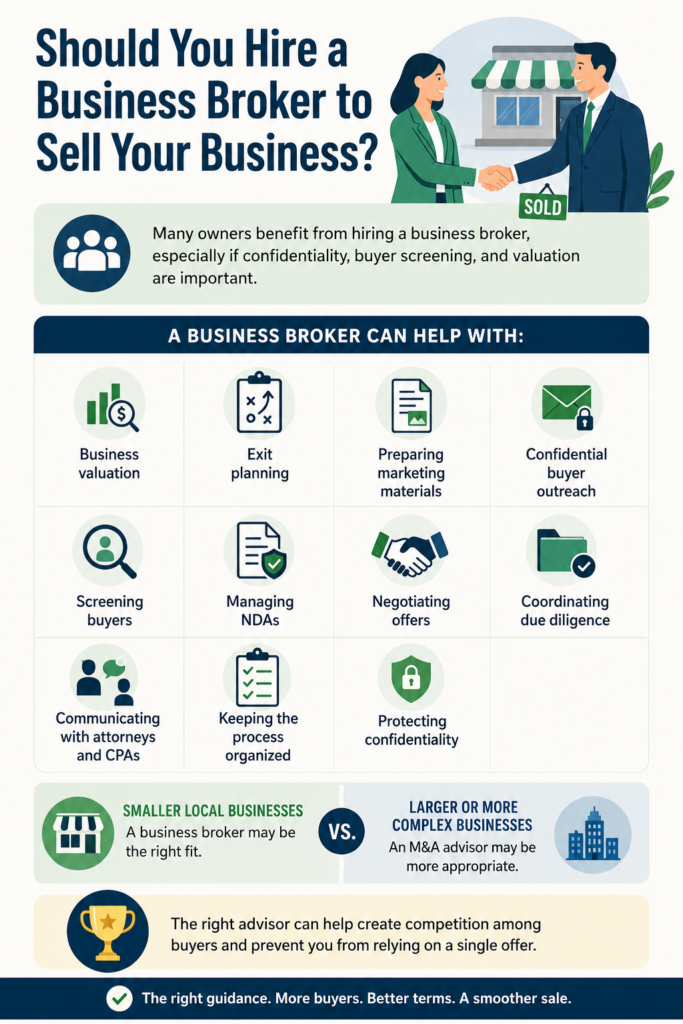
You can find a buyer yourself, but many owners use a business broker or M&A advisor because the process can be time-consuming and sensitive.
A broker or advisor may help with:
- Business valuation
- Buyer research
- Confidential marketing
- Outreach to strategic buyers
- Screening buyer inquiries
- NDA management
- Offer comparison
- Negotiation support
- Due diligence coordination
- Closing process support
For many owners, the main benefit is not just finding buyers. It is finding qualified buyers while protecting confidentiality and maintaining leverage.
How Long Does It Take to Find a Buyer?
Many business sales take 6 to 12 months from preparation to closing.
The timeline depends on:
- Business size
- Industry
- Profitability
- Asking price
- Buyer demand
- Financing requirements
- Quality of records
- Deal complexity
- Seller flexibility
Some businesses find serious buyers quickly. Others take longer, especially if the price is too high, financials are unclear, or the buyer pool is narrow.
FAQs About Finding a Buyer for Your Business
How do I find someone to buy my business?
You can find buyers through business brokers, M&A advisors, strategic buyer outreach, private equity firms, search funds, online marketplaces, competitors, employees, vendors, customers, and industry networks.
How do I know if a buyer is serious?
A serious buyer can explain their acquisition goals, financing plan, timeline, experience, and decision-making process. They should also be willing to sign an NDA and provide proof of funds or lender support when appropriate.
Should I sell my business to a competitor?
You can sell to a competitor, but you should protect confidentiality carefully. Use an NDA, staged information sharing, and avoid releasing sensitive customer, pricing, or employee information too early.
Can I find a buyer without a broker?
Yes, but it can be difficult to manage confidentiality, buyer screening, negotiations, and due diligence alone. A broker or M&A advisor can help run a more structured process.
What type of buyer pays the most?
Strategic buyers sometimes pay more because they may benefit from synergies, customer expansion, or market share. However, the best buyer depends on deal terms, certainty of closing, and overall fit.
What documents do buyers want to see?
Buyers commonly request tax returns, profit and loss statements, balance sheets, payroll records, customer data, vendor contracts, leases, licenses, equipment lists, inventory records, and operational documents.
How many buyers should I talk to?
It depends on your goals and confidentiality concerns. In many cases, speaking with multiple qualified buyers can create leverage and improve deal terms.
What should I avoid when looking for a buyer?
Avoid sharing confidential information too early, relying on unqualified buyers, overpricing the business, neglecting financial preparation, and signing exclusivity without understanding the risks.
Final Thoughts
Finding a buyer for your business is not just about generating interest. It is about finding the right buyer: someone who understands the business, has the financial ability to close, respects confidentiality, and offers acceptable terms.
The strongest sale processes usually start before buyers are contacted. Clean financials, clear documentation, low owner dependence, recurring revenue, and a strong growth story can make the business much more attractive.
Whether you use a business broker, M&A advisor, direct outreach, or industry contacts, the goal is the same: protect the business, qualify buyers carefully, compare offers intelligently, and choose the buyer most likely to close on favorable terms.