

IXL is one of the most widely used online learning platforms for mathematics, language arts, science, social studies, and Spanish.
It offers thousands of interactive skills from pre-K through Grade 12, along with short lessons, videos, personalized recommendations, diagnostic assessments, progress reports, and immediate feedback. Students can work above or below their nominal grade level, making IXL particularly attractive to homeschool families with uneven skills or learning gaps.
As a homeschooling dad, I can see why parents are drawn to it.
IXL makes it easy to find focused practice on almost any academic skill. If my child is struggling with fractions, punctuation, reading comprehension, geography, or Spanish vocabulary, I can locate a relevant exercise within minutes.
The diagnostic tools are also unusually helpful. Instead of assuming that a fifth grader is working at a fifth-grade level in every area, IXL can identify that the same child is ahead in multiplication but behind in fractions, or strong in grammar but weak in reading analysis.
However, IXL is also one of the more controversial educational platforms.
Its SmartScore system can frustrate children because progress becomes harder near mastery and incorrect answers can reduce the score noticeably. Public reviews repeatedly complain that the system feels punishing, repetitive, and stressful, especially when students are required to reach a score of 100.
My overall conclusion is:
IXL is an excellent diagnostic, practice, and skill-reinforcement platform for homeschoolers. It is especially strong in math and language arts, but I would not use it as the sole foundation of a child’s education. It works best alongside direct teaching, physical books, writing, experiments, discussion, and a broader homeschool curriculum.
IXL Review: Quick Verdict
| Category | My assessment |
| Best for | Diagnostic testing, skill practice, review, and closing learning gaps |
| Grade coverage | Pre-K through Grade 12 |
| Subjects | Math, language arts, science, social studies, and Spanish |
| Main format | Interactive questions, lessons, videos, recommendations, and analytics |
| Religious approach | Secular |
| Accreditation | Not an accredited homeschool or school |
| Parent involvement | Low during practice, moderate when selecting and monitoring skills |
| Pricing | Starts at $9.95 monthly or $79 annually for one subject and one child |
| Main strength | Huge skill library with personalized diagnostics |
| Main weakness | SmartScore can create frustration and anxiety |
| Overall rating | 4.2/5 |
IXL is particularly useful for:
- Homeschoolers needing extra math or language-arts practice
- Parents trying to identify skill gaps
- Students working across several grade levels
- Families wanting immediate grading
- Children preparing for standardized tests
- Parents who need detailed progress reports
- Students who benefit from short, focused exercises
- Families looking for independent practice between parent-led lessons
It may be less suitable for:
- Parents wanting a complete accredited school
- Students who become anxious about scores
- Children who need live instruction
- Families seeking literature-based learning
- Parents wanting extensive essay feedback
- Students who need hands-on or project-based work
- Children who strongly dislike repetitive exercises
- Families wanting an integrated Christian worldview
What Is IXL?
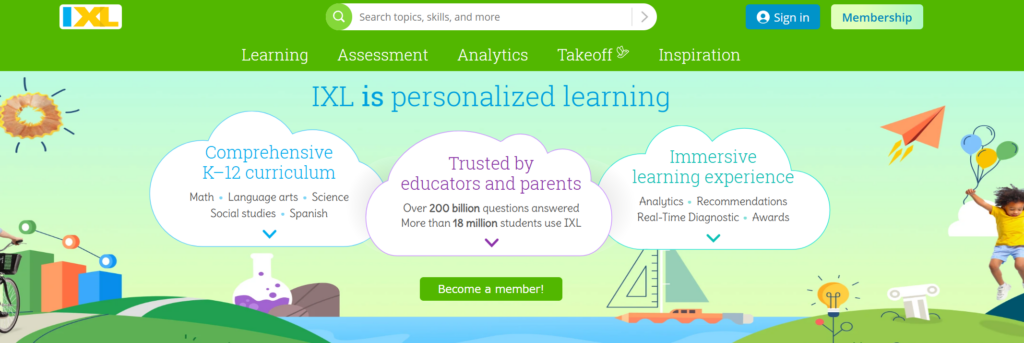
IXL is an online personalized-learning platform used by families, teachers, schools, and districts.
The U.S. version covers five main subject areas:
- Mathematics
- English language arts
- Science
- Social studies
- Spanish
Its curriculum extends from pre-K through Grade 12, with advanced mathematics continuing into subjects such as calculus and physics-related material appearing in the science offerings.
IXL is organized into individual skills rather than conventional courses with a fixed daily schedule.
For example, a student might choose a math skill involving:
- Multiplication facts
- Equivalent fractions
- Linear equations
- Geometry
- Probability
- Trigonometry
A language-arts student might practice:
- Phonics
- Vocabulary
- Grammar
- Punctuation
- Reading comprehension
- Writing strategies
- Literary analysis
IXL’s sixth-grade language-arts page, for instance, includes hundreds of skills covering reading strategies, writing, vocabulary, grammar, and mechanics. Its eighth-grade math program lists hundreds of skills, lessons, and videos.
The child answers questions, receives immediate feedback, and progresses through IXL’s SmartScore system.
When the student answers incorrectly, IXL usually provides an explanation before offering further practice.
Is IXL a Complete Homeschool Curriculum?
IXL markets itself as offering a comprehensive K–12 curriculum, and the skill library is certainly broad.
However, I would distinguish between a comprehensive skills platform and a complete homeschool education.
IXL provides:
- Skill instruction
- Practice
- Review
- Diagnostic assessment
- Short videos
- Immediate feedback
- Progress data
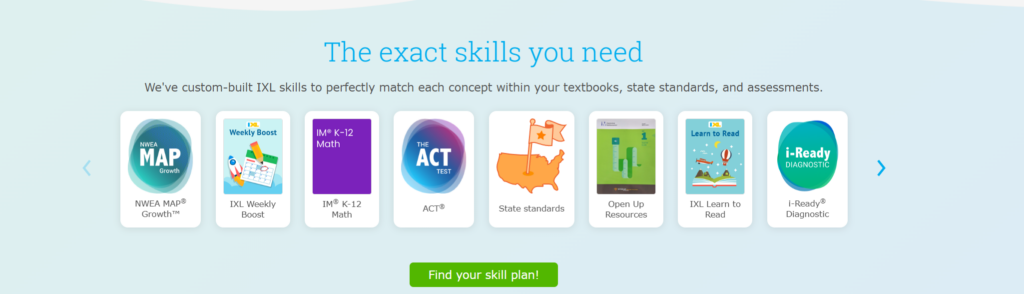
- Standards-aligned skill plans
It does not automatically provide the full experience many parents expect from a complete curriculum, such as:
- A yearlong daily lesson plan
- A coherent collection of complete novels
- Sustained essay instruction and personal feedback
- Hands-on science laboratories
- Art and music
- Physical education
- Parent-led discussion
- Long-term research projects
- Institutional grades, credits, or diplomas
Several homeschool reviewers reach a similar conclusion: IXL is highly useful as a supplement, but they would not rely on it as their only curriculum.
A determined parent could organize IXL skills into a full math or language-arts sequence. The platform provides skill plans aligned with state standards, textbooks, and test preparation.
But the parent still needs to create the wider educational experience.
My Impression as a Homeschooling Dad
IXL’s strongest feature is precision.
Traditional curricula often make a child complete an entire chapter even when only one part of the subject is weak.
IXL allows me to target the exact problem.
Suppose my child understands most fifth-grade math but struggles with:
- Dividing fractions
- Converting units
- Decimal place value
I do not need to buy another complete fifth-grade textbook.
I can assign those exact skills and monitor the results.
That makes IXL especially useful for:
- Summer review
- Remediation
- Test preparation
- Filling gaps after changing curricula
- Keeping one child occupied while teaching a sibling
- Reinforcing a lesson taught elsewhere
One homeschool parent described using IXL for targeted review, busy seasons, summer practice, and independent work while teaching another child. She found the diagnostic useful for revealing that one child could be working at very different grade levels across individual skills.
That reflects one of homeschooling’s greatest advantages: a child does not have to be placed at one artificial grade level across every subject.
The problem begins when IXL turns from a tool into the child’s master.
I would not require a student to continue working until every skill reaches a SmartScore of 100.
The objective is understanding—not defeating an algorithm.
How the IXL Diagnostic Works
IXL’s diagnostic system assesses a child’s current proficiency in mathematics and English language arts.
It identifies the student’s working level in different strands and generates personalized skill recommendations.
Diagnostic levels are expressed numerically.
For example:
- 400 represents readiness to begin fourth-grade skills.
- 450 represents performance around the middle of fourth grade.
The diagnostic initially takes approximately 45 minutes to one hour per subject, although it can be completed across several sessions. Afterward, IXL recommends answering roughly 10 to 15 diagnostic questions each week so the results remain current.
Why the Diagnostic Is Useful
The diagnostic can help a parent determine:
- Which grade-level skills the child has mastered
- Where major gaps exist
- Whether a curriculum is too easy or difficult
- Which skills should be assigned next
- Whether the student is improving over time
It can also prevent a parent from making assumptions based only on age.
A student might have:
- Sixth-grade vocabulary
- Fourth-grade reading comprehension
- Fifth-grade grammar
- Seventh-grade computation
That information can be more useful than a single overall grade label.
Limitations of the Diagnostic
A diagnostic score should not be treated as a medical diagnosis or perfect measurement of intelligence.
Performance can be affected by:
- Fatigue
- Anxiety
- Careless clicking
- Weak keyboard skills
- Unfamiliar question wording
- Lack of motivation
- Guessing
- Attention difficulties
Parents should combine diagnostic data with:
- Observation
- Written work
- Conversation
- Reading aloud
- Curriculum tests
- Real-life performance
The diagnostic is valuable evidence. It is not the final authority on the child.
The IXL SmartScore System
Every practiced skill has a SmartScore from 0 to 100.
The score is intended to represent the student’s current proficiency rather than simply the percentage of answers correct.
Progress is non-linear.
A student can gain points relatively quickly at lower levels. As the score approaches mastery, advancement becomes slower and an incorrect answer may cause a more noticeable decline.
This is the most controversial part of IXL.
Why Parents May Like SmartScore
SmartScore discourages students from reaching “mastery” after answering only a few easy questions.
The system attempts to ensure that a child can handle:
- More difficult questions
- Different question formats
- Repeated application
- Increasing complexity
A child who reaches a high score has usually demonstrated the skill more than once.
Why Children May Hate SmartScore
Public reviews repeatedly describe children becoming angry or discouraged because one wrong answer near the end can undo several correct responses. Reviewers also complain that reaching 100 can feel repetitive and excessively time-consuming.
The emotional problem is obvious.
A child may interpret a falling score as:
- “I am getting worse.”
- “My work was wasted.”
- “Mistakes are punished.”
- “I am bad at this subject.”
That is not the lesson we want children to learn.
Mistakes are part of learning.
How I Would Use SmartScore
I would set reasonable goals instead of automatically demanding 100.
A practical approach might be:
| SmartScore | How I would interpret it |
| 70–79 | Developing understanding |
| 80–89 | Solid proficiency |
| 90–95 | Strong mastery |
| 100 | Optional challenge, not always necessary |
The correct target depends on:
- The importance of the skill
- The child’s age
- Whether it is new or review
- The student’s emotional response
- Whether mastery is demonstrated elsewhere
For a foundational skill such as multiplication facts, I might want very high fluency.
For a difficult advanced skill, a score around 85 followed by later review may be more productive than forcing the child through an exhausting session.
IXL Math Review
Math is probably IXL’s strongest subject.
It covers an enormous range of skills from preschool counting through calculus.
The program is particularly effective for:
- Arithmetic practice
- Fractions
- Decimals
- Measurement
- Geometry
- Algebra
- Statistics
- Probability
- Test preparation
IXL Math Strengths
Precise Skill Breakdown
Complex topics are divided into narrow, manageable skills.
A child struggling with algebra does not simply receive an “algebra” assignment. The parent can identify whether the problem involves:
- Combining like terms
- Solving equations
- Graphing
- Exponents
- Factoring
Immediate Explanations
When a student misses a problem, IXL generally shows the correct method and explanation.
Wide Grade Access
Parents can assign work from any grade level covered by the membership.
Strong Analytics
The diagnostic and progress reports make it easier to locate gaps.
Good for Review
Short daily sessions can improve fluency and retention.
IXL Math Weaknesses
Practice Can Replace Teaching
IXL often works best after a concept has already been introduced.
Although the platform includes lessons and videos, some children need a parent, tutor, or textbook to teach the idea more deeply before beginning adaptive practice.
Children May Guess
A student can click answers without showing written reasoning.
SmartScore Can Produce Anxiety
Math mistakes can feel disproportionately costly near the target score.
Limited Manipulatives
Younger children still need physical objects, drawings, and hands-on demonstrations.
My recommendation would be to pair IXL Math with:
- Direct instruction
- A physical notebook
- Written calculations
- Manipulatives
- Word-problem discussion
- Real-life math
IXL Language Arts Review
IXL language arts covers phonics through high-school grammar, reading, vocabulary, writing strategies, and literary analysis.
Language Arts Strengths
- Detailed grammar practice
- Strong punctuation and mechanics review
- Vocabulary development
- Reading-comprehension exercises
- Immediate correction
- Skills available across grades
- Useful standardized-test preparation
Language Arts Weaknesses
- It does not replace reading complete books.
- It cannot provide meaningful personal feedback on a long essay.
- Writing is often practiced through isolated skills.
- Reading passages are shorter than sustained literature.
- Spelling or dyslexia intervention may require a specialized program.
IXL can help a child identify:
- Main ideas
- Figurative language
- Grammar errors
- Sentence structure
- Vocabulary in context
But strong language arts also requires:
- Novels
- Poetry
- Essays
- Journaling
- Research
- Discussion
- Revision
- Handwriting or typing practice
I would use IXL for language mechanics and reading skills while teaching composition and literature separately.
IXL Science and Social Studies Review
IXL offers science and social-studies practice across many grade levels.
The sixth-grade social-studies program, for example, includes more than 100 skills involving ancient civilizations and world geography.
Strengths
- Clear factual review
- Maps, images, and diagrams
- Immediate assessment
- Broad topic selection
- Useful vocabulary practice
- Standards-aligned skills
Weaknesses
- It can reduce rich subjects to short questions.
- Science requires experiments and observation.
- History requires narratives, primary sources, and discussion.
- Complex debates can be oversimplified.
- Students may memorize answers without understanding context.
IXL is best used as a reinforcement tool in these subjects.
For science, add:
- Experiments
- Nature study
- Lab notebooks
- Models
- Field observations
For social studies, add:
- Biographies
- Historical fiction
- Timelines
- Maps
- Primary documents
- Discussion
- Essays
Is IXL Accredited?
No.
IXL explicitly states that it is not an accredited homeschool and is not authorized to issue or verify school credits.
Using IXL does not provide:
- Enrollment in a school
- Official course credits
- School-issued report cards
- An accredited transcript
- A diploma
- Legal administration of the homeschool
Parents remain responsible for:
- Following state homeschool law
- Tracking attendance
- Keeping records
- Assigning grades
- Preparing transcripts
- Determining graduation requirements
- Issuing a homeschool diploma where permitted
IXL reports may support the parent’s records, but they do not turn IXL into a school.
IXL Pricing in 2026
IXL family memberships are sold by subject selection and number of children.
The official help center states that a single-subject family membership starts at:
- $9.95 per month for one child
- $79 per year for one child
Each additional child costs:
- $4 more per month
- $40 more per year
IXL’s family subscription page also advertises access starting at $9.95.
Parents can choose broader subject combinations at higher prices. Because checkout totals can vary according to subject package, billing cycle, promotions, and number of children, families should confirm the exact current price on the official membership page before purchasing.
Approximate Starting Costs
| Membership | Starting price |
| One subject, one child, monthly | $9.95 |
| One subject, one child, annual | $79 |
| Each additional child, monthly | $4 |
| Each additional child, annual | $40 |
Is IXL Good Value?
IXL can provide excellent value when used for:
- Math practice
- Grammar
- Diagnostics
- Test preparation
- Several children
- Summer review
- Closing specific gaps
It provides less value when:
- The child refuses to use it.
- The parent expects it to provide every homeschool subject.
- SmartScore creates daily conflict.
- A student needs live teaching.
- The family uses only a handful of skills.
I would begin with a shorter membership or limited subject package before committing to a larger annual plan.
What Do Parents and Students Say About IXL?
Reviews are sharply divided.
Positive homeschool reviews commonly praise:
- Diagnostic accuracy
- Grade-level flexibility
- Detailed skill breakdown
- Independent practice
- Immediate feedback
- Progress tracking
- Usefulness during busy periods
Negative student and parent feedback frequently focuses on:
- SmartScore penalties
- Repetitive questions
- Stress near mastery
- Boredom
- Confusing wording
- Lack of direct teaching
Trustpilot displayed a very low overall score when checked in July 2026, with the platform noting that many reviews appeared to come from frustrated students. It also warned that the sample may not represent the entire customer population because IXL had not invited reviews on the platform.
That context matters.
Students are more likely to post angry reviews about mandatory school assignments than parents are to post detailed reviews of a tool that quietly works.
Still, the SmartScore criticism is too consistent to dismiss.
Parents should take it seriously.
IXL Pros and Cons
Pros
- Huge pre-K–12 skill library
- Excellent math coverage
- Strong grammar and language mechanics
- Personalized diagnostic tools
- Detailed progress reports
- Immediate feedback
- Access to multiple grade levels
- Standards and textbook skill plans
- Useful test preparation
- Affordable single-subject entry price
- Easy to use for short daily practice
- Independent work for older children
- Helpful for identifying learning gaps
- Works across common devices
Cons
- Not accredited
- Not a complete school
- SmartScore can cause frustration
- Repetition may become excessive
- Limited personal teaching
- No detailed essay feedback
- Weak replacement for full literature
- Science needs hands-on work
- History needs richer context
- Screen-based
- Some children rush or guess
- Not naturally social
- Parents must select skills carefully
- Can feel more like testing than learning
IXL vs. Khan Academy
| Feature | IXL | Khan Academy |
| Price | Paid membership | Mostly free |
| Main strength | Adaptive practice and diagnostics | Video explanations and structured courses |
| Subjects | Math, ELA, science, social studies, Spanish | Strongest in math, science, computing, and test prep |
| Analytics | Detailed | Useful but less diagnostic-focused for families |
| Practice style | High volume, skill based | Lessons plus practice |
| Best for | Targeting gaps and mastery practice | Learning concepts at no cost |
I would often use Khan Academy to teach or review a concept and IXL to practice it.
IXL vs. Miacademy
| Feature | IXL | Miacademy |
| Main approach | Skill practice and diagnostics | Broader online curriculum with videos and gamification |
| Grade range | Pre-K–12 | Mainly K–8 |
| Social features | Limited | Optional moderated community |
| Student experience | Focused and academic | More colorful and game-like |
| Writing | Skill practice | Broader course structure, but still needs parent feedback |
| Best for | Targeted academic reinforcement | Main online curriculum for younger students |
IXL is stronger for diagnostics and precise practice.
Miacademy may be more engaging as a primary online program for elementary and middle-school children.
Is IXL Good for ADHD, Dyslexia or Autism?
The answer depends on the individual child.
IXL may help students who benefit from:
- Short tasks
- Immediate feedback
- Clear goals
- Audio support
- Repetition
- Flexible grade placement
The diagnostic includes automatic audio support for mathematics and language-arts questions at Grade 2 and below, and parents can extend math audio support through Grade 8.
However, IXL may be difficult for children who:
- Become anxious when scores decline
- Need movement
- Have low frustration tolerance
- Misread dense questions
- Need explicit multisensory teaching
- Interpret mistakes as failure
Public feedback includes complaints that the platform can be especially frustrating for neurodivergent students, although these reviews are anecdotal rather than controlled evidence.
For dyslexia, IXL should not replace a structured-literacy program.
For ADHD, use short sessions and reasonable score targets.
For autism, evaluate whether the predictable format is calming or whether the scoring system causes distress.
How Long Should a Child Use IXL Each Day?
IXL is often most effective in short, focused sessions.
A practical schedule might be:
- 10–15 minutes for a younger child
- 15–25 minutes for upper elementary
- 20–30 minutes for middle or high school
- One or two targeted skills rather than hours of random practice
Long sessions can create fatigue and increase careless mistakes.
I would stop when:
- The child is becoming frustrated.
- Mistakes are caused by fatigue.
- The score is creating anxiety.
- The student can already explain the skill.
- Practice is no longer productive.
IXL should strengthen learning, not become a battle of endurance.
Who Should Use IXL?
IXL is a strong fit for:
- Homeschool families needing targeted practice
- Parents who want diagnostic data
- Children working at mixed grade levels
- Students preparing for tests
- Families wanting independent math review
- Parents who need automatic grading
- Children who respond well to immediate feedback
- Students with isolated learning gaps
- Families using another curriculum as the main program
Who Should Choose Another Program?
Another option may be better for:
- Parents wanting a complete accredited school
- Children needing live teaching
- Students who become highly anxious about scores
- Families wanting literature-based education
- Parents seeking extensive hands-on work
- Children who need specialized reading intervention
- Students who strongly resist repetitive practice
- Families wanting a Christian worldview integrated across subjects
- Parents looking for complete teacher-led courses
Final Verdict: Is IXL Worth It?
IXL is worth using when the parent has a clear purpose.
It is excellent for:
- Identifying gaps
- Practicing mathematics
- Reinforcing grammar
- Reviewing before tests
- Providing independent work
- Tracking skill progress
It is less effective when parents expect it to provide the child’s entire education.
As a homeschooling dad, I would use IXL several times per week for focused practice rather than several hours per day.
I would not judge my child entirely by SmartScore, and I would rarely require 100 unless the child genuinely enjoyed pursuing it.
I would pair IXL with:
- A clear teaching curriculum
- Physical books
- Written work
- Full-length literature
- Experiments
- Projects
- Discussion
- Outdoor and social learning
My final judgment is:
IXL is one of the best online platforms for diagnostics, targeted academic practice, and closing learning gaps. Its enormous skill library and detailed analytics make it highly useful for homeschoolers, but the SmartScore system must be managed carefully, and IXL should usually support—not replace—a broader education.
IXL Rating
| Category | Rating |
| Math practice | 4.8/5 |
| Language-arts practice | 4.5/5 |
| Diagnostic tools | 4.8/5 |
| Progress reporting | 4.7/5 |
| Grade-level flexibility | 4.9/5 |
| Student engagement | 3.8/5 |
| Teaching depth | 3.7/5 |
| Affordability | 4.4/5 |
| Emotional usability | 3.3/5 |
| Overall rating | 4.2/5 |
Frequently Asked Questions
Is IXL a Complete Homeschool Curriculum?
IXL offers extensive pre-K–12 skills in math, language arts, science, social studies, and Spanish. However, most families will still need books, direct instruction, writing, experiments, and other subjects to create a complete homeschool education.
Is IXL Accredited?
No. IXL states that it is not an accredited homeschool and cannot issue or verify school credit.
How Much Does IXL Cost?
A one-subject family membership starts at $9.95 monthly or $79 annually for one child. Each additional child costs $4 monthly or $40 annually. Broader subject packages cost more.
What Subjects Does IXL Include?
IXL covers mathematics, English language arts, science, social studies, and Spanish, with curriculum extending from pre-K through Grade 12.
What Is the IXL Diagnostic?
The diagnostic assesses current proficiency in math and language arts, identifies approximate working grade levels, and generates personalized skill recommendations.
Why Do Students Dislike IXL?
The most common complaint is that the SmartScore becomes difficult near mastery and can decline significantly after an incorrect answer. Some students also find the exercises repetitive.
Should a Child Reach 100 on Every IXL Skill?
Not necessarily. A score around 80–90 may demonstrate sufficient proficiency for many skills. Parents should prioritize understanding and emotional well-being rather than automatically requiring 100.
Is IXL Good for Math?
Yes. IXL is particularly strong for targeted math practice, review, diagnostics, and gap filling. Students may still need direct teaching and written problem-solving work.
Is IXL Good for Dyslexia?
IXL can provide supplementary practice but is not a specialized structured-literacy program. Children with dyslexia generally need explicit, systematic reading instruction from an appropriate curriculum or trained professional.
Can IXL Be Used Without a Membership?
Families can access a limited number of free practice questions, but a paid membership unlocks broader practice, diagnostics, recommendations, and progress tracking.