
Sonlight is one of the first names that appears when Christian parents start researching literature-based homeschool curricula.
Its appeal is easy to understand.
Instead of building the school year around dry textbooks and repetitive worksheets, Sonlight builds much of its curriculum around real books: historical fiction, biographies, novels, illustrated histories, missionary stories, science books, and carefully selected read-alouds.
As a homeschooling dad, I find that idea attractive.
I want my children to know facts, but I also want them to remember the people, decisions, conflicts, and ideas behind those facts. A good story can make an ancient civilization, war, invention, or moral dilemma feel real in a way that a paragraph followed by ten review questions rarely does.
However, Sonlight is not a cheap or lightweight curriculum.
A complete package can cost around $850 to more than $1,200 per child before certain optional resources, upgrades, supplies, and international shipping. The program also expects families to spend a substantial amount of time reading, discussing, and working through books together.
After examining Sonlight’s current History/Bible/Literature programs, All-Subjects Packages, Instructor’s Guides, high-school courses, pricing, Christian approach, and common parent concerns, my conclusion is:
Sonlight is one of the strongest homeschool curricula for Christian families who love books, discussion, history, and learning together. However, it is expensive, reading-intensive, and likely to overwhelm families that prefer short workbook lessons or highly independent elementary study.
Sonlight Curriculum Review: Quick Verdict
Sonlight is best for families who want:
- A Christian homeschool curriculum
- A literature-based education
- Large collections of carefully selected books
- History taught through biographies and stories
- Detailed, open-and-go lesson plans
- Four-day and five-day schedule options
- Strong read-aloud and family discussion time
- A curriculum covering preschool through high school
- Flexible grade and reading-level placement
- The option to teach more than one child together
Sonlight may not be ideal for families who want:
- A low-cost curriculum
- Primarily independent elementary lessons
- A workbook-centered school day
- Minimal reading aloud
- Short daily assignments
- A fully accredited online school
- A secular curriculum
- Heavy testing and memorization
- A strictly classical or traditional textbook program
- A curriculum requiring little bookshelf space
What Is Sonlight Curriculum?

Sonlight is a Christian homeschool curriculum company offering materials from preschool through Grade 12.
The company is best known for its literature-based approach. Rather than relying mainly on traditional textbooks, Sonlight uses books as the foundation for history, Bible, literature, reading, language arts, and portions of science.
Parents can purchase Sonlight in several ways:
- Individual books and resources
- Subject packages
- History/Bible/Literature packages
- Language Arts programs
- Science programs
- Complete All-Subjects Packages
- High-school courses
- Customized packages through Sonlight’s SmoothCourse tool
Sonlight’s All-Subjects Packages are designed to provide a complete school year for one student. They combine History/Bible/Literature with language arts, science, math, handwriting, and other grade-appropriate materials.
The History/Bible/Literature package, often abbreviated as HBL, is the heart of the Sonlight approach.
It typically contains:
- An Instructor’s Guide
- Bible readings and memorization
- History and geography
- A history “spine” or central reference text
- Historical fiction
- Biographies
- Read-aloud books
- Student readers
- Map activities
- Timeline activities
- Discussion questions
- Vocabulary
- Teaching notes
Sonlight says these programs move through several cycles of American and world history, allowing students to revisit major periods at increasingly advanced levels.
Is Sonlight Accredited?
No.
Sonlight is a curriculum publisher, not an accredited school.
The company explains that accreditation applies to schools and educational institutions rather than curriculum products. Purchasing Sonlight does not enroll a child in an accredited academy or transfer legal responsibility for the child’s education away from the parent.
Parents remain responsible for:
- Following state homeschool law
- Teaching or supervising lessons
- Tracking attendance
- Evaluating assignments
- Recording grades
- Maintaining educational records
- Preparing high-school transcripts
- Issuing a homeschool diploma where legally permitted
This is normal for independent homeschooling, but it is important for parents to understand what they are purchasing.
Sonlight provides books, schedules, teaching notes, and academic resources. It does not automatically provide:
- An accredited school enrollment
- Certified teachers
- Official report cards
- Institutional transcripts
- A state-recognized diploma
- Full-time live instruction
Families specifically seeking accreditation should compare Sonlight with accredited private academies or umbrella-school programs.
Also Read: Monarch Homeschool Review
My First Impression as a Homeschooling Dad
My first impression of Sonlight was that it looks less like a curriculum shipment and more like somebody delivered a small library to the house.
That is both its greatest strength and its most obvious warning.
The books are the attraction.
A Sonlight package may include adventure stories, historical novels, biographies, illustrated reference books, missionary accounts, science titles, and classic literature. The curriculum assumes that children can develop academic knowledge through sustained exposure to interesting, meaningful books.
I like that philosophy.
Children should not grow up believing that reading is merely an academic task completed so they can answer comprehension questions.
Books should help them encounter:
- Different cultures
- Historical conflicts
- Courage and cowardice
- Faith and doubt
- Injustice
- Scientific discovery
- Political ideas
- Moral responsibility
- Human suffering
- Personal sacrifice
Sonlight has the potential to make the school day intellectually alive.
However, the curriculum requires the parent to be involved.
If I purchase Sonlight for a young child, I should expect to spend time:
- Reading aloud
- Listening to the child read
- Asking discussion questions
- Explaining historical context
- Reviewing vocabulary
- Completing map work
- Discussing difficult themes
- Checking writing assignments
- Guiding science activities
Sonlight may be open and go from a planning perspective, but it is not passive.
The Instructor’s Guide removes much of the scheduling burden. It does not remove the work of educating the child.
What Makes Sonlight Unique?
1. Literature Is the Center of the Curriculum
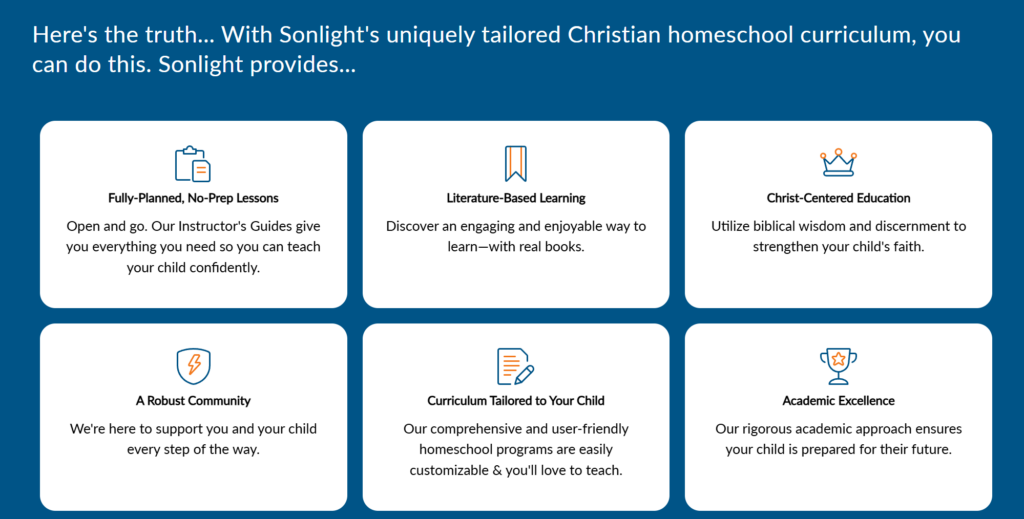
Sonlight does not merely add a few novels to a textbook program.
Books are the primary teaching method.
Its History/Bible/Literature programs combine a chronological history resource with:
- Historical fiction
- Biographies
- Memoirs
- Illustrated nonfiction
- Read-alouds
- Student readers
- Missionary stories
- Classic literature
The central history book provides structure, while the other titles show children what historical events meant for the people living through them.
Sonlight describes its history approach as using a “spine” to provide the foundational chronology, then adding biographies, historical fiction, and informational books to deepen the student’s understanding.
This helps solve one of the major weaknesses of textbook-only history.
A textbook might tell a child that a war began in a particular year.
A novel or biography may help the child understand:
- Why people fought
- What families feared
- How leaders made decisions
- What ordinary people endured
- Which moral questions were involved
Facts still matter. Literature gives those facts human meaning.
2. The Instructor’s Guide Does the Planning
The Instructor’s Guide is one of Sonlight’s strongest features.
Each guide generally includes:
- A 36-week schedule
- Daily reading assignments
- Discussion questions
- Teaching notes
- Vocabulary
- Map assignments
- Timeline activities
- Answer keys
- Writing guidance
- Recordkeeping tools
- Optional activities
- Background information
Sonlight offers Instructor’s Guides for History/Bible/Literature, Language Arts, and Science. The company describes them as complete, ready-to-use lesson plans for the school year.
This is enormously helpful for a parent who wants structure but does not want to design a curriculum from scratch.
Instead of spending Sunday night deciding how many chapters to assign, I can open the guide and see:
- Which pages to read
- Which book comes next
- Which questions to discuss
- What map work to complete
- What writing assignment is scheduled
- What science activity needs preparation
Independent reviewer Cathy Duffy identifies the Instructor’s Guides as one of Sonlight’s most important strengths because they provide detailed week-by-week schedules, instructions, answer keys, and recordkeeping tools.
3. Four-Day and Five-Day Schedule Options
Many Sonlight packages allow parents to choose between a four-day and five-day weekly schedule.
The four-day option can be useful for families that reserve one weekday for:
- Homeschool co-op
- Field trips
- Music lessons
- Sports
- Medical appointments
- Nature study
- Catch-up work
- Religious activities
The five-day schedule generally includes additional books or assignments and spreads the coursework across the full conventional school week.
Sonlight’s History/Bible/Literature Instructor’s Guides cover 36 weeks. The company specifically notes that many programs provide a four-day option for families attending co-ops or needing a flexible weekly rhythm.
As a dad, I appreciate having the choice.
A curriculum should provide structure without pretending that every family has the same schedule.
4. Students Are Grouped by Ability and Age Range
Sonlight’s levels do not always correspond rigidly to one school grade.
History/Bible/Literature programs are often designed for overlapping age and grade ranges.
For example:
- Level F is listed for approximately ages 11–14 and Grades 6–9.
- Level G is listed for ages 12–14 and Grades 7–9.
- Level H is listed for ages 13–15 and Grades 8–10.
- Level W is a condensed world-history program for approximately Grades 7–9.
- Level J covers the history of science for approximately Grades 8–10.
This reflects the reality that literature can often be shared across ages.
A nine-year-old and an eleven-year-old may both enjoy the same read-aloud, even though they complete different math and writing assignments.
The flexibility also helps families place children according to reading ability and maturity rather than automatically buying a package based on age.
5. Multiple Children Can Learn Together
A single History/Bible/Literature program may be used with more than one child when their ages and abilities are reasonably close.
The family can share:
- History
- Bible
- Read-alouds
- Geography
- Timeline activities
- Cultural discussions
- Some science topics
Each child can then use separate:
- Math
- Language arts
- Handwriting
- Readers
- Activity sheets
- Writing expectations
Sonlight explicitly promotes the ability to use one HBL program with multiple children because quality literature can engage a range of ages.
This can improve the value of an otherwise expensive program.
Buying one $500 or $700 shared history package for three children may be more economical than buying three unrelated boxed curricula.
However, teaching multiple ages still requires adaptation. A younger child may listen to the story, while an older child completes analytical writing and independent reading.
6. The Christian Worldview Is Integrated Through Discussion
Sonlight is openly Christian.
Its programs include:
- Daily Bible reading
- Scripture memorization
- Christian teaching notes
- Missionary biographies
- Worldview discussions
- Questions connecting literature and faith
- Church history at selected levels
- Discussion of moral and theological issues
Sonlight says that all of its programs come from a Christian perspective and that students read through most of the Bible more than once before graduation.
However, Sonlight’s method is often different from curricula that use only explicitly Christian books.
Sonlight may include books whose authors or characters express beliefs that differ from the publisher’s theology. The Instructor’s Guide then provides notes to help parents discuss bias, worldview, moral questions, or conflicting beliefs.
This can be a strength.
Children eventually need to encounter ideas they disagree with. The goal should not be to raise students who collapse the moment they read a non-Christian argument.
The challenge is that the parent must participate.
A controversial book does not automatically produce thoughtful analysis. The discussion notes are important.
7. Books Are Chosen for Interest, Not Merely Reading Level
Sonlight places significant emphasis on books children are likely to enjoy.
A child may learn about history through:
- Adventure
- Mystery
- Family stories
- Survival narratives
- War stories
- Biographies
- Cultural experiences
This can help children who dislike conventional history textbooks.
It can also build a family reading culture.
A strong read-aloud may become something children ask to continue after the scheduled stopping point. That is a very different educational atmosphere from a child repeatedly asking, “How many pages do I have left?”
8. Online Instructor’s Guides Add Digital Recordkeeping
Sonlight also offers online Instructor’s Guides.
According to Cathy Duffy’s review, these online guides can include:
- Digital schedules
- Grade tracking
- Assignment uploads
- Grading alerts
- Parent feedback
- Printable activities
- Printable reports
- Student access to assignments and grades
Access generally lasts for 12 months, so parents should download needed records before the access period expires.
This can help families who want Sonlight’s book-based education without managing everything on paper.
It is still not the same as a fully online school. The parent continues teaching and grading.
Sonlight History/Bible/Literature Review
History/Bible/Literature is the defining Sonlight program.
The curriculum cycles through American history, world history, church history, the Eastern Hemisphere, the history of science, government, economics, and worldview studies.
Depending on the level, students may study:
- American history
- Ancient civilizations
- Medieval history
- Modern world history
- Eastern cultures
- Church history
- Scientific discovery
- Government
- Economics
- Comparative worldview
- Global missions
What I Like About Sonlight History
History Becomes a Story
The books allow children to see historical events from the perspective of actual people.
This is more memorable than reading isolated facts.
American and World History Receive Attention
Sonlight’s sequence includes both U.S. and global history rather than treating the rest of the world as background scenery.
Unusual Courses Add Variety
Level F focuses on the Eastern Hemisphere, Level J examines the history of science, and Sonlight 200 focuses on the history of the Christian church.
These are subjects many homeschool programs treat lightly.
Maps and Timelines Reinforce Context
Children can see where and when events occurred rather than remembering names without geographical or chronological understanding.
The Instructor’s Guide Adds Balance
Teaching notes may identify bias, explain difficult issues, and provide additional historical context.
Possible History Weaknesses
The Reading Load Is Heavy
History may involve a central spine, historical fiction, biographies, read-alouds, and student readers.
A family that falls behind can quickly feel buried under unfinished books.
Some Books May Be Emotionally Difficult
Historical literature may deal with:
- War
- Slavery
- Persecution
- Poverty
- Death
- Racism
- Religious conflict
- Political violence
Parents should consider a child’s maturity rather than relying only on the recommended age.
Literature Can Blur Fact and Fiction
Historical fiction creates emotional understanding, but children must learn which details are documented history and which were invented by the author.
Theological and Political Notes May Not Match Every Family
Sonlight is Christian, but Christian families still differ on theology, politics, history, economics, and culture.
Parents should read the notes critically rather than assuming the publisher’s interpretation is automatically correct.
Sonlight Language Arts Review
Sonlight Language Arts connects writing instruction with the literature students are already reading.
Depending on the level, it can include:
- Phonics
- Spelling
- Grammar
- Copywork
- Dictation
- Creative writing
- Expository writing
- Literary analysis
- Research
- Vocabulary
- Editing
- Composition
The goal is to teach children to write by exposing them to good writing and then using those books as models or prompts.
Sonlight says its writing activities progress from early sentences and paragraphs toward creative and scholarly writing.
Language Arts Strengths
Writing Has a Meaningful Context
Children may write about a story, character, historical event, or idea they have already discussed.
This is more natural than responding to unrelated prompts.
Literature and Composition Reinforce Each Other
Students see how real authors build narratives, arguments, descriptions, and characters.
The Instructor’s Guide Gives Parents Direction
Parents receive schedules, teaching notes, and assignment guidance rather than being told simply to “teach writing.”
Readers Can Be Matched to Ability
A child’s reading level does not have to match the family’s history level exactly.
Language Arts Weaknesses
The Approach May Feel Unsystematic to Some Parents
Families accustomed to separate grammar, spelling, and composition textbooks may find the integrated approach less predictable.
Struggling Spellers May Need More Practice
Some children benefit from a dedicated, systematic spelling program.
Writing Assignments Can Frustrate Reluctant Writers
A child who enjoys listening to stories may not automatically enjoy responding in writing.
Parents Need Confidence in Evaluating Writing
Answer keys can grade objective work. Essays and creative assignments require judgment.
Advanced Grammar May Need Supplementation
Families wanting intensive sentence diagramming or traditional grammar drill may prefer an additional program.
Sonlight Science Review
Sonlight Science is also literature-based, though it includes experiments, activity sheets, and structured lesson plans.
A science package may contain:
- Illustrated science books
- Reference books
- Biographies
- Experiment instructions
- Activity sheets
- Videos
- Supply kits
- An Instructor’s Guide
The Science Instructor’s Guide includes schedules, explanations, questions, hands-on activities, and reinforcement material.
Science Strengths
The Books Are Engaging
Children learn from visually appealing and readable resources rather than relying only on dense textbooks.
Experiments Are Scheduled
Parents are not left to invent hands-on activities.
Scientific Discovery Can Be Connected With History
Sonlight’s Level J, focused on the history of science, is especially distinctive.
Activity Sheets Provide Accountability
Students do more than listen passively.
Science Weaknesses
Literature-Based Science May Feel Less Systematic
Some parents prefer one coherent textbook with a clear sequence of definitions, diagrams, reviews, and tests.
Experiments Require Preparation
Even with a supply kit, the parent must read instructions and supervise.
High-School Labs Need Careful Documentation
College-bound students may need clear lab records and courses matching admission expectations.
Theological Questions May Require Review
Christian families have different positions on creation, evolution, geology, and the age of the Earth. Parents should inspect the exact science level rather than assuming all Sonlight courses take one identical position.
Sonlight Math Review
Sonlight does not rely on one proprietary math program for every child.
Its All-Subjects Packages allow families to choose from established math curricula and select the appropriate level.
This flexibility is valuable because children often need different math approaches.
A family may prefer:
- Conceptual mathematics
- Spiral review
- Mastery-based instruction
- Manipulatives
- Traditional textbooks
- Video-supported courses
Math Strengths
- Parents can choose the program that fits the child.
- Math placement can differ from the student’s history level.
- The All-Subjects Package can still organize the materials into one purchase.
- Families are not locked into a weak in-house sequence.
Math Weaknesses
- Parents must research and choose among options.
- A poor placement choice can create gaps.
- Different children may require different teaching methods.
- Math is less integrated with Sonlight’s central literature approach.
- Some package totals vary significantly depending on the math choice.
Sonlight Curriculum by Level
Sonlight uses lettered levels for many elementary and middle-school programs and numbered levels for high school.
The level should be chosen based on:
- Age
- Reading ability
- Emotional maturity
- Previous history study
- Family composition
- Desired workload
Elementary Levels
Elementary programs introduce students to American history, world history, Bible, literature, geography, and read-alouds.
These levels are parent intensive because much of the literature is read aloud.
That is not necessarily a weakness.
Reading aloud improves family connection and allows children to understand books above their independent reading level.
However, parents must be realistic about time.
Middle-School Levels
Middle-school options include:
- Eastern Hemisphere
- Two-year world history
- Condensed world history
- History of science
These courses contain more independent reading and increasingly complex discussion.
Sonlight lists overlapping age and grade ranges rather than restricting each course to one exact grade.
High-School Levels
Sonlight’s major high-school HBL options include:
- Sonlight 100: American History and Literature
- Sonlight 200: History of the Christian Church and Classical Literature
- Sonlight 300: 20th-Century World History and Literature
- Sonlight 400: American Government, Economics, and Literature
- Sonlight 500: World History, Worldview Studies, and Literature
The company also offers high-school math, science, electives, and selected AP-preparation options.
Sonlight High School Review
Sonlight’s high-school courses become more student driven.
Teens are expected to:
- Read substantial books
- Analyze complex issues
- Write essays
- Evaluate competing ideas
- Discuss worldview
- Complete independent assignments
- Manage longer-term work
The company describes its high-school curriculum as literature-based, rigorous, customizable, and designed to strengthen critical thinking.
High-School Strengths
Strong Reading Preparation
Students encounter full-length books rather than relying only on textbook summaries.
History and Literature Are Connected
Literature is studied within the historical and philosophical context in which it was written.
Worldview Is Taken Seriously
Students are encouraged to examine ideas rather than merely memorize Christian vocabulary.
Courses Can Be Customized
Families can mix history, literature, science, math, electives, and AP-preparation resources.
Student Independence Increases
The parent can gradually shift from direct teacher to mentor and evaluator.
High-School Weaknesses
The Reading Volume Can Be Intense
A reluctant or slow reader may struggle to keep pace.
Parents Still Handle Transcripts and Grades
Sonlight is not an accredited school.
Science and Math Must Be Planned Carefully
College admission requirements vary.
Some Books May Challenge Family Preferences
High-school literature may include mature moral, political, or theological themes.
The Package Is Expensive
A complete high-school package can exceed $1,000.
Sonlight Curriculum Pricing in 2026
Sonlight is one of the more expensive mainstream homeschool curricula.
The cost reflects the large number of physical books, Instructor’s Guides, student materials, and subject resources included.
The following starting prices were displayed for All-Subjects Packages on July 16, 2026:
| Sonlight package | Grade | Displayed package price |
| All-Subjects Package K | Kindergarten | $851.99 |
| All-Subjects Package A | Grade 1 | $899.25 |
| All-Subjects Package B | Grade 2 | $908.02 |
| All-Subjects Package C | Grade 3 | $937.62 |
| All-Subjects Package D | Grade 4 | $1,014.24 |
| All-Subjects Package E | Grade 5 | $1,005.19 |
| All-Subjects Package F | Grade 6 | $1,189.30 |
| All-Subjects Package G | Grade 7 | $897.38 |
| All-Subjects Package H | Grade 8 | $927.10 |
| All-Subjects Package 100 | Grade 9 | $1,029.78 |
| All-Subjects Package 200 | Grade 10 | $983.83 |
| All-Subjects Package 300 | Grade 11 | $1,016.54 |
| All-Subjects Package 400 | Grade 12 | $1,206.90 |
These prices reflected a 20% package discount. Sonlight also displayed alternative packages such as combined history levels or condensed world-history options, and totals changed depending on selected schedules and resources.
Why Is Sonlight So Expensive?
A Sonlight package may include dozens of physical books.
The cost covers items such as:
- Instructor’s Guides
- History spines
- Read-alouds
- Student readers
- Novels
- Biographies
- Bible resources
- Science books
- Activity sheets
- Math materials
- Handwriting
- Experiment supplies
- Manipulatives
The company says All-Subjects Packages receive a 20% discount, while History/Bible/Literature packages receive a smaller package discount.
Hidden Costs to Consider
Parents may also spend money on:
- Additional student activity sheets
- Separate consumables for siblings
- Science experiment supplies
- Printer ink
- Binders
- Timeline materials
- Shipping
- International customs fees
- Replacement books
- Optional electives
- Standardized testing
- Co-op fees
- Extra math practice
- Additional grammar or spelling
- High-school lab materials
Can Sonlight Be Reused?
Many of the physical books can be reused with younger siblings.
Reusable items may include:
- History books
- Novels
- Read-alouds
- Science books
- Reference books
- Instructor’s Guides
Families may need to repurchase:
- Student activity sheets
- Consumable workbooks
- Certain math books
- Handwriting books
- Updated Instructor’s Guides when editions change
The cost becomes easier to justify when the same library serves several children.
Sonlight Pros and Cons
Pros
1. Exceptional Book Selection
Sonlight’s strongest feature is its library of engaging literature, biographies, history books, and read-alouds.
2. History Feels Alive
Children encounter historical events through human stories rather than isolated facts.
3. Detailed Instructor’s Guides
Parents receive structured schedules, questions, notes, answers, and teaching guidance.
4. Four-Day and Five-Day Options
Families can choose a schedule that fits their weekly rhythm.
5. Strong Family Learning
Several children can share history, Bible, and literature.
6. Christian Worldview
Bible study and faith-based discussion are integrated throughout the program.
7. Broad Global Coverage
Students study American history, world history, the Eastern Hemisphere, church history, and worldview.
8. Strong Reading Culture
Children are exposed to far more books than in many conventional curricula.
9. Customizable Packages
Parents can adjust readers, math, schedules, and subject selections.
10. Preschool Through High School
Families can use the same general philosophy for many years.
Cons
1. High Price
Complete packages usually cost around $850 to $1,200.
2. Very Heavy Reading Load
Families that dislike reading aloud may struggle.
3. Parent Intensive
Elementary students require substantial parental teaching and discussion.
4. Too Many Books for Some Families
The volume can create clutter and scheduling stress.
5. Falling Behind Feels Overwhelming
Missed reading can accumulate rapidly.
6. Not Accredited
Parents remain responsible for records, grades, and transcripts.
7. Some Subjects May Need Supplementation
Spelling, formal grammar, math facts, or laboratory science may need extra support.
8. Sensitive Books Require Parental Judgment
Some historical and literary themes may be difficult for particular children.
9. Not Ideal for Workbook-Oriented Students
Children who prefer concise, direct assignments may find the program frustrating.
10. International Shipping Can Be Costly
The large quantity of physical books can make overseas delivery expensive.
Sonlight vs. My Father’s World
Sonlight and My Father’s World are both Christian, literature-rich curricula, but they create different homeschool experiences.
| Feature | Sonlight | My Father’s World |
| Central approach | Literature-based | Literature-based family unit study |
| Book quantity | Very high | High |
| Hands-on projects | Moderate | Frequent |
| History | Strongly book-driven | Chronological and thematically integrated |
| Bible | Integrated plus separate study | Central organizing framework |
| Multiple ages | Strong | Exceptional |
| Instructor planning | Very detailed | Detailed weekly grids |
| Parent workload | Heavy reading | Reading plus projects |
| Cost | High | Moderate to high |
| Best for | Families that love books | Families wanting shared thematic study |
I would choose Sonlight when my priority is an exceptional reading list and daily discussion.
I would choose My Father’s World when I want stronger thematic integration, projects, geography, and several children completing a shared family cycle.
Sonlight vs. The Good and the Beautiful
| Feature | Sonlight | The Good and the Beautiful |
| Cost | High | Low to moderate |
| Free curriculum | Limited samples | Many free math and language arts PDFs |
| Literature | Central to nearly everything | Strongly integrated into language arts |
| History | Extensive book-based packages | Family-style courses |
| Parent workload | High | Low to moderate |
| Visual design | Books from many publishers | Highly polished proprietary books |
| Christian approach | Explicit evangelical | Broadly Christian |
| Complete high school | Strong | More limited |
| Best feature | Depth through literature | Beauty and affordability |
The Good and the Beautiful is easier to afford and simpler to start.
Sonlight provides a deeper and more extensive literature-based education, particularly in history and high school.
Sonlight vs. Master Books
| Feature | Sonlight | Master Books |
| Daily lesson style | Reading and discussion | Short workbook lessons |
| Book quantity | Very high | Moderate |
| Parent involvement | High | Low to moderate |
| Cost | High | Lower |
| Christian worldview | Evangelical and discussion-based | Evangelical and explicitly integrated |
| History | Literature-driven | Narrative textbooks and workbooks |
| Science | Books plus activities | Standalone creationist courses |
| Best for | Strong readers and read-aloud families | Families wanting simplicity |
Master Books is likely to work better for a child who needs short, predictable lessons.
Sonlight is likely to work better for a family that wants education built around books and conversation.
Sonlight vs. Abeka
| Feature | Sonlight | Abeka |
| Teaching style | Literature and discussion | Traditional textbook instruction |
| Drill | Limited to moderate | Extensive |
| Testing | Less central | Frequent |
| Read-alouds | Major component | Supplementary |
| Parent role | Reader and discussion leader | Teacher and assignment supervisor |
| Video instruction | Limited compared with Abeka | Full video academy options |
| Flexibility | High | Lower |
| Best for | Book-loving, discussion-oriented students | Students who thrive on structure and repetition |
Abeka may be a better choice for families wanting a conventional classroom-at-home model.
Sonlight may be better for families wanting books, ideas, discussion, and flexibility.
Is Sonlight Rigorous Enough?
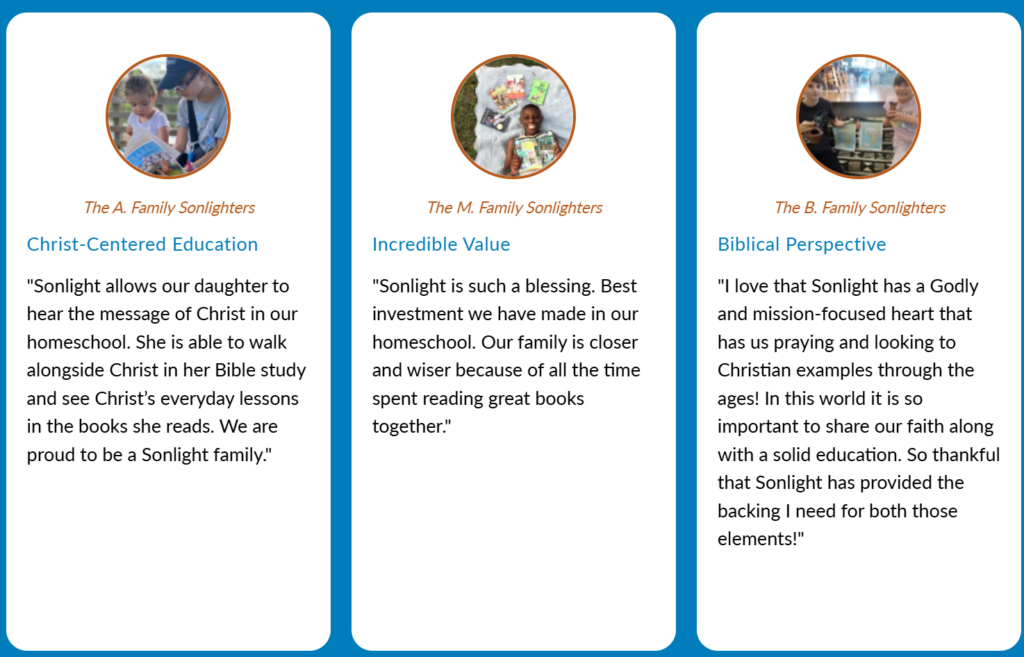
Sonlight can be academically demanding, especially in reading, history, literature, and writing.
The program expects students to:
- Read full-length books
- Listen attentively
- Discuss ideas
- Understand historical context
- Compare viewpoints
- Write regularly
- Build vocabulary
- Analyze literature
- Connect faith with academic topics
However, rigor depends on how the family uses the program.
A child who passively listens while the parent rushes through the schedule may retain little.
A child who discusses, writes, maps, researches, and reads independently may receive a very strong education.
Sonlight may require supplementation in areas such as:
- Math facts
- Formal grammar
- Systematic spelling
- Intensive composition
- Test preparation
- Advanced science laboratories
Rigor should be measured by student mastery, not by the number of books purchased.
Is Sonlight Too Much Reading?
For some families, yes.
Sonlight is intentionally reading intensive.
A typical day may include:
- Bible
- History spine
- Read-aloud
- Student reader
- Independent literature
- Science reading
- Language arts connected to literature
This can be wonderful for children who love books.
It can be exhausting for:
- Dyslexic students
- Slow readers
- Highly active children
- Parents teaching several unrelated levels
- Families with limited read-aloud time
- Children who need more visual or hands-on instruction
Parents do not have to finish every optional book.
The schedule should serve the family rather than control it.
Who Should Use Sonlight?
Sonlight is especially suitable for:
- Christian homeschooling families
- Parents who enjoy reading aloud
- Children who love stories
- Strong readers
- Families teaching close age ranges
- Parents who value history and literature
- Families wanting prepared lesson plans
- Students who learn through discussion
- Households with strong library culture
- College-bound students who need substantial reading practice
Who Should Avoid Sonlight?
It may be a poor fit for:
- Families on a tight curriculum budget
- Parents who dislike reading aloud
- Students who prefer workbooks
- Children with severe reading resistance
- Parents seeking an accredited school
- Families wanting short daily lessons
- Parents who become overwhelmed by unfinished books
- Secular families
- Households with little storage space
- Students who require extensive drill and repetition
Final Verdict: Is Sonlight Worth It?
Sonlight is expensive, but the value cannot be judged by the number of worksheets in the box.
Its real value lies in the books, conversations, and intellectual atmosphere it can create.
As a homeschooling dad, I like the idea of a school day in which my children gather around to hear a good book, argue about a character’s decision, locate the setting on a map, connect the story with history, and continue discussing it at dinner.
That kind of education can shape more than test performance.
It can shape imagination, empathy, faith, judgment, and a lifelong relationship with reading.
But Sonlight is not effortless.
The parent must read, discuss, adapt, and decide when enough is enough. A family that tries to complete every assignment perfectly may turn a joyful literature-based curriculum into a daily race against the schedule.
My final assessment is:
Sonlight is one of the best Christian homeschool curricula for families that genuinely love books and want history, Bible, and literature woven together. It is worth the investment for strong reading families, but parents should reduce the workload when necessary and avoid buying the program merely because the book collection looks impressive.
Overall Rating
| Category | Rating |
| Literature selection | 5/5 |
| History | 4.8/5 |
| Christian worldview | 4.6/5 |
| Instructor’s Guides | 4.8/5 |
| Family learning | 4.6/5 |
| Flexibility | 4.5/5 |
| Ease of planning | 4.8/5 |
| Ease of daily teaching | 3.7/5 |
| Affordability | 3.1/5 |
| High-school preparation | 4.6/5 |
| Overall rating | 4.5/5 |
Frequently Asked Questions
Is Sonlight a Complete Homeschool Curriculum?
Sonlight offers complete All-Subjects Packages from kindergarten through high school. These can include History/Bible/Literature, language arts, science, math, handwriting, and required resources. Families can also purchase individual subjects or customize packages.
Is Sonlight Curriculum Christian?
Yes. Sonlight teaches from a Christian perspective and includes scheduled Bible reading, Scripture memorization, missionary stories, and faith-based discussion.
Is Sonlight Accredited?
No. Sonlight is a curriculum publisher rather than a school. Parents remain responsible for legal compliance, grades, records, transcripts, and diplomas.
How Much Does Sonlight Cost?
In July 2026, complete All-Subjects Packages generally started between approximately $852 and $1,207 after Sonlight’s displayed 20% package discount. The price varies by grade, schedule, math selection, reader level, and required resources.
What Does HBL Mean in Sonlight?
HBL stands for History/Bible/Literature. It is Sonlight’s central literature-based package combining history, geography, Bible, read-alouds, student readers, and teaching notes.
Is Sonlight Open and Go?
The Instructor’s Guides provide complete daily schedules and significantly reduce advance planning. However, parents still need to read, teach, discuss, grade, and prepare certain science activities.
Can Sonlight Be Used With Multiple Children?
Yes. Children within a reasonable age range can share a History/Bible/Literature program while completing separate math, language arts, and age-appropriate assignments.
Does Sonlight Have a Four-Day Week?
Many Sonlight programs offer both four-day and five-day schedules. The four-day option is useful for families with co-ops, appointments, field trips, or other weekly commitments.
Is Sonlight Good for Dyslexia?
Sonlight’s strong read-aloud component may allow dyslexic children to access advanced stories and history. However, the amount of independent reading and writing may require adaptation, audiobooks, assistive technology, or a specialized phonics program.
Is Sonlight Good for High School?
Yes, especially for students who can handle substantial reading and writing. Sonlight offers high-school history, literature, Bible, government, economics, worldview, science, math, electives, and selected AP-preparation resources.
Is Sonlight Common Core Aligned?
Sonlight has historically stated that it does not design its curriculum around Common Core. Families should compare individual math and language arts selections with their state or academic requirements when alignment matters.
What Is the Secular Version of Sonlight?
BookShark uses a similar literature-based structure without Sonlight’s Christian Bible and worldview content. Independent curriculum reviewer Cathy Duffy describes BookShark as an option for families wanting a Sonlight-style education from a secular perspective.