


Selling a construction company can be highly profitable, but it is also more complicated than selling many other types of businesses. Buyers do not look only at revenue. They evaluate backlog, project margins, and whether the company can keep winning jobs after the owner exits.
Whether you own a general contracting company, specialty contractor, concrete company, remodeling company, restoration business, flooring company, excavation company, or commercial construction firm, preparation can significantly affect your valuation and deal outcome.
This guide explains how to sell your construction company, what buyers look for, how construction businesses are valued, and how to maximize your sale price.
Quick Answer
To sell your construction company successfully, organize your financial records, review your backlog, document licenses and contracts, reduce owner dependence, strengthen your management team, protect confidentiality, identify qualified buyers, and prepare for detailed due diligence. Construction companies with clean books, strong margins, recurring or repeat customers, reliable crews, documented systems, and a healthy project pipeline usually attract stronger buyer interest.
Looking to Sell Your Business?
Maximize your business sale by consulting USA’s top business brokers. More buyers. Bigger profits.
Key Takeaways
- Construction companies are often attractive to strategic buyers, private equity-backed platforms, competitors, search funds, and individual operators.
- Buyers closely evaluate project margins, backlog quality, customer concentration, safety records, bonding capacity, equipment, and workforce stability.
- A strong management team can increase value because buyers want confidence the company can operate after the owner exits.
- Clean financials and accurate job costing are critical during due diligence.
- Confidentiality matters because employees, customers, subcontractors, vendors, and competitors may react negatively if the sale becomes public.
- The best time to sell is usually when revenue, profitability, and backlog are stable or growing.
Why Construction Companies Attract Buyers
Construction companies can be attractive acquisition targets because many operate in industries with consistent demand, skilled labor, local reputation, repeat customers, and specialized capabilities.
Buyers may be interested in a construction company because they want to:
- Enter a new geographic market
- Expand into a new trade or service line
- Acquire skilled crews
- Increase bonding capacity
- Add licenses or certifications
- Gain customer relationships
- Increase market share
- Acquire equipment and operational infrastructure
- Build a regional platform
- Consolidate a fragmented industry
Potential buyers may include:
- Local competitors
- Regional construction firms
- Private equity-backed platforms
- Strategic acquirers
- Search fund buyers
- Family offices
- Individual operators
- Employees or management teams
The right buyer depends on your company’s size, trade, profitability, location, customer base, and management depth.
What Types of Construction Companies Can Be Sold?
Many types of construction and contractor businesses can be sold, including:
- General contracting companies
- Commercial construction firms
- Residential construction companies
- Roofing businesses
- HVAC contractors
- Plumbing companies
- Electrical contractors
- Concrete businesses
- Excavation companies
- Site preparation companies
- Flooring companies
- Painting companies
- Restoration businesses
- Remodeling companies
- Landscaping and hardscaping companies
- Masonry companies
- Specialty trade contractors
- Construction management firms
- Infrastructure-related contractors
Each type of construction company has different buyer expectations. For example, a roofing business may be evaluated differently from a commercial general contractor or an excavation company with heavy equipment.
How Construction Companies Are Valued
Construction company valuation usually depends on earnings, risk, backlog, assets, customer base, and transferability.
Common valuation methods include:
- EBITDA multiples
- Seller discretionary earnings multiples
- Asset-based valuation
- Comparable transaction analysis
- Revenue multiples in limited cases
Smaller owner-operated construction businesses are often valued based on seller discretionary earnings. Larger construction companies with management teams and stronger financial controls are more commonly valued using EBITDA.
| ✅Factors That Can Increase Valuation | ❌Factors That Can Reduce Valuation |
|---|---|
| Stable or growing revenue | Messy financial records |
| Strong gross margins | Weak job costing |
| Clean financial records | Declining revenue |
| Accurate job costing | Inconsistent margins |
| Reliable backlog | Heavy owner dependence |
| Repeat customers | Outdated equipment |
| Diversified customer base | Poor safety record |
| Strong management team | High customer concentration |
| Low owner dependence | Unresolved legal disputes |
| Skilled employees or crews | Labor shortages |
| Good safety record | Weak backlog |
| Transferable licenses | Heavy reliance on one general contractor or developer |
| Strong subcontractor relationships | Unclear licenses or permits |
| Well-maintained equipment | Poor documentation |
| Documented operating systems | – |
| Realistic growth opportunities | – |
What Buyers Look for in a Construction Company
Ready to Sell Your Business?
Take the first step towards a successful business exit
Construction buyers usually conduct detailed due diligence because construction revenue can be project-based, seasonal, and margin-sensitive.
Clean Financial Records
Buyers typically request:
- Profit and loss statements
- Tax returns
- Balance sheets
- Payroll records
- Revenue by project
- Revenue by customer
- Gross margin by job
- Work-in-progress reports
- Accounts receivable aging
- Accounts payable reports
- Debt schedules
- Add-back documentation
Construction buyers want to understand the true profitability of the company, not just top-line revenue.
Accurate Job Costing
Job costing is one of the most important factors in construction company sales.
Buyers want to know:
- Which jobs are profitable
- Which jobs lose money
- How estimates compare to actual costs
- Whether labor and materials are tracked properly
- Whether margins are improving or declining
- Whether overhead is allocated correctly
Strong job costing gives buyers confidence that the company understands its margins.
Backlog Quality
Backlog can increase buyer confidence, but only if it is profitable and realistic.
Buyers may evaluate:
- Signed contracts
- Pending projects
- Expected start dates
- Expected completion dates
- Estimated margins
- Customer quality
- Contract terms
- Cancellation risk
A large backlog is not always valuable if margins are weak or contracts are risky.
Customer Concentration
If one customer, developer, builder, government agency, or general contractor accounts for too much revenue, buyers may see risk.
A diversified customer base can improve valuation. Repeat customers are valuable, but overdependence on one source can create concern.
Workforce Stability
Construction companies depend heavily on people.
Buyers often evaluate:
- Project managers
- Estimators
- Crew leaders
- Superintendents
- Licensed tradespeople
- Field workers
- Administrative staff
- Salespeople
- Employee retention
- Subcontractor reliability
A strong team can make the business easier to transfer.
Licenses, Permits, and Certifications
Depending on the trade and state, buyers may review:
- Contractor licenses
- Trade licenses
- Insurance certificates
- Bonding capacity
- Safety certifications
- Union agreements, if applicable
- Local permits
- Specialty certifications
If licenses are tied personally to the owner, transition planning becomes especially important.
Equipment and Vehicles
For equipment-heavy construction companies, buyers will review:
- Equipment list
- Vehicle list
- Age and condition
- Maintenance records
- Replacement needs
- Financing or liens
- Market value
- Utilization rates
Well-maintained equipment can improve buyer confidence, while neglected assets can create price reductions.
Safety Record
Safety matters because poor safety history can affect insurance, reputation, employee retention, and future project eligibility.
Buyers may review:
- OSHA history
- Workers’ compensation claims
- Insurance loss runs
- Safety policies
- Training records
- Incident reports
- Experience modification rate, if applicable
A strong safety record can be a real selling point.
How to Prepare Your Construction Company for Sale
1. Clean Up Financial Documentation
Prepare at least three years of financial statements and tax returns, plus current year-to-date financials.
Make sure you can explain:
- Revenue trends
- Gross margins
- EBITDA or seller discretionary earnings
- Add-backs
- Debt
- Payroll
- Equipment expenses
- Owner compensation
- One-time expenses
Messy books can reduce buyer confidence and slow the sale process.
2. Prepare a Work-in-Progress Report
A work-in-progress report helps buyers understand active projects and expected profitability.
Include:
- Project name
- Customer
- Contract amount
- Percent complete
- Costs incurred
- Estimated cost to complete
- Expected gross profit
- Billing status
- Completion timeline
A clear WIP report can make your company look much more professional.
3. Document Your Backlog
Create a detailed backlog report showing signed and pending work.
Buyers want to know what revenue is likely after closing.
Include:
- Signed contracts
- Expected project start dates
- Estimated completion dates
- Expected margins
- Customer details
- Contract terms
4. Organize Licenses, Insurance, and Bonding Documents
Before going to market, gather:
- Contractor licenses
- Trade licenses
- Insurance policies
- Bonding information
- Safety records
- Workers’ compensation records
- Permits
- Certifications
This helps reduce diligence delays.
5. Reduce Owner Dependence
Many construction companies are hard to sell because the owner controls estimating, bidding, customer relationships, vendor relationships, project management, and hiring.
To reduce owner dependence:
- Train project managers
- Delegate estimating
- Document sales processes
- Build a leadership team
- Strengthen customer relationships beyond the owner
- Create standard operating procedures
- Develop crew leaders and supervisors
A buyer pays more for a business than for a job.
6. Strengthen Your Management Team
A strong management team can significantly improve buyer confidence.
Important roles may include:
- Operations manager
- Estimator
- Project manager
- Office manager
- Field supervisor
- Sales manager
- Controller or bookkeeper
If the company can run without the owner handling every decision, it becomes more attractive.
7. Improve Margins Before Going to Market
Buyers care deeply about margins.
Ways to improve margins include:
- Tightening job costing
- Raising prices where possible
- Reducing unprofitable work
- Improving estimating accuracy
- Negotiating better supplier terms
- Reducing overtime
- Improving scheduling
- Standardizing project workflows
- Focusing on higher-margin services
Even small margin improvements can increase valuation.
How to Maximize the Sale Price
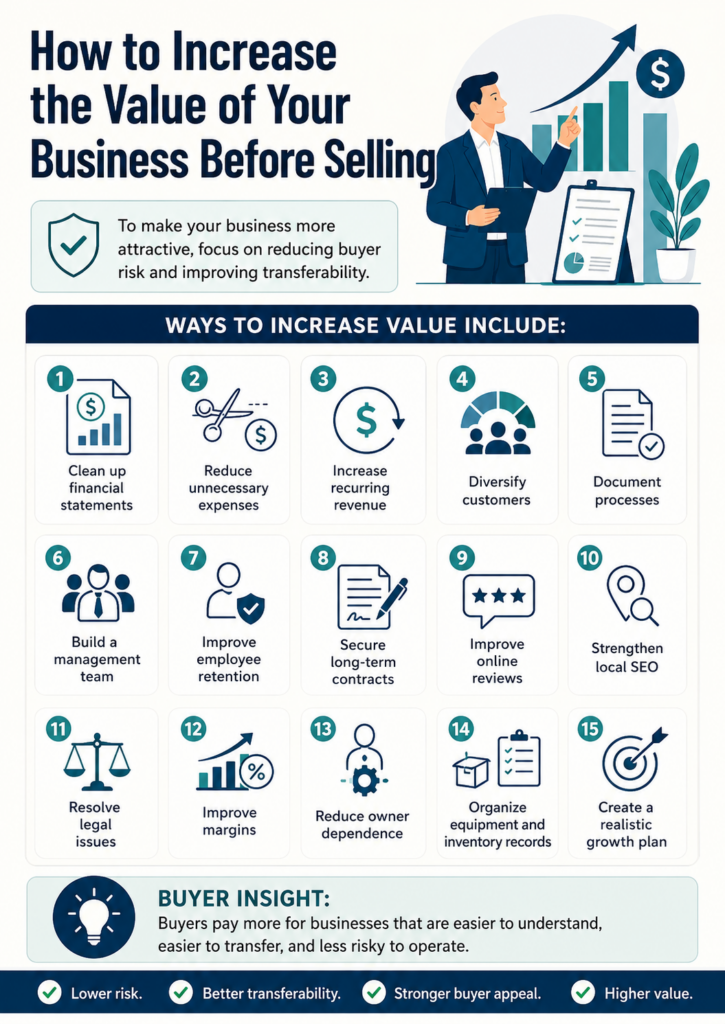
Build Repeat Revenue
Construction revenue can be project-based, but repeat customers make the business more predictable.
Valuable repeat revenue sources include:
- Maintenance contracts
- Property management relationships
- Commercial accounts
- Builder relationships
- Facility service agreements
- Government or institutional work
- Multi-year customer relationships
Reduce Customer Concentration
A business with many customers is usually less risky than one dependent on one large client.
If one customer represents a major share of revenue, try to diversify before selling.
Improve Estimating Accuracy
Buyers want confidence that future jobs will be profitable. Strong estimating systems and historical margin data can improve trust.
Document Processes
Document how your company handles:
- Lead intake
- Estimating
- Bidding
- Scheduling
- Purchasing
- Job costing
- Project management
- Quality control
- Safety
- Billing
- Collections
Documented systems make the company easier to transfer.
Clean Up Accounts Receivable
Slow collections can hurt valuation and create working capital concerns.
Before selling, review:
- A/R aging
- Retainage
- Disputed invoices
- Unbilled work
- Collection process
- Customer payment terms
Better collections can improve perceived business quality.
Maintain Equipment
Equipment condition can affect buyer confidence.
Address obvious maintenance issues, organize service records, and prepare a clear asset list.
Create a Realistic Growth Story
Buyers pay more when they see a believable path to growth.
Examples include:
- Expanding into nearby markets
- Adding crews
- Hiring salespeople
- Targeting commercial accounts
- Improving digital marketing
- Adding maintenance contracts
- Expanding into complementary services
- Increasing bonding capacity
- Building a stronger referral program
Avoid vague claims. Show buyers where growth can realistically come from.
Confidentiality When Selling a Construction Company
Confidentiality is especially important in construction.
If employees, customers, subcontractors, vendors, or competitors hear about the sale too early, it can create uncertainty.
Potential risks include:
- Employees leaving
- Customers delaying projects
- Competitors using the information against you
- Subcontractors becoming nervous
- Vendors changing terms
- Key managers losing confidence
A confidential sale process usually includes:
- Blind teaser materials
- NDAs
- Buyer screening
- Staged information sharing
- Secure data rooms
- Controlled disclosure of customer and project information
Competitors may be serious buyers, but they should not receive sensitive information too early.
Who Buys Construction Companies?
Strategic Buyers
Strategic buyers are often companies already operating in construction or adjacent services.
They may want your company for customers, employees, geographic expansion, licenses, equipment, or market share.
Private Equity-Backed Platforms
Private equity-backed buyers are active in many contractor and home service sectors, especially HVAC, roofing, plumbing, electrical, restoration, landscaping, and facility services.
They often prefer companies with strong management, repeat customers, and scalable systems.
Competitors
Competitors may understand your company quickly and value synergies, but confidentiality must be managed carefully.
Search Funds
Search fund buyers often look for stable, profitable companies they can acquire and operate.
They may be a good fit for smaller or lower middle-market construction companies.
Employees or Management
A management buyout can work if your team has the ability and financing to take over.
This may preserve culture and continuity, but funding can be a challenge.
Should You Use a Construction Business Broker or M&A Advisor?
Many owners use a business broker or M&A advisor because construction transactions can be difficult to manage while running the company.
An advisor may help with:
- Business valuation
- Confidential marketing
- Buyer research
- Strategic buyer outreach
- Private equity outreach
- NDA management
- Offer comparison
- Negotiation support
- Due diligence coordination
- Deal structuring
- Closing support
For smaller owner-operated construction companies, a business broker may be enough. For larger companies with strong EBITDA, management teams, and strategic buyer interest, an M&A advisor may be more appropriate.
Steps to Sell Your Construction Company
- Clarify your exit goals and ideal timeline.
- Organize financial statements and tax returns.
- Prepare job costing, WIP, backlog, and customer reports.
- Review licenses, insurance, bonding, and safety records.
- Create equipment and vehicle lists.
- Identify valuation drivers and business risks.
- Reduce owner dependence where possible.
- Prepare confidential marketing materials.
- Identify and qualify potential buyers.
- Execute NDAs before sharing sensitive information.
- Hold buyer meetings and management discussions.
- Receive and compare offers.
- Negotiate price, structure, transition terms, and contingencies.
- Complete financial, operational, legal, equipment, safety, and project due diligence.
- Finalize purchase documents.
- Close the transaction and support the transition.
Common Mistakes to Avoid
Selling With Messy Job Costing
If buyers cannot understand project profitability, they may lower their offer or walk away.
Relying Too Much on the Owner
Owner-dependent construction companies are harder to sell.
Ignoring Backlog Quality
A large backlog does not help if the work is low-margin, risky, or uncertain.
Sharing Customer Details Too Early
Protect customer names, pricing, bid history, and project details until buyers are properly qualified.
Overpricing the Business
Construction companies can be valuable, but buyers will discount for risk. Unrealistic pricing can reduce serious buyer interest.
Not Preparing for Due Diligence
Buyers will ask for detailed records. Prepare before going to market.
Neglecting Safety and Insurance Records
Poor safety documentation can create buyer concerns and financing issues.
Construction Company Sale FAQs
How long does it take to sell a construction company?
Many construction company sales take 6 to 12 months, although larger or more complex companies may take longer because of due diligence, financing, backlog review, bonding issues, and legal documentation.
How is a construction company valued?
Construction companies are often valued using EBITDA, seller discretionary earnings, asset value, backlog quality, customer concentration, margins, management depth, equipment condition, and risk profile.
Who buys construction companies?
Common buyers include strategic construction firms, competitors, private equity-backed platforms, search funds, family offices, individual operators, and management teams.
What makes a construction company more valuable?
Clean financials, strong margins, accurate job costing, diversified customers, skilled employees, repeat revenue, quality backlog, documented systems, good safety records, and low owner dependence can improve valuation.
Can I sell my construction company confidentially?
Yes. A confidential process can use blind teasers, NDAs, buyer screening, staged information sharing, and secure data rooms.
Do buyers care about backlog?
Yes. Buyers care about backlog, but they will evaluate the quality of the backlog, expected margins, customer risk, contract terms, and likelihood of completion.
Should I sell to a competitor?
A competitor may be a strong buyer, but you should use strict confidentiality controls and avoid sharing sensitive customer, pricing, employee, subcontractor, or bid information too early.
Do buyers care about bonding capacity?
Yes, especially for commercial, government, and larger project-based construction companies. Bonding capacity can affect future revenue and project eligibility.
Should I fix operational issues before selling?
Yes, if the issues affect profitability, safety, customer retention, job costing, or buyer confidence. You do not need to solve every problem, but major risks should be addressed before going to market.
Final Thoughts
Selling a construction company requires preparation, confidentiality, strong financial documentation, and a clear understanding of what buyers value.
Buyers want confidence that your company has durable earnings, skilled employees, profitable projects, reliable backlog, strong customer relationships, good safety practices, and systems that can continue after you exit.
Owners who clean up financials, improve job costing, document backlog, reduce owner dependence, strengthen management, organize equipment records, and protect confidentiality are usually in a stronger position to attract qualified buyers and negotiate better terms.