

iTrustCapital and BitcoinIRA are two prominent platforms for holding cryptocurrency inside a self-directed retirement account. Both let eligible US investors transfer or roll over retirement funds, buy supported digital assets, and trade within a tax-advantaged account. Nevertheless, their fees, account choices, investment features, custody arrangements, and target customers differ significantly.
iTrustCapital is generally the stronger choice for cost-conscious investors. It charges a 1% cryptocurrency transaction fee and advertises no setup, monthly, annual, storage, or exit fees. BitcoinIRA charges 2% on purchases and sales, plus a monthly account fee equal to 0.08% of assets held.
BitcoinIRA may justify its higher cost for investors who need a SIMPLE IRA or Solo 401(k), want access to its staking program, prefer its portfolio-bundle functionality, or value its support model and advertised custody insurance. However, investors primarily interested in buying and holding Bitcoin or other major cryptocurrencies will usually find iTrustCapital less expensive.
Explore The AI-Linked Asset Class Elites are Investing In
This comparison is educational and is not personalized investment, legal, or tax advice. Cryptocurrency can lose most or all of its value, and retirement-account errors may produce taxes or penalties.
What Is a Crypto IRA?
A Crypto IRA is a self-directed retirement account that permits investment in supported digital assets. “Crypto IRA” and “Bitcoin IRA” are industry descriptions rather than separate account categories established by the Internal Revenue Service. The underlying legal account is typically a Traditional, Roth, SEP, or SIMPLE IRA.
A Traditional Crypto IRA generally offers tax-deferred growth. Eligible contributions may be deductible, depending on income and workplace-plan coverage, while distributions are ordinarily taxable. A Roth Crypto IRA uses after-tax contributions, and qualified withdrawals can be tax-free.
Trading within a correctly administered IRA generally does not create an immediately reportable capital gain every time cryptocurrency is sold or exchanged. Tax treatment instead occurs according to the rules governing the retirement account.
Investors do not personally control the account’s wallet keys in the same way they would with a self-custody wallet. A qualified custodian must hold and administer the retirement assets.
What Is iTrustCapital?
iTrustCapital is a US digital-asset platform specializing in cryptocurrency and precious-metal retirement accounts. It provides an online interface through which customers can open, fund, and self-direct their accounts.
The platform offers Traditional, Roth, and SEP IRAs. Accounts can generally be funded through a new contribution, an IRA-to-IRA transfer, or an eligible retirement-plan rollover.
In addition to cryptocurrency, iTrustCapital supports physical gold and silver. This may appeal to investors who want to combine digital assets and precious metals within one retirement account.
The company has also introduced taxable Premium Custody Accounts for individuals and Treasury Accounts for eligible US entities. These accounts use similar custody infrastructure but do not offer IRA tax treatment.
Bonus Free Guide Included
What Is BitcoinIRA?
BitcoinIRA is a technology platform that connects investors with qualified custodians, digital wallets, and cryptocurrency trading services. The company emphasizes that it is not itself the custodian, exchange, or digital wallet.
BitcoinIRA supports a wider range of retirement structures than iTrustCapital. Its current account lineup includes Traditional and Roth IRAs, SEP and SIMPLE IRAs, and Solo 401(k) plans. This gives self-employed investors and small-business owners more choices.
The platform also provides cryptocurrency staking, portfolio bundles, a mobile application, and account-support services. It currently advertises 100 supported cryptocurrencies following an expansion announced in July 2026.
Main Differences
The largest difference between the platforms is cost. iTrustCapital charges 1% per cryptocurrency purchase or sale without a recurring asset-based account fee. BitcoinIRA charges 2% per purchase or sale and 0.08% of the account’s value every month.
BitcoinIRA offers more retirement-account types, including SIMPLE IRAs and Solo 401(k)s. It also provides staking and portfolio bundles, which may make it more attractive to investors seeking features beyond straightforward buying and holding.
Both platforms advertise broad cryptocurrency selections. BitcoinIRA currently reports 100 assets, while iTrustCapital’s recent documentation refers to more than 90 assets. The precise selection changes, so investors should search each platform for the particular cryptocurrency they want before transferring money.
Account Types
iTrustCapital offers Traditional, Roth, and SEP IRAs. These cover many individual investors and self-employed business owners, but the platform does not currently advertise SIMPLE IRAs or Solo 401(k)s as part of its core Crypto IRA service.
BitcoinIRA offers Traditional, Roth, SEP, and SIMPLE IRAs, as well as Solo 401(k) accounts. Its official account documentation confirms this broader selection.
A Traditional IRA may be suitable for investors seeking tax-deferred growth and potentially deductible contributions. A Roth IRA may appeal to investors who qualify to contribute and expect future qualified tax-free distributions. SEP IRAs are commonly used by self-employed people and small-business owners.
SIMPLE IRAs serve eligible small employers, while Solo 401(k) plans can provide higher contribution capacity to qualifying self-employed individuals with no employees other than a spouse. Establishment deadlines, employer contributions, testing, filings, and rollover rules can make employer plans more complicated.
BitcoinIRA has the advantage when a SIMPLE IRA or Solo 401(k) is essential. For Traditional, Roth, and SEP accounts, both platforms are viable.
Contributions, Transfers, and Rollovers
Both providers allow eligible investors to make contributions, transfer existing IRA assets, or roll over funds from qualifying employer-sponsored plans. Transfers and direct rollovers can be much larger than the ordinary annual IRA contribution limit because they generally represent the movement of existing retirement assets rather than new contributions.
For 2026, the combined annual contribution limit for Traditional and Roth IRAs is $7,500 for people under 50 and $8,600 for eligible people aged 50 or older. Income, compensation, workplace-plan coverage, and filing status may restrict the deduction or the ability to make a direct Roth contribution.
iTrustCapital’s documentation states that it can accept a transfer from another IRA, a rollover from a former-employer plan, or a cash contribution. Cryptocurrency generally cannot be deposited into an iTrustCapital IRA from a personal wallet; an in-kind transfer must come from another qualifying Crypto IRA.
BitcoinIRA lists rollovers or transfers from Traditional, Roth, SEP, and SIMPLE IRAs, as well as eligible 401(k), 403(b), Solo 401(k), pension, Thrift Savings Plan, and Keogh accounts. Employer-plan eligibility may depend on whether the investor has left the employer or qualifies for an in-service distribution.
A direct custodian-to-custodian transfer is generally preferable to receiving retirement money personally because an indirect rollover introduces withholding rules, deadlines, and the possibility of a taxable distribution.
Account Minimums
iTrustCapital currently requires at least $1,000 to open an IRA. Subsequent contributions, transfers, or rollovers generally require at least $500. There is no stated maximum for qualifying transfers and rollovers, although annual cash contributions remain subject to IRS limits. These requirements are set out in the company’s minimum-balance documentation.
BitcoinIRA does not display a universal opening minimum within its current public fee summary. Minimums can depend on the account, funding method, promotion, or custodial arrangement. Prospective customers should obtain written confirmation before starting a rollover.
An absence of setup fees does not necessarily mean an account can be funded with any amount. Investors should confirm both the opening requirement and the minimum individual trade.
iTrustCapital Fees
iTrustCapital charges 1% when cryptocurrency is purchased and another 1% when cryptocurrency is sold. The fee is applied to the transaction amount.
For example, purchasing $10,000 of Bitcoin produces a $100 transaction fee. If the investment later grows to $20,000 and the entire position is sold, the sale produces a $200 fee. The total charge across those two transactions would be $300.
The company currently advertises no setup, monthly, annual, storage, commission, or exit fees for its standard Crypto IRA service. iTrustCapital’s self-trading guide confirms the 1% buy-and-sell fee and the absence of those recurring platform charges.
Physical gold and silver use separate pricing. Investors should review the difference between the quoted purchase or sale price and the current spot price before trading precious metals.
Cash distributions by ACH currently have no iTrustCapital distribution fee, while bank wires carry a $15 charge. Taxes, penalties, cryptocurrency-network expenses, and fees imposed by another institution remain separate.
BitcoinIRA Fees
BitcoinIRA currently charges no account-setup or incoming-deposit fee. It charges 2% when cryptocurrency is purchased and 2% when it is sold.
It also charges 0.08% of the account’s value every month. This equals approximately 0.96% per year when calculated as twelve monthly charges, although the actual dollar cost changes as the account value fluctuates.
A $10,000 account would incur approximately $8 per month, or $96 over a year if its value remained unchanged. A $100,000 account would incur approximately $80 per month, or $960 annually. A $500,000 account would incur approximately $400 per month, or $4,800 annually.
These recurring charges apply independently of trading activity. An investor who buys Bitcoin and holds it without making further trades continues to pay the monthly asset-based fee.
BitcoinIRA’s current prices are documented in its official fee schedule. Investors should also review the more detailed legal fee disclosure and their account agreement because certain services, assets, distributions, staking arrangements, or custodians may have additional conditions.
Fee Comparison
For straightforward cryptocurrency trading, iTrustCapital is materially less expensive. Its trading charge is half of BitcoinIRA’s current rate, and it does not impose BitcoinIRA’s recurring 0.08% monthly account fee.
Suppose an investor deposits $100,000 and immediately buys cryptocurrency. iTrustCapital’s 1% fee would be approximately $1,000. BitcoinIRA’s 2% purchase fee would be approximately $2,000.
If the account then remained worth $100,000 for a year, BitcoinIRA would charge approximately another $960 in monthly account fees. The first-year difference would therefore be about $1,960 before accounting for variations in asset value, execution price, additional transactions, or other services.
If the position later doubled to $200,000 and was sold, iTrustCapital’s sale charge would be approximately $2,000, while BitcoinIRA’s would be approximately $4,000. BitcoinIRA’s monthly fee would also have increased as the portfolio grew.
This does not mean the cheaper provider is automatically better. BitcoinIRA’s staking, account options, bundles, support, and insurance structure may carry value for some customers. Nevertheless, investors should quantify that value because the fee difference can compound substantially over a long retirement horizon.
Long-Term Cost
An asset-based fee has a different effect from a one-time trading fee. Transaction fees become less important when an investor buys infrequently, but a percentage charged every month continues reducing the account for as long as the assets remain on the platform.
If a BitcoinIRA account maintained an average value of $250,000, its 0.08% monthly fee would equal approximately $200 a month or $2,400 a year. Over ten years, that would total roughly $24,000 if the account value did not change. If the portfolio appreciated, the dollar cost would be higher.
This simple illustration excludes compounding, trading charges, staking income, distributions, taxes, and market movements. It nevertheless demonstrates why long-term investors should focus on recurring costs rather than setup fees alone.
Supported Cryptocurrencies
BitcoinIRA announced that its platform had reached 100 cryptocurrencies in July 2026. The list encompasses major assets and a range of altcoins, although availability may depend on account, custodian, jurisdiction, and current platform policy.
iTrustCapital’s recent materials refer to more than 90 digital assets. It supports widely traded cryptocurrencies and periodically adds new ones. The platform also offers US-dollar stablecoin functionality and physical gold and silver.
The headline asset counts are now relatively close. The better selection depends on whether the platform supports the particular assets an investor wants to hold.
Investors should not select a provider merely because it offers more coins. Small crypto projects can have limited liquidity, concentrated ownership, uncertain legal status, security weaknesses, and extreme volatility. Their availability inside an IRA does not make them suitable retirement investments.
Precious Metals
iTrustCapital provides physical gold and silver alongside cryptocurrency. This allows a customer to allocate one self-directed retirement account across digital assets, cash, and precious metals.
BitcoinIRA’s central product is focused on cryptocurrency. Investors seeking physical precious metals should verify current availability and structure rather than assuming that a tokenized gold asset is equivalent to physical bullion.
iTrustCapital has the advantage for investors who specifically want both cryptocurrency and physical gold or silver in the same platform.
Staking
BitcoinIRA offers staking for selected proof-of-stake cryptocurrencies. Its 2026 materials describe support involving Ethereum, Cardano, Polkadot, Solana, and Sui.
Staking allows eligible cryptocurrency to participate in network validation and potentially earn rewards. BitcoinIRA credits rewards after deducting service-provider and custodian fees. Reward rates are variable and not guaranteed.
Staking also creates risks. Assets may be temporarily locked, unstaking may take time, validator performance can reduce returns, protocol rules can change, and slashing may create losses. The value of the cryptocurrency may fall by more than the rewards earned.
BitcoinIRA has the advantage for investors who want platform-integrated staking. However, customers should ask for the gross reward rate, validator fee, custodian fee, platform share, bonding period, unbonding period, slashing policy, and treatment of protocol changes.
iTrustCapital provides certain reward-related products but does not currently offer the same widely promoted multi-asset staking program. Availability depends on the asset and regulatory environment.
Crypto Bundles
BitcoinIRA offers Crypto Bundles, which allow users to group multiple cryptocurrencies and manage them as a portfolio. A customer can create up to ten bundles per account, with as many as 20 assets in each bundle.
Bundles may make diversification and rebalancing more convenient. However, every rebalance can generate multiple purchases and sales, each potentially subject to trading charges. With a 2% fee in each direction, frequent rebalancing can become expensive.
iTrustCapital allows customers to hold and trade multiple assets but does not emphasize an equivalent automated bundle system. Investors who value portfolio grouping may prefer BitcoinIRA, while investors who want to minimize transaction frequency may favor iTrustCapital.
Trading Access
Both platforms provide online access for monitoring accounts and trading supported cryptocurrency outside normal stock-market hours. This is important because digital-asset markets operate continuously.
Orders are executed through platform liquidity arrangements rather than through a traditional public securities exchange. The displayed price may incorporate market spreads, liquidity conditions, execution costs, and platform charges.
A fee percentage alone does not show the complete trading cost. Investors should compare the quoted execution price with an independent market reference immediately before confirming the transaction.
Neither platform is designed as a professional high-frequency trading exchange. Users should not expect advanced derivatives, margin, sophisticated order books, or unrestricted external-wallet activity inside an IRA.
Conditional Orders
iTrustCapital offers conditional transactions for supported assets, allowing customers to establish instructions that execute when specified price conditions are reached. These can help investors buy or sell without monitoring the market continuously.
Conditional orders are not guaranteed to execute at the trigger price. Fast markets, insufficient liquidity, platform interruptions, and price gaps can affect execution.
BitcoinIRA’s available order types and automation may differ by asset and trading system. Prospective customers who require limit orders, recurring purchases, stop-like instructions, or automated rebalancing should request a live platform demonstration.
Custody at iTrustCapital
iTrustCapital uses a qualified-custodian structure involving Fortis Bank and institutional storage technology. It identifies Coinbase Custody, Fidelity Digital Assets, and Fireblocks among the providers supporting digital-asset storage.
The company describes multiparty computation, offline cold storage, external audits, SOC 2 Type II certifications, and commercial crime insurance maintained by storage providers. Assets are represented as held separately from iTrustCapital’s operating funds.
The platform’s closed-loop design limits the destinations to which assets can be withdrawn. This can make unauthorized extraction more difficult, although no custodial system eliminates every operational, cyber, fraud, or counterparty risk.
Customers do not choose their custody provider. Custodial arrangements may also vary by asset.
Custody at BitcoinIRA
BitcoinIRA connects clients to regulated custodians and wallet providers. Digital Trust and BitGo have historically been prominent parts of its custody infrastructure, although the exact provider and protection can vary according to the asset and solution.
BitcoinIRA advertises up to $250 million in custody insurance. The company notes that terms and coverage may vary by asset and custody choice. This headline should not be interpreted as $250 million of individual protection for every customer.
Customers should request the policyholder’s name, insurer, covered events, exclusions, deductibles, aggregate limit, per-wallet limit, and method for allocating a claim among customers. Insurance generally does not cover cryptocurrency’s loss of market value.
BitcoinIRA has the stronger published insurance headline, while iTrustCapital identifies several major institutional custody providers but states that their insurance limits are not publicly disclosed.
Does FDIC or SIPC Insurance Protect the Crypto?
Cryptocurrency is not an FDIC-insured bank deposit. If Bitcoin or another digital asset loses value, neither FDIC insurance nor a commercial crime policy reimburses the investor.
Any FDIC protection applies only to qualifying cash held at an insured bank and remains subject to ownership, account, and coverage rules. SIPC protection generally applies to qualifying securities and cash at a failed SIPC-member brokerage; it does not guarantee crypto prices and may not apply to the digital assets themselves.
Both providers’ insurance and cash-protection statements must therefore be read carefully. “Insured” does not mean that every form of loss is covered.
Wallet Control and In-Kind Distributions
Crypto held in either IRA is controlled within a custodial retirement structure. Investors cannot simply send assets from the IRA to a personal hardware wallet while continuing to treat them as IRA property.
An external transfer ordinarily must be structured as an in-kind distribution or as a qualified custodian-to-custodian movement. An in-kind distribution can create taxable income and an early-distribution penalty depending on the account, the investor’s age, and whether an exception applies.
iTrustCapital supports in-kind crypto distributions after identity and security verification. BitcoinIRA customers should confirm which assets qualify for in-kind distributions, the applicable fee, the processing time, and the supported blockchain network.
Anyone seeking personal control of private keys should recognize that a custodial Crypto IRA is fundamentally different from self-custody.
Traditional IRA Tax Treatment
Traditional IRA investments generally grow tax deferred. Buying and selling assets inside the account typically does not create annual capital-gains taxation, but distributions are generally taxable as ordinary income according to the account’s composition.
Contributions may be deductible, but the deduction can be reduced or eliminated by income, filing status, and participation in an employer retirement plan.
Required minimum distributions eventually apply to Traditional IRAs. If the account is heavily invested in volatile or illiquid cryptocurrency, the owner may need to sell or distribute assets during unfavorable market conditions.
Roth IRA Tax Treatment
Roth IRA contributions are made with after-tax money and are not deductible. Qualified withdrawals can be tax-free when the applicable age and holding-period conditions are satisfied.
Direct Roth contributions are subject to income limitations. Investors with higher incomes may investigate a backdoor Roth strategy, but conversions, existing pretax IRA balances, and the pro-rata rule can create complicated tax consequences.
A Roth IRA can be attractive for an asset expected to appreciate significantly, but no cryptocurrency return is guaranteed. A severe loss inside a Roth IRA also consumes contribution or conversion capacity that may be difficult to replace.
Prohibited Transactions
Self-directed accounts are subject to prohibited-transaction rules. Investors cannot use IRA assets for personal benefit, pledge them as security, or engage in certain transactions with disqualified persons.
Improperly transferring cryptocurrency between a personal wallet and an IRA can create compliance problems. Using IRA-owned assets in decentralized finance, lending, collateral, personal purchases, or related-party transactions may also be prohibited or unavailable through the platforms.
The custodian performs administrative functions, but the account owner remains responsible for investment decisions and rule compliance.
Distributions
Withdrawals from a Traditional IRA are generally taxable. A distribution before age 59½ may also carry a 10% additional tax unless an exception applies.
Roth IRA distributions follow ordering and qualification rules. Contributions, conversions, and earnings may receive different treatment, and each conversion can have its own holding period for certain penalty purposes.
The platforms may process distributions in cash or, for eligible assets, in kind. The fair market value of cryptocurrency distributed from an IRA must be established for tax reporting.
Investors should consult a tax professional before taking a large cash or crypto distribution.
Mobile Applications
BitcoinIRA provides a mobile application through which customers can monitor balances, review performance, and place transactions. Its mobile experience is frequently emphasized in the company’s marketing and customer-review materials.
iTrustCapital also provides access from compatible devices, with an interface centered on portfolio monitoring and self-directed trading.
Mobile convenience should not override security. Investors should enable multifactor authentication, use a unique email account and password, secure their telephone number against unauthorized transfers, and avoid initiating retirement transactions on public networks.
Customer Support
BitcoinIRA emphasizes guided onboarding and access to account representatives. This may help investors who are unfamiliar with retirement transfers or cryptocurrency.
iTrustCapital also provides US-based support for account opening, transfers, rollovers, trading, and distributions. Its experience is generally more self-directed, with users placing their own trades through the online platform.
Support representatives can explain platform procedures but may not be fiduciary advisers, tax professionals, or attorneys. Investors should not treat operational assistance as a personalized recommendation to purchase a particular cryptocurrency.
Customer Reviews
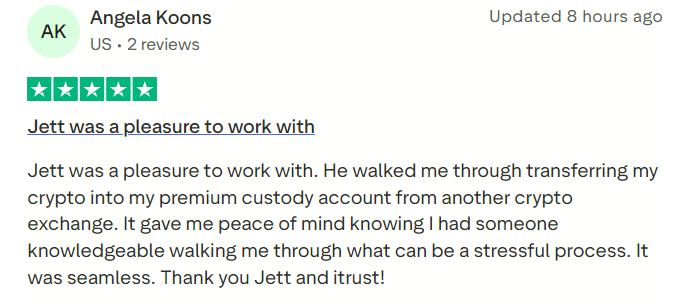
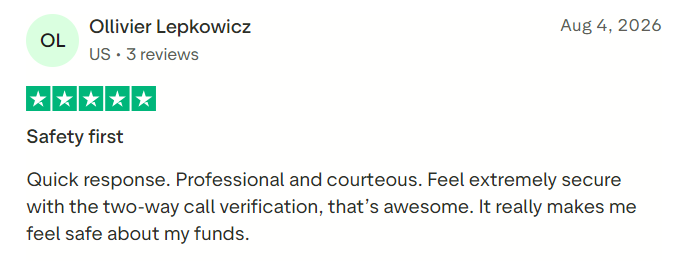
Both companies have substantial public review histories. Positive iTrustCapital reviews commonly mention its straightforward interface, transparent fee structure, asset selection, and help with IRA transfers. Critical feedback can involve processing times, custodial restrictions, withdrawals, and customer-service delays.
Positive BitcoinIRA reviews frequently highlight onboarding support, mobile access, security, and assistance from account representatives. Critical reviews often focus on fees, account transfers, trading costs, and service experiences.
Review scores can change and should be interpreted carefully. Investors should read recent positive and negative comments and distinguish company-controlled testimonials from reviews collected by independent services.
#1.
#2.

#3.

#4.
iTrustCapital Pros
iTrustCapital’s most important advantage is cost. Its 1% trading charge is half BitcoinIRA’s current 2% rate, and it does not impose BitcoinIRA’s recurring monthly asset-based fee.
The platform supports more than 90 cryptocurrencies as well as physical gold and silver. Its $1,000 opening minimum is clearly disclosed, and additional deposits generally begin at $500.
Institutional custody providers, continuous trading access, conditional transactions, and the absence of setup or exit fees make the platform attractive to long-term investors.
iTrustCapital Cons
iTrustCapital does not provide as many retirement-account structures as BitcoinIRA. The absence of SIMPLE IRA and Solo 401(k) options can be decisive for certain self-employed investors or small-business owners.
Its staking functionality is less extensive than BitcoinIRA’s program. It also lacks BitcoinIRA’s prominently marketed portfolio bundles.
Custodial provider selection is controlled by the platform, and customers cannot move IRA assets freely to personal wallets. Insurance limits maintained by its storage providers are not publicly disclosed.
BitcoinIRA Pros
BitcoinIRA offers a wider range of retirement accounts, including Traditional, Roth, SEP, and SIMPLE IRAs plus Solo 401(k) plans. It currently advertises 100 cryptocurrencies.
Its staking program can generate protocol rewards on selected assets, subject to fees and risks. Crypto Bundles make it easier to group and rebalance multiple holdings.
BitcoinIRA also emphasizes hands-on support, mobile access, and up to $250 million of custody insurance, although coverage varies.
BitcoinIRA Cons
BitcoinIRA’s principal drawback is its cost. Its 2% purchase and sale fees are twice iTrustCapital’s standard rate. The additional monthly charge of 0.08% of assets creates an ongoing drag that grows as the account becomes more valuable.
Frequent trading or bundle rebalancing can magnify expenses. Staking rewards must be evaluated after validator, custodian, and other applicable deductions.
BitcoinIRA’s insurance headline requires careful examination because coverage can vary by asset, custodian, and loss event. Like iTrustCapital, it does not give IRA owners unrestricted control of wallet keys.
Which Platform Is Better for Bitcoin?
iTrustCapital is generally better for an investor who wants to buy Bitcoin and hold it for years. The lower trading fee matters at the time of purchase, while the lack of a recurring asset-based charge becomes increasingly valuable over a long holding period.
BitcoinIRA may be preferable when the investor values its service, mobile experience, account structure, or insurance arrangement enough to justify the additional cost.
Because Bitcoin itself does not offer protocol staking, BitcoinIRA’s staking advantage does not apply to a Bitcoin-only account.
Which Is Better for Altcoins?
The two platforms now have similar headline asset counts, with BitcoinIRA at 100 and iTrustCapital advertising more than 90. The result therefore depends on the specific altcoin rather than the total number.
BitcoinIRA’s staking support may make it more attractive for selected proof-of-stake assets. iTrustCapital’s lower trading fee may be more important to investors who rebalance between several coins.
Investors should consider liquidity, custody support, trading minimums, and withdrawal availability in addition to whether an asset’s name appears on the platform.
Which Is Better for Active Trading?
iTrustCapital is the better of the two for active trading because its 1% transaction fee is lower and it has no recurring account charge. However, a 1% fee on both entry and exit still creates a substantial hurdle.
For example, ten $10,000 purchases would produce approximately $1,000 in iTrustCapital fees and $2,000 in BitcoinIRA fees. Selling all ten positions at the same values would double those amounts.
Neither platform is ideal for frequent short-term trading. Crypto IRAs are generally more appropriate for long-term retirement allocation than repeated speculation.
Which Is Better for Self-Employed Investors?
BitcoinIRA is more flexible because it offers SEP and SIMPLE IRAs as well as Solo 401(k) plans. A Solo 401(k) can allow qualifying self-employed people to make both employee and employer contributions.
iTrustCapital offers SEP IRAs but not the same complete range of small-business retirement structures.
Account design can affect contribution capacity, required filings, employer obligations, Roth availability, and future distributions. A tax or retirement-plan professional should help select the structure before the investor compares cryptocurrencies.
Which Is Better for Precious Metals?
iTrustCapital is the stronger choice because it explicitly supports physical gold and silver alongside cryptocurrency.
Investors should still compare precious-metal pricing, custody, spread, liquidity, and distribution rules. The absence of an annual storage fee does not mean there is no economic difference between the platform’s quoted price and the spot market.
Which Is Better for Staking?
BitcoinIRA is the stronger option for staking. Its program supports selected proof-of-stake assets and credits rewards to the retirement account after applicable deductions.
The decision should depend on net rewards rather than the advertised annual percentage yield. Investors should compare the staking return with BitcoinIRA’s 0.96% approximate annual account fee, validator and custodian deductions, lock-up periods, and the risk that the underlying coin declines.
Final Verdict
iTrustCapital is the better overall choice for most cost-conscious Crypto IRA investors. Its 1% cryptocurrency transaction fee, absence of recurring account charges, broad asset selection, physical gold and silver, and clearly disclosed $1,000 minimum make it particularly suitable for long-term buying and holding.
BitcoinIRA is better for investors who need a SIMPLE IRA or Solo 401(k), want integrated staking or portfolio bundles, or place significant value on its onboarding support and custody-insurance structure. Those benefits come at a materially higher price: a 2% fee on purchases and sales plus a monthly charge equal to 0.08% of assets.
Before transferring retirement funds, obtain each provider’s complete fee disclosure, verify the exact asset and account type, examine custody and insurance terms, and calculate the projected cost over at least ten years. Crypto should ordinarily represent only a risk-appropriate portion of a diversified retirement strategy.