

Thinkific is a hosted learning-commerce platform for creating, marketing, selling, and delivering online courses and other educational products. It combines a course builder, website tools, communities, memberships, digital downloads, coaching, webinars, payment processing, and student reporting in one system.
The platform is suitable for individual experts, professional academies, training businesses, associations, and companies offering customer education. Its main strengths are course delivery, ease of use, ecommerce functionality, and scalability. However, advanced branding, reporting, B2B selling, SCORM, and mobile applications can require expensive plans or add-ons.
Bonus Free Guide Included
What Is Thinkific?
Thinkific is a Canadian software company founded in 2012. The platform began as an online-course builder and has expanded into a broader learning-commerce system for courses, communities, memberships, coaching, webinars, and downloadable products.
Thinkific can be used to deliver self-paced courses, cohort programs, professional training, customer education, employee onboarding, certification programs, membership academies, coaching packages, and continuing education.
Because Thinkific is hosted, creators do not need to purchase separate LMS hosting or maintain course-delivery software. They can use a Thinkific website or connect the learning platform to an existing WordPress, Squarespace, Webflow, or custom-built site.
Thinkific Course Builder
Thinkific provides a drag-and-drop course builder that allows users to organize educational material into chapters and lessons. It is designed for creators without coding or development experience.
Course content can include video, text, audio, PDFs, presentations, downloads, quizzes, assignments, discussions, surveys, live sessions, and embedded material. Businesses can also create free previews so prospective customers can sample selected lessons before purchasing.
Paid subscriptions currently include unlimited published courses. However, student capacity and monthly video bandwidth are subject to plan allowances. Basic, Start, and Grow support up to 10,000 current students, with monthly video-bandwidth limits of 100 GB, 200 GB, and 400 GB respectively.
Explore The AI-Linked Asset Class Elites are Investing In
AI Course Creation
Thinkific provides AI-assisted tools for producing course outlines, lesson structures, marketing material, and landing pages. These features can help creators move from an initial idea to a usable course framework more quickly.
AI may assist users with course titles, descriptions, lesson ideas, learning objectives, promotional copy, and content organization. Thinkific Plus also provides an AI teaching assistant that can answer learner questions using the organization’s course content.
AI-generated material should be reviewed for accuracy, originality, tone, and instructional quality. Businesses creating medical, legal, compliance, financial, or safety courses should require approval from qualified subject-matter experts.
Video Hosting
Thinkific includes video hosting, eliminating the need for many creators to purchase a separate Vimeo or Wistia account. Uploaded videos can be used within course lessons and delivered through the hosted learner experience.
Bandwidth is limited according to the selected subscription. Businesses serving large audiences or offering video-intensive libraries should calculate expected consumption rather than looking only at the number of permitted courses.
Creators should also test playback performance, captions, transcripts, mobile delivery, download permissions, and accessibility before launching a large video library.
Quizzes, Assignments, and Assessments
Thinkific supports quizzes, surveys, and student discussions on Basic. Start adds more substantial assignment and grading functionality, including the ability to evaluate student work and control progression.
Assessments can be used for knowledge checks, course feedback, written submissions, professional-development programs, and completion requirements.
The assessment features are adequate for many commercial education businesses. Universities, accredited examination providers, and regulated organizations may need stronger question banks, identity verification, proctoring, grading workflows, and compliance reporting.
Certificates
The Start plan and higher subscriptions include completion certificates. Creators can issue branded PDFs when students satisfy course requirements.
Certificates may be useful for professional-development programs, workshops, corporate training, coaching certifications, and continuing education. They can also be shared on LinkedIn.
A Thinkific certificate does not automatically make a course accredited. Providers remain responsible for satisfying the rules of licensing bodies, professional associations, employers, and education regulators.
Learning Paths and Prerequisites
Creators can use prerequisites and progression rules to control how learners move through a course. Lessons may be released only after earlier requirements have been completed.
Thinkific Plus adds more extensive learning paths for guiding users through several courses or a structured training program. This is useful for customer onboarding, professional academies, role-based training, and certification journeys.
Organizations needing complex competencies, recurring compliance assignments, or detailed organizational hierarchies should evaluate Thinkific Plus against specialist corporate learning-management systems.
SCORM Support
Thinkific supports SCORM content on its Plus plan. Organizations can import compatible learning packages created with external authoring software.
SCORM is not included on Basic, Start, or Grow. This is an important limitation for businesses migrating existing corporate training or purchasing interactive content from third-party providers.
Organizations should test representative SCORM packages before signing a contract. Completion, score, resume, and reporting behavior can vary depending on how a package was created.
Live Courses, Coaching, and Webinars
Start, Grow, and Plus support live cohorts, coaching, and webinar products. Start includes unlimited Zoom sessions, bookable calendars, and attendance tracking.
These tools can be used for live classes, group coaching, consultations, office hours, professional workshops, product demonstrations, and cohort programs.
Thinkific is not a complete video-conferencing platform. Live sessions generally depend on Zoom or another connected service, which may involve separate charges and participant limits.
Communities
Thinkific Communities provide a private environment where learners and members can interact around courses or membership programs. Community features include posts, comments, reactions, direct messaging, member profiles, live events, moderation, and weekly email summaries.
Spaces allow administrators to divide a community into areas for separate topics, cohorts, membership tiers, or learning programs. Private spaces can restrict access to selected groups.
Basic and Start include one community, Grow includes three, and Plus includes unlimited communities. Communities are useful for supporting learning but may not offer the same flexibility as dedicated platforms such as Circle, Mighty Networks, or Skool.
Memberships and Subscriptions
Start and higher plans allow creators to offer memberships and recurring subscriptions. A membership can provide ongoing access to courses, communities, resources, live sessions, and other products.
Memberships can support recurring revenue for professional academies, coaching programs, continuing-education libraries, fitness businesses, associations, and creator communities.
Administrators should establish how access changes when a payment fails, a subscription is paused, or a customer cancels. They should also test upgrades, downgrades, coupons, refunds, and content-access rules.
Digital Downloads
Thinkific can sell standalone digital products such as ebooks, templates, workbooks, planners, audio files, and downloadable resources.
Basic supports up to five digital downloads, while Start, Grow, and Plus provide unlimited downloads. These products can be sold separately, used as lead magnets, or bundled with courses and memberships.
Creators requiring extensive file protection, software licensing, large-file delivery, or complex digital-product taxation should verify whether Thinkific’s controls are sufficient.
Website and Landing-Page Builder
Thinkific includes tools for creating a hosted education website. Users can build a homepage, course pages, checkout pages, landing pages, instructor pages, and other supporting content.
A custom domain can be connected on Basic and higher subscriptions. Start also provides access to HTML and CSS editing for more extensive customization, while Grow removes Thinkific branding.
The site builder is convenient for small education businesses, but it is not as flexible as WordPress, Webflow, or a specialist website platform. Businesses requiring advanced blogging, multilingual SEO, dynamic databases, or complex navigation may use Thinkific only for course delivery.
Email Automation
Thinkific provides email features for student communication and sales recovery. Basic includes abandoned-cart emails, while the broader platform provides configurable templates and sequences for selected activities.
Email automation can support welcome messages, course reminders, purchase confirmations, incomplete-checkout follow-up, and student engagement.
Thinkific is not a complete replacement for an advanced email-marketing system. Businesses needing behavioral segmentation, lead scoring, sophisticated nurture campaigns, or multichannel automation may still require Kit, ActiveCampaign, Mailchimp, HubSpot, or another specialist service.
Ecommerce and Checkout
Thinkific’s ecommerce system supports free products, one-time purchases, subscriptions, and monthly payment plans. Creators can also offer coupons, bundles, upsells, order bumps, gifts, group purchases, and different pricing options.
Basic includes checkout, order bumps, gifting, and coupon codes. Start adds bundles, upsells, payment plans, memberships, and subscriptions. Grow adds B2B group orders and invoicing.
The platform can be used for both business-to-consumer and business-to-business sales, although the more advanced B2B functionality requires Grow or Plus.
Thinkific Payments and TCommerce
Thinkific Payments is the company’s integrated payment processor. It allows creators to collect payments, manage subscriptions, issue refunds, retry failed charges, and monitor transactions through the Thinkific dashboard.
TCommerce expands the selling system with order bumps, Buy Now Pay Later, gifting, group orders, incomplete-purchase reminders, smart card retries, tax tools, and reporting.
Thinkific states that standard processing through Thinkific Payments begins around 2.9%, depending on country and transaction type. Alternative methods such as Buy Now Pay Later carry different fees. For example, Thinkific currently documents a charge of 6.5% plus a fixed amount for supported BNPL transactions.
Stripe and PayPal
Thinkific also supports Stripe and PayPal. However, customers in certain countries may be charged an additional third-party payment-gateway fee when they use these processors instead of Thinkific Payments.
The extra fee varies according to the Thinkific plan and customer location. Standard Stripe or PayPal processing charges also apply.
Prospective customers should compare the complete cost of Thinkific Payments, Stripe, and PayPal before selecting a gateway. They should also verify supported currencies, payout schedules, reserves, chargeback handling, subscription functionality, and regional availability.
Sales Tax and VAT
Thinkific offers an automated sales-tax and VAT service through TCommerce. The company currently charges 0.5% on transactions where the service assesses tax, including transactions for which the calculated rate is ultimately zero.
Thinkific also supports B2B invoicing on higher subscriptions. Invoices paid through the platform carry an additional documented fee of 0.4%, subject to applicable currency limits, in addition to payment-processing costs.
Businesses remain responsible for determining their tax registrations, product classifications, exemptions, filings, and remittances.
Group Orders and B2B Selling
Grow includes group orders, bulk-seat sales, and invoicing. These features allow companies to purchase access for employees, customers, partners, or association members.
B2B selling can support corporate training, customer education, professional certification, franchise programs, and association learning.
Organizations with complex contracts, procurement systems, purchase-order rules, seat transfers, or customer-specific portals should discuss their requirements with Thinkific before relying on standard Grow functionality.
Revenue Partners and Affiliates
Thinkific allows businesses to assign revenue partners to selected products and track the commission owed from referred sales. As of July 2026, paid plans include an unlimited number of revenue partners.
Commission percentages can be configured for courses, communities, bundles, and individual pricing options. Recurring products can calculate commission across subsequent customer payments.
Thinkific tracks the amount owed, but administrators should confirm whether payouts, tax documents, refunds, and disputed commissions require manual processing.
Mobile Applications
Thinkific provides a shared learner mobile application as well as a branded mobile-app option. The apps allow students to access courses and communities from iOS and Android devices.
The branded mobile application carries a listed price of $199 per month and may be included in selected Thinkific Plus agreements. It can present the creator’s logo, colors, and name while supporting mobile learning and push notifications.
Businesses should verify app-store ownership, developer-account requirements, supported features, in-app purchase rules, update schedules, and cancellation consequences before purchasing the add-on.
Reporting and Analytics
Thinkific provides reports covering sales, enrollments, course completion, student activity, revenue, subscriptions, and engagement.
Basic includes sales and student dashboards. Grow adds student-engagement reports that help administrators identify where learners stop progressing and which lessons contribute to completion. Plus supports customized analytics dashboards.
Administrators can monitor revenue, orders, transactions, monthly recurring revenue, churn, course progress, completion, and failed payments. Companies requiring predictive analysis, consolidated accounting, or advanced learning-impact measurement may need an external analytics platform.
Integrations and App Store
Thinkific provides an application marketplace and connections with marketing, ecommerce, analytics, communications, and automation software.
Available or documented connections include Zoom, Shopify, Zapier, Mailchimp, ActiveCampaign, Kit, HubSpot, Salesforce, Typeform, Google Analytics, Mixpanel, Segment, and various student-engagement tools.
Grow provides API access and webhooks, while Plus includes more advanced CRM and enterprise integration options. Buyers should confirm the required data fields, triggers, API limits, synchronization frequency, and additional application costs.
Branding and White-Labeling
Basic allows creators to use a custom domain, while Start provides HTML and CSS editing. Grow removes Thinkific branding from the website and learning products.
Branding options can include logos, colors, fonts, custom pages, domains, email styling, certificates, and learner-facing navigation. A fully branded mobile application is available separately.
Businesses should note that removing website branding does not automatically include the branded mobile application or every white-label capability.
Security and Reliability
Thinkific advertises SOC 2 Type II compliance and 99.9% uptime. It also provides SSL certificates and supports administrative controls intended to protect customer and learner data.
Larger organizations should request documentation addressing encryption, backups, data location, retention, subprocessors, breach notification, disaster recovery, accessibility, single sign-on, and service-level agreements.
Single sign-on and more extensive enterprise controls are generally associated with Thinkific Plus rather than standard creator subscriptions.
Basic Plan
Basic is designed for experts publishing their first courses. It includes unlimited courses, video lessons, quizzes, student discussions, one community, five digital downloads, ecommerce essentials, abandoned-cart emails, sales and student dashboards, and a custom domain.
The plan supports up to 10,000 current students and includes 100 GB of monthly course-video bandwidth. Thinkific branding remains present, and memberships, advanced assignments, certificates, and payment plans require Start.
Start Plan
Start adds live cohorts, coaching, unlimited Zoom sessions, booking calendars, attendance tracking, certificates, graded assignments, bundles, upsells, payment plans, memberships, subscriptions, and HTML or CSS editing.
It includes unlimited digital downloads and coaching or webinar products. The monthly video-bandwidth allowance increases to 200 GB.
Start is the strongest general-purpose option for an established individual creator or small academy that requires subscriptions and more substantial learning tools.
Grow Plan
Grow adds removal of Thinkific branding, three communities, group orders, B2B sales, invoicing, API access, webhooks, student-engagement reports, telephone support, and priority chat.
Its course-video bandwidth increases to 400 GB per month. Grow is intended for professional education businesses requiring stronger analytics, integrations, branding, and corporate selling.
Thinkific Plus
Thinkific Plus uses customized pricing and contracts. It is designed for established academies and companies requiring large-scale customer education, advanced integrations, organizational controls, and dedicated services.
Potential Plus capabilities include SCORM, learning paths, single sign-on, an AI teaching assistant, custom roles, additional administrators, HubSpot and Salesforce integrations, custom analytics, extensive learner capacity, migration assistance, and a dedicated customer-success team.
Selected Plus contracts may include a branded mobile application. Buyers should request a proposal documenting implementation, support, migration, user allowances, bandwidth, mobile access, integrations, renewal terms, and overage charges.
Additional Costs
The Thinkific subscription may not represent the complete cost of operating an education business. Additional expenses can include payment processing, third-party gateway fees, automated tax-service fees, invoicing fees, Buy Now Pay Later charges, a branded mobile application, external email marketing, Zoom, domain registration, integrations, content production, migration, custom design, advertising, affiliate commissions, taxes, refunds, and chargebacks.
Companies should also monitor current-student and video-bandwidth allowances. Higher usage may require a different subscription or custom agreement.
Customer Support and Reviews
Basic and Start include email and chat support. Grow adds telephone and priority support, while Plus provides a dedicated customer-success arrangement.
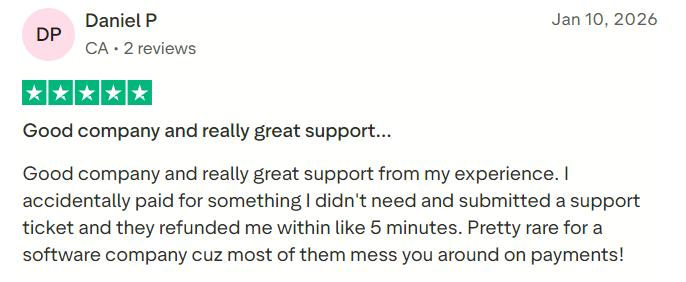
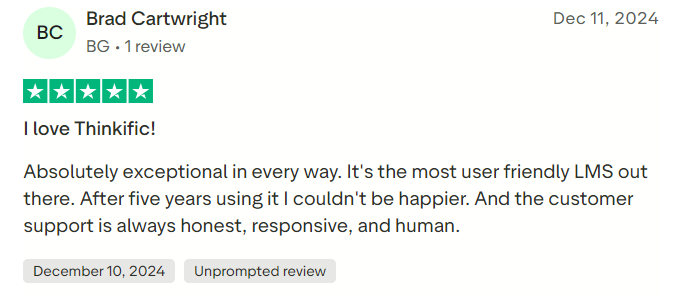
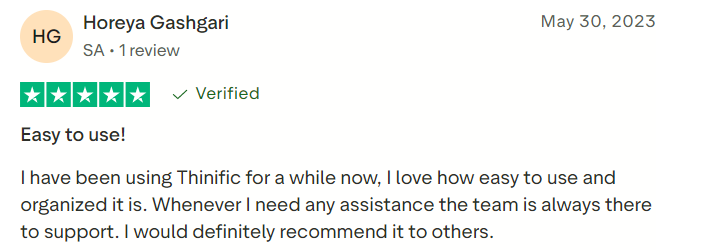
Thinkific currently displays a G2 rating of 4.5 out of 5 from more than 405 reviews. Reviewers frequently praise its ease of use, course builder, student experience, and ability to launch without programming.
Reported criticisms include plan costs, customization limitations, feature restrictions between tiers, additional application expenses, and the need for external marketing tools. Capterra has also historically shown favorable ratings, although review counts and averages change over time.
#1.
#2.
#3.
Thinkific Pros and Cons
Pros
Thinkific provides unlimited courses on paid plans, hosted video, AI-assisted creation, quizzes, assignments, certificates, communities, memberships, coaching, webinars, digital downloads, a website builder, custom domains, and integrated ecommerce.
It supports one-time purchases, subscriptions, payment plans, bundles, upsells, order bumps, gifting, coupons, and B2B sales. Other strengths include its 30-day trial, mobile access, application marketplace, payment management, strong customer ratings, and ability to scale from an independent creator to a larger academy.
Cons
Thinkific no longer provides a permanent free plan, and its August 2026 price increase makes the paid subscriptions more expensive. Thinkific branding is not removed until Grow, while SCORM and single sign-on require Plus.
The branded mobile application costs $199 per month unless included in a qualifying Plus contract. Payment processing, external-gateway fees, tax services, invoicing, apps, and third-party marketing software can increase the total cost substantially. Its website and email tools are also less advanced than specialized products.
Is Thinkific Worth It?
Thinkific is worth considering for creators and education businesses that prioritize structured course delivery, communities, reliable hosting, and integrated ecommerce. Start provides the most balanced feature set for a typical course business, while Grow is valuable for B2B academies and companies requiring stronger integrations.
The main concern is total cost. The subscription, payment charges, tax tools, applications, mobile app, and marketing software can create a much larger annual expense than the advertised plan price.
Final Verdict
Thinkific is a mature and capable learning-commerce platform that combines courses, communities, digital products, memberships, coaching, payments, and student management. Its interface is approachable for beginners while Grow and Plus provide a path toward professional and enterprise use.
Its primary strengths are course creation, ecommerce, learner experience, and scalability. Its main disadvantages are rising subscription prices, expensive advanced features, payment-related fees, and the separate cost of a branded mobile application.
Prospective customers should use the 30-day trial to build a representative course, upload video, configure payments, test assessments, create a community, complete a sample purchase, and review the mobile learner experience. If the platform satisfies those real-world requirements, Thinkific remains a strong option for building and scaling an online education business.