


Payhip is an ecommerce platform that allows creators to sell digital downloads, online courses, memberships, coaching services, subscriptions, and physical products. It combines a hosted storefront with checkout tools, payment integrations, file delivery, course hosting, customer management, marketing features, and tax support.
The platform is particularly accessible to beginners because its principal features are available through the Free Forever plan. Payhip does not restrict products or revenue by subscription level. Instead, sellers generally upgrade to reduce or eliminate the platform’s transaction fee. Although this pricing structure makes Payhip attractive to new creators, its website design, email automation, course administration, and customization tools are not as advanced as those offered by some specialist platforms.
Bonus Free Guide Included
What Is Payhip?
Payhip is a hosted ecommerce service created for educators, authors, coaches, artists, designers, software developers, and small online businesses. It provides the essential tools needed to present products, collect payments, deliver purchases, and manage customers without requiring a custom ecommerce website.
Creators can use Payhip to sell ebooks, templates, printables, music, audio, videos, photography, design assets, software, license keys, courses, memberships, coaching programs, subscriptions, digital bundles, and physical merchandise. Sellers can operate Payhip as their main website or add Payhip product links and checkout buttons to an existing site. The official Payhip website provides further information about its supported product formats.
How Payhip Works
After opening an account, a creator selects a product type, uploads the relevant content, establishes a price, and connects a supported payment processor. Payhip then generates a product page and checkout experience.
When a customer purchases a digital product, Payhip processes the payment through the connected provider and automatically supplies the relevant file or access instructions. Course customers enter the learning area, membership subscribers receive access to protected content, and coaching clients can follow the configured scheduling or meeting links. Sellers can also customize their storefront, connect a domain, create promotions, email customers, review orders, and monitor sales from the administrative dashboard.
Explore The AI-Linked Asset Class Elites are Investing In
Digital Downloads
Digital downloads are among Payhip’s strongest features. Creators can upload ebooks, PDFs, videos, audio recordings, ZIP archives, templates, graphics, spreadsheets, presentations, and numerous other digital formats. Individual files can currently be as large as 5 GB, and several files can be included within a single product.
Payhip automatically creates a download page after a successful payment and emails the customer a link for later access. Sellers can configure fixed or pay-what-you-want pricing, product variations, preview files, limited quantities, tax exemptions, mailing-list connections, license keys, and public, private, or unlisted visibility. For example, a price of “0+” allows customers to pay any amount, including nothing, while “5+” establishes a minimum contribution of $5. Payhip’s digital-product guide explains these settings in greater detail.
PDF Protection
Payhip provides PDF stamping to discourage unauthorized distribution. Eligible PDF files can be marked with customer information, making a shared copy easier to connect to its original purchaser.
This protection serves as a basic deterrent rather than comprehensive digital-rights management. Customers may still photograph, reproduce, or modify the material, so businesses selling especially valuable intellectual property may need stronger security or controlled browser-based access.
Software License Keys
Software creators can configure Payhip to generate a unique license key for each eligible purchase. This feature can support the sale of plugins, applications, templates, and other licensed digital products.
The built-in system is appropriate for basic key generation and delivery. Developers needing device activation, recurring-license validation, remote revocation, usage restrictions, or detailed licensing analytics may require a dedicated license-management platform.
Online Courses
Payhip includes a hosted course builder that organizes educational material into sections and lessons. Course creators can publish video, text, downloads, quizzes, surveys, assignments, embedded media, and links to external resources. They can also release lessons gradually through drip schedules and provide completion certificates.
The course functionality is included in every Payhip subscription and is well suited to independent educators delivering straightforward, self-paced programs. However, it lacks some of the capabilities available in advanced learning-management systems, including SCORM support, complex learning paths, detailed gradebooks, sophisticated prerequisites, secure examinations, and enterprise reporting.
Course Video Hosting
Course creators can embed video from YouTube, Vimeo, Wistia, and similar services without paying Payhip an additional hosting fee. Payhip has also historically offered direct course-video hosting for an extra $5 per month.
Creators should confirm the current price and storage allowance before uploading an extensive video library. External hosting may reduce Payhip expenses, but it can introduce another subscription and require careful privacy configuration.
Drip Content
Payhip’s drip functionality allows lessons to be released according to a predefined schedule. This is useful for cohort programs, weekly courses, membership education, and structured learning experiences.
Scheduled delivery can help learners remain focused and prevent them from rushing through an entire program without completing its activities. Before launching, creators should test how release dates, time zones, late enrollments, and access for existing students are handled.
Quizzes and Assignments
Course lessons can contain quizzes, surveys, and assignments. These features allow instructors to conduct knowledge checks, ask reflection questions, distribute homework, collect student projects, obtain program feedback, and create intake or completion activities.
The tools are suitable for creator-led education but may not meet the requirements of formal academic programs. Organizations needing advanced grading, question banks, examination security, proctoring, or accredited assessments should consider a specialized learning-management system.
Completion Certificates
Payhip can issue certificates to eligible learners after course completion. Certificates may improve motivation and provide students with evidence that they completed a particular program.
Course creators should avoid suggesting that these certificates represent professional accreditation unless the course has received appropriate external recognition. Regulatory and professional requirements exist independently of Payhip’s certificate feature.
Memberships
Payhip allows creators to sell recurring access to protected digital products and member-only content. Memberships can be divided into tiers with different prices, downloads, premium posts, courses, videos, audio, monthly resources, community updates, and subscriber benefits.
Plans may be billed monthly or annually. Because Payhip subscriptions have traditionally required Stripe, sellers should verify which payment gateways and recurring-payment methods are available in their countries. The membership functionality works well for content subscriptions, although it provides fewer social and community features than dedicated platforms such as Circle or Mighty Networks.
Coaching Products
Coaches and consultants can use Payhip to sell individual sessions or packaged services. Products can direct customers to external scheduling and communication tools such as Calendly, Zoom, or Skype.
Possible offers include discovery sessions, private coaching, consulting, tutoring, mentoring, strategy calls, professional reviews, group programs, and fixed-duration packages. Payhip handles the sales page and payment process, while the connected service manages scheduling and meetings. It does not include the advanced contracts, client notes, goals, progress tracking, and engagement tools found in coaching-specific platforms such as Paperbell or CoachAccountable.
Physical Products
Payhip also supports physical merchandise. Sellers can create product variations, assign stock-keeping units, monitor inventory, apply sale prices, and manage orders. This makes it possible to sell printed books, artwork, crafts, accessories, educational materials, branded goods, and other merchandise alongside digital products.
Inventory is automatically reduced when sales occur, but the seller remains responsible for packaging, shipping, delivery, returns, and customer support. Payhip is suitable for modest physical-product catalogs, while businesses with multiple warehouses, large inventories, retail locations, or complex fulfillment requirements may find Shopify or another dedicated ecommerce platform more appropriate.
Product Bundles
Creators can combine courses, ebooks, templates, downloads, memberships, and other products into packages. Bundles can increase average order value, create themed collections, or represent different stages of an educational program.
Sellers should check bundle access whenever individual products are updated, removed, or sold separately. This helps ensure that customers continue receiving everything included in their original purchase.
Store Builder
Payhip includes a hosted store builder that allows users to customize themes, pages, colors, typography, navigation, product displays, and branding without coding. A store can contain a homepage, product and collection pages, course listings, an About page, contact details, policies, and custom content sections.
The builder is adequate for creating a professional storefront, and custom CSS can provide selected design adjustments. Nevertheless, Payhip does not offer the extensive theme selection, application marketplace, blogging functionality, or development flexibility available through Shopify or WordPress.
Custom Domains
Sellers can connect a custom domain or subdomain without paying Payhip an additional connection fee. The domain itself must still be registered and renewed through an external registrar.
Using a custom domain can strengthen branding and make the store appear more independent. Sellers should retain ownership of their registrar accounts and document their DNS settings in case they later move to another platform.
Embedding Payhip on Another Website
Creators with an existing website can link directly to Payhip products or add Buy Now buttons to their pages. This arrangement allows WordPress, Squarespace, Wix, or another website platform to manage public content while Payhip handles checkout and product delivery.
The complete purchasing experience should be tested on desktop and mobile devices. Even when Payhip appears integrated with another website, certain stages of checkout or delivery may still occur on Payhip-hosted pages.
Payment Processors
Payhip’s documentation currently identifies 13 supported payment processors: PayPal, Stripe, Mollie, Square, Mercado Pago, Flutterwave, Paystack, Xendit, Midtrans, PayU, Razorpay, Iyzico, and PayTabs. Availability depends on the seller’s country, currency, product type, and the requirements of each provider.
Sellers can generally connect PayPal together with one additional processor for card payments and other regional methods. Each provider has its own fees, payout times, reserves, dispute procedures, and supported currencies. Payhip’s payment guide contains the current list and regional conditions.
Payouts
Payments are handled by the seller’s connected processor rather than being accumulated under a universal Payhip payout schedule. The time required to access funds therefore depends on Stripe, PayPal, Square, or the applicable regional provider.
Verification reviews, newly created accounts, high-risk products, disputes, and sudden increases in sales may delay payouts. Sellers should understand their provider’s reserve and verification policies before running a major promotion.
EU and UK VAT
Payhip is known for managing digital VAT in the European Union and United Kingdom. For qualifying transactions, it can calculate the required tax, collect it from the customer, and manage remittance.
This service can reduce the administrative burden associated with international digital sales. However, creators must still retain appropriate accounting records and confirm which products and jurisdictions are covered. Tax treatment varies according to the product, customer location, business registration, and current legislation, so professional advice may be necessary.
US Sales Tax
Payhip states that, from July 1, 2026, it handles US sales-tax collection and remittance as a marketplace facilitator. Sellers assign the appropriate category to each product, after which Payhip calculates tax according to the customer’s jurisdiction.
Payhip does not charge an additional platform fee for this service. However, businesses with a physical presence or another obligation in a state might still need to submit a zero-dollar return even when Payhip remits the tax. The company’s US sales-tax documentation explains this distinction. Sellers should remember that Payhip’s tax services do not remove every possible income-tax, VAT, GST, sales-tax, or business-registration obligation.
Marketing Tools
Every Payhip plan includes promotional tools covering coupons, sales, affiliates, customer referrals, cross-selling, upgrade discounts, reviews, mailing lists, newsletters, lead magnets, collaborations, marketplace listings, social profiles, basic SEO, Google Analytics, and Meta Pixel.
The availability of these tools on the Free Forever plan allows creators to test promotional strategies without upgrading their accounts. Payhip’s marketing documentation provides a current directory of these features.
Coupons and Discounts
Sellers can create percentage-based or fixed-value coupons that apply to an entire order, an individual product, or a product collection. They can establish expiration dates, redemption limits, and discount durations.
For subscriptions and installment plans, a discount may apply only to the first payment, continue for several months, or remain active throughout the customer relationship. Payhip can also generate up to 50 unique coupon codes in one session. The coupon guide explains the available conditions.
Affiliate Marketing
Payhip includes a built-in affiliate system through which sellers can approve partners, assign eligible products, establish commission percentages, and distribute tracked links. Its referral cookie currently lasts 30 days, and commissions are attributed according to the final qualifying touchpoint.
Although Payhip produces monthly affiliate-sales reports, it does not automatically pay affiliates. Sellers must calculate and issue payments using PayPal or another suitable method. Payhip’s affiliate documentation provides further information about registration, tracking, and manual payouts.
Customer Referrals
Payhip’s referral system encourages existing customers to recommend products in exchange for incentives. Unlike a conventional affiliate program, it is primarily intended to generate customer-to-customer sharing and word-of-mouth promotion.
Creators should calculate referral discounts and related acquisition costs carefully. They must also ensure that incentive programs comply with relevant advertising and disclosure rules.
Cross-Selling and Upsells
Sellers can recommend related products or provide upgrade discounts following selected purchases. These offers may increase average order value by introducing customers to complementary products.
For example, someone purchasing an ebook could receive an offer for a related course, membership, or template package. Recommendations should remain relevant and should not make the checkout experience unnecessarily confusing.
Email Marketing
Payhip offers newsletters and basic customer email tools, although its automation capabilities are less advanced than those of specialized email-marketing platforms. It integrates directly with ActiveCampaign, AWeber, Campaign Monitor, Kit, Drip, Elastic Email, EmailOctopus, Flodesk, GetResponse, Klaviyo, Mad Mimi, MailerLite, Mailchimp, and SendFox. Other platforms may be connected through Zapier.
Customers can be added to a designated mailing list after purchasing a product. EU customers must provide active consent during checkout before their information can be transferred to the connected marketing provider. Payhip’s mailing-list documentation explains its supported services and consent procedures.
Analytics and Reporting
The Payhip dashboard provides information about orders, revenue, products, customers, coupons, and affiliate activity. Connections with Google Analytics and Meta Pixel can supply additional information about traffic, advertising, and conversions.
These reports are adequate for routine creator-business management. Companies requiring detailed attribution, cohort analysis, forecasting, or consolidated multichannel reporting may need a dedicated analytics or business-intelligence platform.
Payhip Marketplace
Payhip operates a marketplace that may introduce products to customers beyond a creator’s existing audience. Eligibility, product categories, approvals, rankings, and visibility remain under Payhip’s control.
Marketplace exposure should be considered an additional opportunity rather than a guaranteed sales channel. Sellers remain responsible for developing audiences through content marketing, email lists, partnerships, social media, and advertising.
Payhip Pricing
Payhip currently provides three subscription options. Free Forever costs nothing per month and applies a 5% Payhip transaction fee. Plus costs $29 per month and reduces the fee to 2%, while Pro costs $99 per month and removes the platform transaction fee.
All three plans include the same principal features, unlimited products, and unlimited revenue. Upgrading changes the fixed subscription price and Payhip’s percentage fee rather than unlocking a separate collection of features. Payment processors continue to apply their normal charges on every plan. Sellers should verify current terms through the official Payhip pricing page before subscribing.
Free Forever Plan
The Free Forever plan has no monthly charge and applies a 5% fee to sales. It includes the store builder, digital downloads, courses, memberships, coaching products, marketing tools, unlimited products, and unlimited revenue.
This option is especially useful for creators who are validating an idea, have unpredictable sales, or want to avoid fixed software expenses. However, its percentage fee becomes progressively more expensive as revenue increases.
Plus Plan
The Plus plan costs $29 per month and reduces Payhip’s fee from 5% to 2%. Because the plan saves three percentage points, it reaches an approximate break-even point at $967 in monthly sales:
$29÷0.03≈$967
Above approximately $967 in monthly Payhip revenue, Plus may cost less than Free Forever, excluding payment-processing fees, taxes, refunds, and other expenses.
Pro Plan
The Pro plan costs $99 per month and eliminates Payhip’s platform transaction fee. Payment processors still impose their regular charges.
Compared with Plus, Pro costs an additional $70 per month while saving two percentage points in fees. Its approximate break-even point is therefore $3,500 in monthly sales:
$70÷0.02=$3,500
A seller generating more than approximately $3,500 per month may pay less with Pro than with Plus. Compared directly with Free Forever, Pro reaches an approximate break-even point at $1,980 per month. Actual results depend on refunds, taxes, payment-processing costs, and the transactions to which Payhip applies its percentage fee.
Additional Costs
Payhip’s subscription or transaction fee may not represent the complete cost of operating an online store. Other expenses can include payment processing, direct course-video hosting, domain registration, email-marketing software, Zapier, external video platforms, scheduling tools, affiliate commissions, advertising, accounting software, professional tax advice, legal assistance, website design, and content production.
Businesses must also allow for refunds, chargebacks, and currency conversion. Physical-product sellers face additional costs related to inventory, packaging, shipping, customs, returns, fulfillment, and lost deliveries.
Ease of Use
Payhip is relatively easy to operate. Beginners can upload a product, connect a payment provider, and publish a checkout without configuring a complicated ecommerce system. Its administrative interface is straightforward, and users can build and test a store on the Free Forever plan without providing payment details for a subscription.
This simplicity involves a tradeoff. Businesses may eventually outgrow Payhip if they need advanced website design, complex inventory management, a large application ecosystem, sophisticated course administration, detailed reporting, or extensive email automation.
Customer Support and Reviews
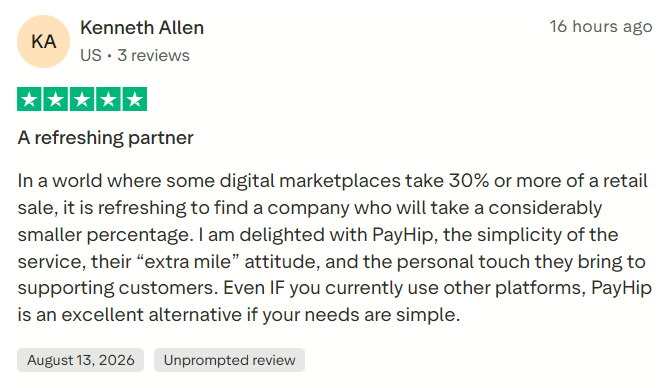
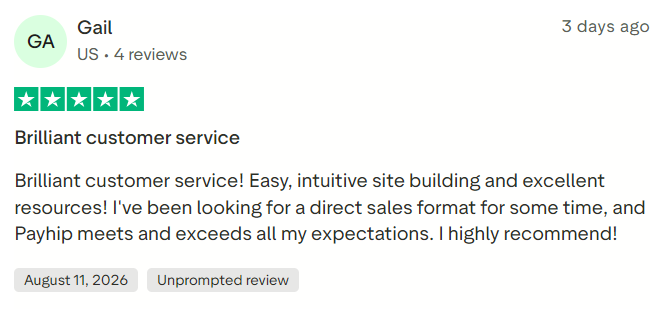
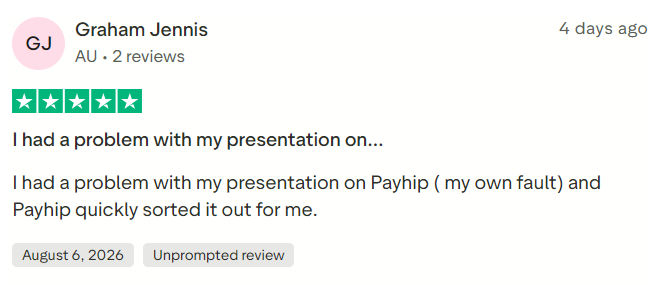
Payhip provides a help center and email-based support. Customer reviews frequently praise the company for responsive, detailed, and personalized assistance.
As of August 2026, Payhip had a Trustpilot rating of 4.5 out of 5 based on 495 reviews. Positive feedback commonly mentioned affordability, ease of use, storefront management, and helpful support, while some reviewers reported slow responses, domain-related technical difficulties, or unexpected account closures. Because ratings and review totals change, readers should consult Payhip’s current Trustpilot profile.
Businesses should also examine Payhip’s acceptable-use policies and retain independent backups of their product files, descriptions, reports, and customer records. This can reduce disruption if an account is restricted or the seller decides to migrate.
#1.
#2.
#3.
Payhip Advantages
Payhip’s most significant advantage is its feature-complete Free Forever plan. Creators can sell unlimited products and earn unlimited revenue without committing to a monthly subscription. The platform supports downloads, courses, memberships, coaching, subscriptions, and physical products within one storefront.
Additional strengths include automatic product delivery, custom domains, certificates, coupons, affiliate tools, email integrations, tax support, and access to numerous regional payment processors. Its pricing is also relatively transparent, allowing businesses to choose plans according to revenue instead of required functionality.
Payhip Disadvantages
The principal drawback is that Free Forever and Plus apply Payhip transaction fees in addition to payment-processing charges. These percentages can become costly as sales grow.
Payhip’s website builder, SEO tools, course functionality, email automation, community features, reporting, and physical-product management are also less sophisticated than those of specialist platforms. Affiliate payments require manual administration, direct course-video hosting may cost extra, and the platform lacks the extensive third-party application ecosystem available through Shopify or WordPress.
Who Should Use Payhip?
Payhip is a strong option for first-time digital sellers, ebook authors, template creators, designers, artists, photographers, musicians, independent educators, coaches, consultants, membership businesses, and developers with straightforward licensing needs. It can also serve creators selling a modest combination of digital and physical products.
The Free Forever plan is particularly valuable for businesses that want to test demand before committing to regular software expenses.
Is Payhip Worth It?
Payhip is worth considering for creators who want to begin selling without paying a monthly subscription. The Free Forever plan is unusually generous because it includes the platform’s principal features, unlimited products, and unlimited revenue.
The most economical option depends largely on sales volume. Free Forever is generally attractive below approximately $967 in monthly revenue, while Plus becomes increasingly economical above that level. Pro may provide better value than Plus when monthly revenue reaches approximately $3,500.
Price should not be the only consideration. Sellers should also evaluate payment availability, tax responsibilities, design expectations, course requirements, marketing functionality, and expected business growth.
Final Verdict
Payhip is an accessible and cost-effective platform for selling digital downloads, online courses, memberships, coaching services, and a modest range of physical products. Its leading advantages are its comprehensive free plan, straightforward storefront, unlimited products, broad payment support, automatic delivery, tax assistance, and useful promotional tools.
Its main weaknesses are the transaction fees imposed by the lower plans and its comparatively limited ecommerce, email, community, reporting, and learning-management capabilities.
Overall, Payhip is an excellent option for new and growing digital creators who want to minimize upfront costs and use uncomplicated selling tools. Its Plus and Pro subscriptions provide logical upgrade paths as revenue grows, although larger and more specialized businesses may eventually require a more advanced platform.