
When my family first started researching Christian homeschool curricula, Master Books appeared almost everywhere.
Parents praised its short lessons, biblical worldview, colorful workbooks, simple schedules, and relatively affordable prices. It sounded like the kind of curriculum that could make homeschooling feel manageable rather than turning our home into a miniature private school.
However, curriculum marketing and daily family life are not the same thing.
As a homeschooling dad, I do not just want books that look attractive on a shelf. I want to know whether the lessons are academically useful, whether my children can understand them, how much preparation falls on the parent, whether the curriculum fits our Christian beliefs, and what the entire school year will actually cost.
After examining Master Books’ programs, schedules, grade-level packages, online support, and common parent complaints, my conclusion is fairly straightforward:
Master Books is one of the better options for Christian families who want an affordable, gentle, open-and-go homeschool curriculum. However, it may feel too light for families seeking an academically intensive or highly traditional program.
Master Books Review: Quick Verdict
Master Books is best suited to families who want:
- A strongly Christian homeschool curriculum
- Short, manageable lessons
- Minimal teacher preparation
- Colorful, workbook-based materials
- A flexible rather than rigid school schedule
- The option to buy complete grade packages or individual subjects
- A gentler alternative to highly structured programs such as Abeka
It may not be the best choice for parents who want:
- A secular or religiously neutral curriculum
- Heavy repetition and drill
- Long, challenging daily assignments
- A traditional classroom-at-home structure
- Advanced math and language arts without supplementation
- A conventional mainstream treatment of origins and earth history
Master Books describes its curriculum as biblically rooted, academically solid, simple to use, and designed around open-and-go lesson plans. Its programs cover preschool through 12th grade, with options in mathematics, language arts, science, history, geography, Bible, apologetics, and electives.
What Is Master Books?
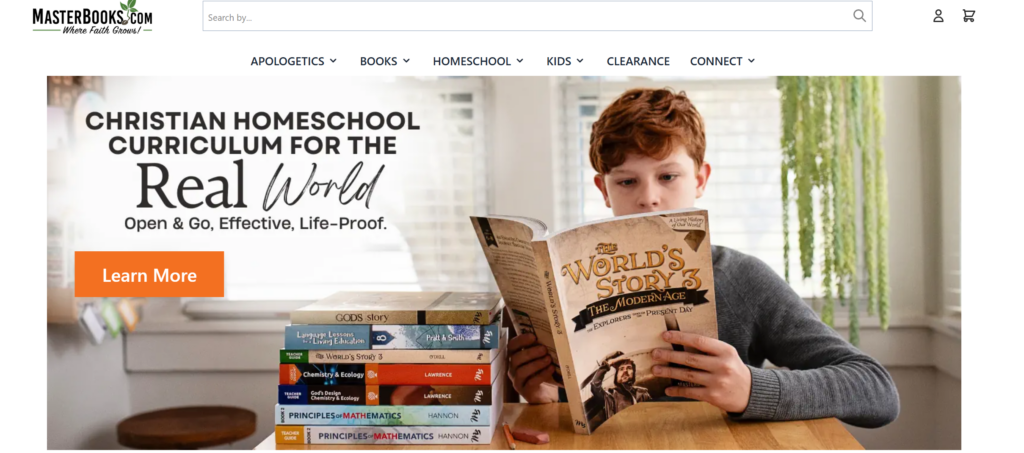
Master Books is a Christian curriculum publisher owned by New Leaf Publishing Group. It offers printed and digital homeschool materials from preschool through high school.
The curriculum is explicitly Christian rather than merely “family friendly.” Biblical teachings are integrated into academic subjects, especially science, history, language arts, geography, and apologetics.
Master Books offers two primary ways to build a homeschool program:
- Purchase a Basic 4-Subject Set for the student’s grade.
- Choose individual courses à la carte.
The Basic 4-Subject Sets generally include:
- Mathematics
- Language arts
- Science
- History or geography
Parents can then add Bible, handwriting, foreign language, art, music, physical education, or other electives separately.
The company also operates Master Books Academy, which provides optional self-paced video instruction and enrichment classes. Academy courses include core subjects and electives, with 18 months of on-demand access.
Is Master Books Accredited?
Master Books is a curriculum publisher, not an accredited school.
That distinction matters.
Buying Master Books materials does not mean your child is enrolled in an accredited private or online school. The parent remains responsible for administering the homeschool, maintaining records, meeting state requirements, issuing grades, and preparing transcripts where necessary.
Accreditation is generally attached to an institution rather than a collection of textbooks.
For most homeschool families, this is not automatically a problem. Many homeschoolers use non-accredited curricula successfully and create parent-issued transcripts. However, families should check their state’s homeschool laws and any specific college, scholarship, military, or athletic requirements that may apply.
My First Impression as a Homeschooling Dad
My first impression of Master Books was that it seemed designed by people who understood the difference between homeschooling and recreating a classroom at the dining-room table.
That is one of its greatest strengths.
Some curricula hand parents multiple teacher manuals, extensive supply lists, complicated lesson plans, tests, answer keys, flashcards, charts, and supplementary readers. Before teaching the first lesson, the parent feels as though he needs professional development training.
Master Books generally takes the opposite approach.
The books are intended to be opened and used with relatively little preparation. Instructions, assignments, schedules, and answer keys are commonly incorporated into a manageable set of materials.
As a dad balancing work and family responsibilities, that matters to me. I want to participate in my children’s education without spending Sunday evening assembling an administrative binder for the coming week.
Master Books is particularly attractive to:
- First-time homeschoolers
- Families teaching several children
- Parents with limited planning time
- Children who become overwhelmed by long assignments
- Families moving away from public school
- Parents who want education to feel connected to ordinary family life
What Makes Master Books Different?
Several features separate Master Books from more traditional Christian homeschool programs.
1. The Open-and-Go Format
“Open and go” is one of the company’s main selling points, and in most cases the description is accurate.
The parent opens the book, follows the provided schedule, reads the instructions, and begins the assignment. Master Books says its curricula include preplanned, age-appropriate lessons intended to help students progress without extensive preparation by the parent.
This does not mean parents are unnecessary.
Younger students still need instruction, supervision, discussion, correction, and encouragement. Even older students benefit from a parent checking their understanding rather than merely marking completed pages.
But the curriculum removes much of the organizational burden.
I do not need to invent an entire educational plan. I can focus on helping my child learn.
2. Shorter, Gentler Lessons
Master Books lessons are generally shorter than those found in traditional classroom-style curricula.
For example, reviews of Math Lessons for a Living Education commonly describe daily lessons as taking roughly 20 to 30 minutes, depending on the student and level. One parent reviewing Level 5 reported that the course followed a 36-week, 180-day structure with daily lessons designed to remain manageable.
This shorter format can be a major advantage for:
- Young children
- Reluctant learners
- Students with attention difficulties
- Children recovering from school-related burnout
- Families teaching multiple grade levels
- Parents who prefer focused instruction over busywork
As a dad, I would rather see my child work attentively for 25 minutes than spend 60 minutes staring at a worksheet because somebody decided longer automatically means better.
However, “gentle” can also become a weakness. Some students need more practice than Master Books provides, particularly in math, spelling, grammar, and writing.
3. A Living-Education Approach
Several of Master Books’ best-known programs carry the phrase “Living Education,” including:
- Math Lessons for a Living Education
- Language Lessons for a Living Education
- America’s Story
- The World’s Story
The approach uses stories, real-life applications, conversation, narration, copywork, observation, and hands-on activities rather than relying exclusively on abstract drills.
It is often described as Charlotte Mason-inspired, although it is not a pure Charlotte Mason curriculum. It incorporates some Charlotte Mason techniques while retaining a workbook-based structure.
Language Lessons for a Living Education, for example, combines stories with grammar, vocabulary, spelling, reading comprehension, writing, memorization, narration, and other activities. Independent curriculum reviewers describe it as blending traditional exercises, stories, puzzles, discussion, copywork, and creative work.
This style can help children see why they are learning something.
A math problem may appear inside a family story. A language lesson may involve Scripture, observation, or narration. History may be presented as a connected narrative rather than a list of disconnected dates.
4. A Four-Day Weekly Schedule in Many Courses
Many Master Books courses are arranged around a four-day week, although schedules vary by course.
The four-day structure provides breathing room for:
- Field trips
- Co-op classes
- Appointments
- Catch-up work
- Nature study
- Family activities
- Electives
- A lighter Friday
A four-day schedule does not necessarily mean the curriculum is incomplete. Homeschooling usually requires less time than conventional schooling because the parent is not managing 25 or 30 students.
Still, parents should not assume every child will finish each lesson within the suggested time. Some children will need additional days or practice.
5. Christianity Is Integrated Across Subjects
Master Books is unapologetically Christian.
Bible verses and Christian teachings are not confined to a separate religion textbook. The worldview appears throughout language arts, science, history, geography, literature, and other courses.
The company says its scope and sequence combines academic subjects with biblical apologetics and a Christian worldview.
For our family, that integration can be a significant advantage. I do not want faith treated as something that happens for an hour on Sunday and then disappears when we discuss history or science.
However, families need to understand how specific the Master Books worldview is.
This is not a generally spiritual curriculum that occasionally mentions God. It often reflects conservative evangelical Protestant theology and a young-earth creationist interpretation of origins.
Parents who agree with that perspective may consider it one of the curriculum’s greatest strengths. Catholic, Orthodox, mainline Protestant, or theologically diverse families may want to review individual courses before buying a complete package.
Secular families will almost certainly find the religious content too extensive.
6. Strong Emphasis on Biblical Apologetics
Master Books is closely associated with Christian apologetics, including material connected to Answers in Genesis founder Ken Ham.
Students may encounter lessons defending:
- Biblical authority
- Creation
- A young earth
- The historical reliability of Genesis
- Christian responses to evolution
- Christian interpretations of history and culture
This makes Master Books more worldview-driven than many other Christian curricula.
Some Christian publishers add Bible verses to conventional academic content. Master Books more frequently attempts to construct the subject itself through a biblical framework.
Whether that is a strength or weakness depends heavily on the parents’ beliefs.
7. Grade-Level Bundles and À La Carte Flexibility
One of the practical advantages of Master Books is that parents do not have to purchase an entire boxed curriculum.
A family can buy the Basic 4-Subject Set, but it can also mix levels and subjects.
For example, a fifth-grade child might use:
- Fifth-grade language arts
- Sixth-grade math
- Fourth- or fifth-grade science
- A history course shared with siblings
That flexibility matters because homeschooled children do not always progress at the same level in every subject.
Master Books officially allows families to choose a full-grade package or shop by individual subject. Its website also provides placement tests and a scope and sequence to assist parents.
8. Physical and Digital Options
Many Master Books materials are available as printed books, digital PDFs, or both.
Digital files may reduce the initial cost and are useful for:
- International families
- Immediate access
- Reprinting selected activities where licensing permits
- Families avoiding shipping costs
- Parents who prefer tablets or computers
However, parents should read the licensing conditions before printing copies for multiple children.
Consumable physical workbooks may need to be repurchased for younger siblings, while reusable textbooks can often be passed down.
9. Optional Master Books Academy Courses
Master Books Academy adds instructor-led video support to selected courses.
The Academy is not a separate accredited school. It is an online supplement designed to accompany Master Books materials.
According to the company, Academy courses are:
- Self-paced
- Taught by Christian instructors
- Available on demand
- Accessible for 18 months
- Offered in core subjects and electives
Courses include options in math, science, language arts, music, physical education, and other topics.
This could be helpful when:
- A parent is uncomfortable teaching a subject
- A student benefits from video explanation
- An older child needs greater independence
- The family wants outside teaching without enrolling in a full online school
It also increases the total cost, so families should not assume online instruction is included with the printed curriculum.
Master Books Curriculum by Subject
Master Books Math Review
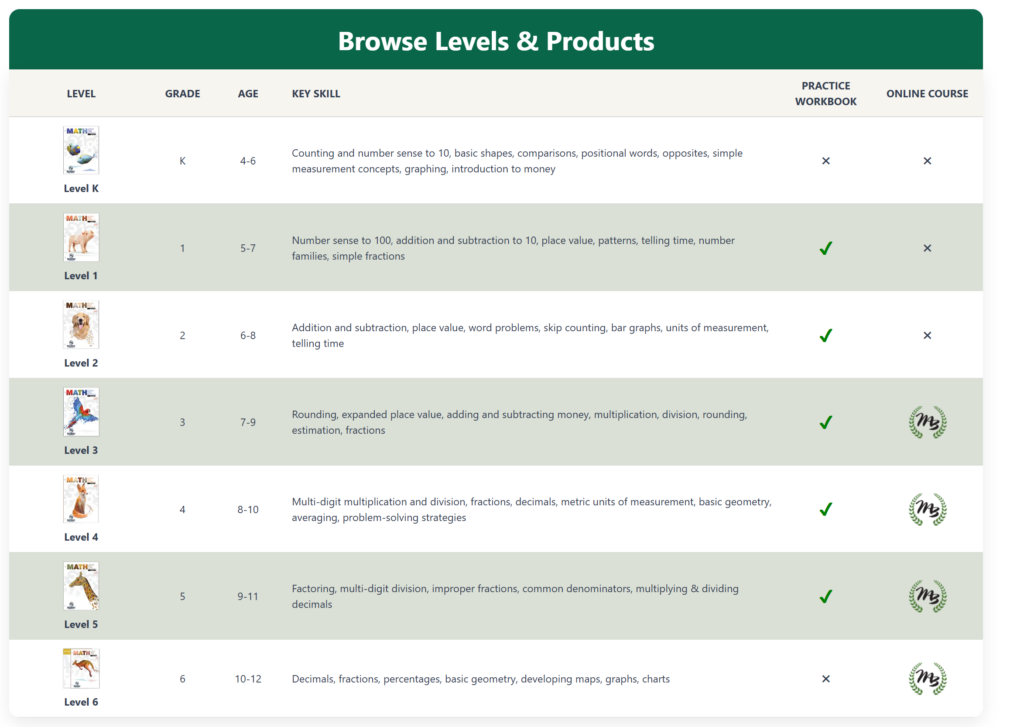
Math Lessons for a Living Education is probably the company’s most recognizable series.
The elementary program teaches mathematics through stories, everyday applications, short assignments, review exercises, and hands-on activities.
A typical level may cover:
- Addition and subtraction
- Multiplication and division
- Place value
- Fractions
- Measurement
- Geometry
- Money
- Time
- Word problems
- Practical mathematical reasoning
What I Like About Master Books Math
The program tries to answer the question children frequently ask:
“When am I ever going to use this?”
Math is connected to shopping, cooking, building, travel, nature, family projects, and daily decisions. This can make abstract concepts feel less intimidating.
The pages are colorful and usually less visually overwhelming than worksheets packed with dozens of nearly identical problems.
Level 1 was listed at a promotional price of $39.19, with a regular list price of $48.99, when checked in July 2026.
Possible Weaknesses of Master Books Math
The most common concern is that the elementary math series may not provide enough repetition for every student.
A child who understands concepts quickly may do well. A child who needs extensive drill to retain math facts may require:
- Additional worksheets
- Flashcards
- Mental-math practice
- A separate facts program
- More cumulative review
- Math games or manipulatives
Some parents also believe the sequence feels unconventional or moves too gently compared with programs such as Saxon, Singapore Math, Math-U-See, or Christian Light Education.
My view as a dad is that a math curriculum should be judged by mastery, not by how relaxed or rigorous its reputation sounds.
If my child can explain the concept and solve problems independently, the program is working. If he enjoys the stories but cannot retain basic facts, I need to supplement or switch.
Master Books Language Arts Review
Language Lessons for a Living Education combines several language arts components into one program.
Depending on the level, these can include:
- Reading
- Grammar
- Writing
- Spelling
- Vocabulary
- Copywork
- Narration
- Memorization
- Reading comprehension
- Picture study
- Biblical character lessons
Level 1 is designed for children approximately ages five to seven who have already completed a basic phonics course and can read simple words and beginning sight words. Master Books describes it as a gentle course using stories and hands-on activities to develop reading and writing confidence.
What I Like About Master Books Language Arts
Combining multiple areas into one course simplifies the school day.
Instead of buying separate grammar, spelling, handwriting, composition, and reading-comprehension programs, a parent can cover several skills through one daily routine.
The narrative format also makes lessons feel less clinical.
Independent reviewers have praised the program’s predictable weekly rhythm, shorter assignments, story-based instruction, and integration of copywork, narration, grammar, spelling, and Scripture.
Possible Weaknesses of Master Books Language Arts
The all-in-one design means that no individual area is always covered as deeply as it would be in a specialized program.
Children who struggle with spelling may need a dedicated spelling curriculum.
Students who need systematic grammar instruction may require more explicit teaching and review.
Strong writers may find some assignments too light, while reluctant writers may appreciate the gradual progression.
Some parents also feel that the amount of Scripture memorization or Bible-related material becomes repetitive when the family already uses a separate Bible curriculum.
In my home, I would evaluate language arts by looking at the child’s actual work:
- Can he spell common words?
- Can he write a coherent paragraph?
- Can he identify basic grammar?
- Can he summarize what he read?
- Is his writing improving over time?
Finishing the workbook is not the same as mastering the subject.
Master Books Science Review
Master Books science is one of the company’s most distinctive—and potentially divisive—areas.
Programs include titles and series such as:
- Adventures in Creation
- Let’s Talk Science
- God’s Design
- Applied Engineering
- General Science
- Biology
- Chemistry
- Physics
- Earth science and astronomy resources
The courses are presented from a biblical creationist worldview.
Advantages of Master Books Science
Christian families who want science and faith treated as compatible will appreciate the direct worldview integration.
The books are often visually attractive and use:
- Demonstrations
- Experiments
- Discussion questions
- Diagrams
- Real-world examples
- Vocabulary exercises
- Biblical connections
Elementary science activities often rely on common household materials rather than expensive laboratory kits.
Potential Concerns About Master Books Science
Parents must be comfortable with young-earth creationism.
Master Books materials may challenge conventional scientific conclusions concerning:
- The age of the earth
- Evolution
- Fossil formation
- Geological timescales
- Human origins
Families should not purchase the science curriculum merely because it is labeled Christian. They should examine sample pages and understand the scientific and theological framework being taught.
Parents preparing students for college-level biology, geology, medicine, or other scientific fields may also want to ensure that students understand mainstream terminology and theories, even when the family disagrees with some conclusions.
A strong education should prepare a student to explain both his own position and the position he is criticizing.
Master Books History Review
Master Books offers several narrative history and geography programs, including:
- My Story
- America’s Story
- The World’s Story
- World Geography
- American history
- Civics and economics
- Church history and apologetics resources
The history programs often emphasize:
- Stories and biographies
- Christian figures
- Providence
- Western civilization
- American history
- Geography
- Family discussion
- Biblical worldview connections
Strengths of Master Books History
The narrative approach is generally more engaging than a textbook filled with dates and vocabulary terms.
History is presented as the story of real people making moral decisions rather than merely a sequence of government policies and wars.
Several programs can also be adapted for family use, allowing siblings to study related topics together.
Possible Weaknesses of Master Books History
Because the curriculum has a defined Christian and conservative worldview, some topics may receive an interpretation different from that found in mainstream public-school materials.
That is not automatically a defect. Every history curriculum selects facts, themes, and perspectives.
However, parents should consider whether the course:
- Presents competing interpretations fairly
- Uses reliable primary and secondary sources
- Distinguishes fact from theological interpretation
- Gives difficult historical subjects sufficient depth
- Avoids idealizing individuals or nations
I want my children to understand our beliefs, but I also want them to recognize complexity rather than assuming every historical event fits neatly into a moral slogan.
Master Books Pricing in 2026
Master Books is generally less expensive than many all-inclusive Christian homeschool programs, although the final total depends on grade level, electives, digital versus physical materials, and whether the family adds Academy courses.
The following prices were displayed on the official Master Books website when checked in July 2026.
| Grade | Basic 4-Subject Set Price | Listed Retail Price |
| Kindergarten | $151.16 | $188.96 |
| Grade 1 | $236.72 | $295.92 |
| Grade 2 | $163.16 | $203.96 |
| Grade 3 | $194.34 | $242.94 |
| Grade 4 | $194.34 | $242.94 |
| Grade 5 | $234.33 | $292.93 |
| Grade 6 | $276.72 | $345.92 |
| Grade 7 | $280.72 | $350.92 |
| Grade 8 | $280.72 | $350.92 |
| Grade 9 | $320.72 | $400.92 |
| Grade 10 | $331.11 | $413.91 |
| Grade 11 | $324.71 | $405.91 |
| Grade 12 | $341.47 | $426.87 |
The grade-level sets include four core subjects: math, language arts, science, and history or geography. Exact course selections can change as editions and bundles are updated.
The Grade 12 Basic 4-Subject Set was listed at $341.47 against a retail price of $426.87.
Individual Course Prices
Individual elementary courses commonly cost approximately $30 to $55 at promotional prices, although curriculum packs containing several books cost more.
Examples from July 2026 included:
| Product | Displayed Price | List Price |
| Math Lessons for a Living Education Level 1 | $39.19 | $48.99 |
| Foundations Phonics | $35.99 | $44.99 |
| My Story 1 | $41.59 | $51.99 |
| Adventures in Creation Level 1 | $40.79 | $50.99 |
| Math Lessons for a Living Education Level 5 | $39.19 | $48.99 |
| Language Lessons for a Living Education Level 5 | $41.59 | $51.99 |
| Writing Strands Beginning 1 | $31.19 | $38.99 |
Some language arts curriculum packs cost considerably more because they include the core workbook and required companion books. For example, the Language Lessons for a Living Education Level 1 curriculum pack was listed at $79.16 against a retail price of $98.96.
Preschool Pricing
The Stepping Stones preschool course was listed in the 2026 spring catalog at:
- $50.99 regular price
- $40.79 promotional print price
- $35.69 for the digital PDF
Additional Costs to Consider
The Basic 4-Subject Set is not necessarily the family’s complete annual homeschool cost.
Parents may also need to budget for:
- Bible curriculum
- Handwriting
- Art or music
- Foreign language
- Laboratory materials
- Manipulatives
- Printer ink and paper
- Standardized testing
- Co-op fees
- Academy video courses
- Shipping
- Additional practice workbooks
- Replacement consumable books for siblings
Master Books provides free shipping on qualifying Basic 4-Subject Sets within the contiguous United States, but international families and families outside that area may face substantial shipping expenses.
Is Master Books Affordable?
Compared with all-in-one programs that can cost $700 to more than $1,500 per child, Master Books’ core packages are relatively affordable.
A family purchasing a Basic 4-Subject Set might spend roughly $150 to $350 per student before electives, online courses, supplies, and shipping.
Families can also reduce costs by:
- Purchasing only required subjects
- Choosing digital versions
- Reusing non-consumable books
- Buying during sitewide sales
- Using sibling-friendly history or science courses
- Avoiding unnecessary Academy add-ons
- Purchasing used teacher guides where permitted
The company runs periodic promotions. For example, its April 2026 early-bird sale advertised 30% off eligible sitewide purchases. Discounts are therefore not guaranteed year-round.
Pros and Cons of Master Books
Master Books Pros
1. Very Little Lesson Preparation
Schedules and instructions are generally prepared for the parent.
This is particularly useful for new homeschoolers and families with multiple children.
2. Strong Christian Worldview
Faith is integrated throughout the curriculum instead of being added as an afterthought.
3. Affordable Core Packages
A complete four-subject package generally costs considerably less than many premium boxed curricula.
4. Short, Manageable Lessons
Children can often complete focused work without spending the entire day at a desk.
5. Attractive, Full-Color Materials
The colorful pages and illustrations can make schoolwork more inviting, especially for younger students.
6. Flexible Scheduling
Parents can adjust the schedule, mix grade levels, choose individual courses, and use four-day weeks where appropriate.
7. Practical Learning
Lessons frequently connect academics with ordinary life, family activities, nature, stories, and real-world situations.
8. Good for Reluctant or Overwhelmed Learners
Students who struggled with a rigid school environment may respond well to the gentler pace.
9. Parent and Student Independence Can Increase Gradually
Older students may be able to work more independently once they understand the course routine.
Some homeschooling parents specifically praise Master Books for helping children transition toward independent work.
10. Optional Online Support
Master Books Academy gives families access to video teaching without requiring enrollment in a full online school.
Master Books Cons
1. It May Be Too Gentle for Some Students
Advanced students or families accustomed to traditional academic programs may find the workload light.
2. Some Subjects May Require Supplementation
Math facts, spelling, grammar, composition, or test preparation may need additional resources.
3. Strong Young-Earth Creationist Perspective
The science curriculum will not suit every Christian family, and it is inappropriate for families seeking secular science.
4. Protestant Evangelical Theology
Christian families from other traditions should inspect Bible and apologetics content carefully.
5. Less Drill and Repetition
Students who require repeated practice may not achieve mastery from the scheduled assignments alone.
6. Consumable Workbooks Increase Sibling Costs
Some books cannot simply be passed down without purchasing a new student workbook.
7. Complete Packages Do Not Include Everything
Parents may still need electives, Bible, handwriting, supplies, testing, and online instruction.
8. High-School Parents Must Manage Records
Master Books does not automatically provide accredited enrollment, official transcripts, counseling, or diploma services.
9. The Story Format Will Not Appeal to Every Child
Some students love learning through ongoing narratives. Others prefer direct explanations without fictional characters or extended stories.
10. International Shipping Can Be Expensive
Digital editions may be more practical for families outside the United States.
What Other Homeschooling Parents Say
Parent feedback tends to repeat several themes.
Positive reviews frequently mention:
- Easy schedules
- Short lessons
- Attractive workbooks
- Reduced planning
- Affordability
- Biblical integration
- Improved attitudes toward school
- Greater independence
The Homeschool Mom’s collection of parent reviews includes praise for the prepared schedule and the ability of children to begin their daily work independently.
Critical reviews frequently mention:
- Insufficient rigor
- Weak math-fact practice
- Limited spelling instruction
- Not enough cumulative review
- Excessive religious integration for some families
- The need to supplement
- Courses being below a child’s expected grade level
Independent reviews often characterize Master Books as a good fit for families seeking a gentle approach but warn that it can be too easy for advanced children or parents expecting intensive academics.
These conflicting opinions are not necessarily evidence that one group is wrong.
A curriculum can be too gentle for one child and exactly right for another.
Master Books vs. Abeka
Master Books and Abeka are both Christian, but their teaching styles differ substantially.
| Feature | Master Books | Abeka |
| Overall approach | Gentle and flexible | Traditional and structured |
| Lesson length | Generally shorter | Generally longer |
| Parent preparation | Low to moderate | Moderate to high |
| Academic repetition | Less drill | Extensive drill and review |
| Visual style | Colorful workbooks | Colorful textbooks and workbooks |
| Scheduling | Flexible | More school-like |
| Student fit | Reluctant or average-paced learners | Students who handle structure and repetition |
| Christian content | Strongly integrated | Strongly integrated |
| Video option | Supplemental Academy courses | Full video-school options available |
| Typical concern | May be too light | May be overwhelming |
I would choose Master Books over Abeka for a child who:
- Becomes frustrated by long worksheets
- Needs shorter lessons
- Learns through stories
- Needs a softer transition from public school
- Benefits from flexibility
I would consider Abeka over Master Books for a child who:
- Thrives on repetition
- Enjoys textbooks and structured assignments
- Needs strong built-in review
- Is comfortable with a traditional classroom model
- Wants a more intensive daily workload
Master Books vs. The Good and the Beautiful
Both are known for attractive materials and relatively accessible homeschooling.
However, their worldviews and structures differ.
| Feature | Master Books | The Good and the Beautiful |
| Religious perspective | Explicit conservative Christianity | General Christian emphasis |
| Science worldview | Young-earth creationist | Less denominationally specific |
| Math | Story-based living education | More conventional workbook approach |
| Language arts | Biblical and story-driven | Literature, art, grammar, geography |
| Lesson preparation | Low | Low to moderate |
| Cost | Affordable | Some language arts downloads are free |
| Best fit | Families wanting strong biblical integration | Families seeking beautiful, broad Christian materials |
Master Books may appeal more to parents who want clear apologetics and conservative evangelical teaching.
The Good and the Beautiful may feel more accessible to families wanting Christian values without the same degree of theological specificity.
Master Books vs. BJU Press
BJU Press is generally more academically traditional and comprehensive.
| Feature | Master Books | BJU Press |
| Academic intensity | Gentle to moderate | Moderate to rigorous |
| Teaching style | Story-based and practical | Textbook-based and systematic |
| Parent workload | Lower | Higher without video courses |
| Video instruction | Optional supplements | Full online/video options |
| Science | Young-earth Christian | Young-earth Christian |
| Testing | Lighter | More formal testing |
| Cost | Usually lower | Usually higher |
| Best fit | Flexible, relaxed homeschool | Structured college-preparatory homeschool |
For elementary children, I might lean toward Master Books when protecting curiosity and family peace is the priority.
For an academically driven high-school student, I would compare BJU Press carefully, especially in math, science, and college-preparatory courses.
Is Master Books Rigorous Enough?
This is the most important question in almost every Master Books review.
The honest answer is:
It depends on the child, the subject, and what the parent means by rigorous.
A curriculum is not rigorous merely because it creates tears, takes six hours, or assigns 40 nearly identical math problems.
True rigor means the student:
- Understands concepts
- Retains knowledge
- Applies skills independently
- Reads increasingly difficult material
- Writes clearly
- Solves unfamiliar problems
- Develops intellectual discipline
Master Books can provide a solid education for many children, particularly when parents remain involved and supplement genuine weaknesses.
However, families should use placement tests rather than assuming the child’s age automatically determines the correct level.
They should also review student work throughout the year.
Warning signs that supplementation may be necessary include:
- Poor retention of math facts
- Weak spelling
- Inability to write independently
- Difficulty summarizing reading
- Avoidance of challenging problems
- High scores caused by assignments being too easy
- Large gaps on external assessments
Master Books should be treated as a tool, not an authority. The curriculum serves the child; the child does not serve the curriculum.
Who Should Use Master Books?
Master Books is likely to work well for:
- Christian homeschooling families
- First-time homeschool parents
- Families with several children
- Parents who need an open-and-go curriculum
- Children who prefer shorter lessons
- Reluctant learners
- Students experiencing burnout
- Families who value biblical apologetics
- Parents who want affordable printed materials
- Children who enjoy stories and practical learning
Who Should Avoid Master Books?
It may not be the best fit for:
- Secular homeschool families
- Parents seeking neutral science
- Families opposed to young-earth creationism
- Students who need extensive repetition
- Highly advanced learners
- Parents wanting a rigorous classical curriculum
- Families expecting an accredited online school
- Students who dislike story-based instruction
- Parents unwilling to supplement weak areas
- Families wanting a conventional public-school sequence
Can Master Books Be Used Independently?
Some older students can use portions of Master Books independently.
However, the answer depends on the course and child.
Elementary children will generally need:
- Direct instruction
- Oral reading
- Help with new concepts
- Discussion
- Correction
- Accountability
Middle- and high-school students may be able to follow schedules, read lessons, complete assignments, and check portions of their work with less supervision.
Parents should still review:
- Written answers
- Essays
- Tests
- Science comprehension
- Math corrections
- Long-term progress
Independent learning does not mean educational neglect.
Does Master Books Have Tests?
Testing varies by course.
Some programs include:
- Quizzes
- Reviews
- Unit tests
- Worksheets
- Written responses
- Projects
- Oral narration
- Cumulative assignments
The elementary curriculum often relies less heavily on formal testing than a traditional classroom program.
Parents who need frequent conventional tests for recordkeeping or accountability should inspect the sample pages and teacher materials for each course before purchasing.
Is Master Books Good for High School?
Master Books can be used for high school, but parents need to plan more deliberately.
The company offers high-school options in:
- Algebra
- Geometry
- Consumer math
- Language arts
- Writing
- Biology
- Chemistry
- Physics
- General science
- American history
- World history
- Geography
- Civics and economics
- Electives
High-school Basic 4-Subject Sets cost roughly $300 to $350 at the prices checked in July 2026.
Before using any high-school package, I would compare it against:
- State graduation expectations
- College admission requirements
- NCAA requirements, where relevant
- Scholarship criteria
- The child’s career plans
- Laboratory-science expectations
- Foreign-language requirements
- Standardized-test preparation
A parent should not simply purchase “Grade 9” and assume that every long-term requirement has been covered.
Final Master Books Review: Is It Worth It?
For the right family, Master Books is worth considering.
Its greatest strengths are not prestige or academic intimidation. Its strengths are usability, affordability, flexibility, attractive materials, biblical integration, and respect for the rhythms of family life.
As a homeschooling dad, I appreciate any curriculum that helps parents teach confidently without turning the home into a bureaucratic institution.
Master Books understands that children do not always need more worksheets. Sometimes they need a clear explanation, a meaningful story, a practical activity, a short period of focused work, and a parent who is paying attention.
However, parents should not confuse pleasant lessons with guaranteed mastery.
Master Books may need supplementation, particularly for students requiring:
- More math practice
- Stronger spelling
- Formal grammar
- Advanced composition
- Standardized-test preparation
- Greater academic challenge
My overall assessment is:
Master Books is an excellent choice for Christian families seeking a gentle, affordable, open-and-go curriculum—but only if parents are willing to monitor progress and strengthen areas where the program is too light.
Master Books Rating
| Category | Rating |
| Ease of use | 4.8/5 |
| Christian worldview | 5/5 |
| Affordability | 4.5/5 |
| Visual presentation | 4.5/5 |
| Flexibility | 4.6/5 |
| Academic rigor | 3.6/5 |
| Independent learning | 4/5 |
| Support for struggling learners | 4.2/5 |
| Suitability for advanced learners | 3.2/5 |
| Overall rating | 4.3/5 |
Frequently Asked Questions About Master Books
Is Master Books a complete homeschool curriculum?
Master Books offers complete four-subject grade packages covering math, language arts, science, and history or geography. Families may still need Bible, electives, handwriting, testing, laboratory supplies, or other resources.
How much does Master Books cost?
In July 2026, Basic 4-Subject Sets ranged from approximately $151 for kindergarten to about $341 for Grade 12. Individual courses commonly cost around $30 to $55, while larger curriculum packs can cost more.
Is Master Books Christian?
Yes. Master Books is an explicitly Christian curriculum with biblical teachings integrated across subjects.
Is Master Books young-earth creationist?
Yes. Its science and apologetics materials generally teach a young-earth creationist interpretation of Genesis and earth history.
Is Master Books accredited?
No. Master Books publishes curriculum but is not itself an accredited school.
Does Master Books use Common Core?
Master Books markets its curriculum independently rather than as a Common Core program. Parents should compare individual course sequences with their own state standards when equivalency matters.
Is Master Books too easy?
It may be too gentle for advanced students or families expecting extensive drill. Other students may find the pace appropriate. Placement testing and regular progress checks are important.
How long do Master Books lessons take?
Many elementary lessons are designed to be completed in approximately 20 to 30 minutes per subject, although the actual time varies by child and course.
Can I use Master Books for only one subject?
Yes. Families can purchase individual courses instead of a complete grade-level package.
Does Master Books offer online classes?
Master Books Academy provides optional self-paced video courses with Christian instructors and 18 months of on-demand access. These courses supplement the printed curriculum and normally cost extra.