

Selling a trucking business can be a strong exit opportunity, but it is also more complex than selling many other service-based companies. Buyers do not look only at revenue. They evaluate fleet condition, driver retention, customer contracts, insurance costs, safety history, operating authority, compliance records, dispatch systems, margins, customer concentration, and whether the company can continue running after the owner exits.
Whether you own a local delivery company, long-haul trucking business, freight carrier, hotshot trucking operation, refrigerated trucking company, flatbed carrier, drayage business, last-mile delivery company, or specialized transportation business, preparation can significantly affect your valuation and closing outcome.
This guide explains how to sell your trucking business, what buyers look for, how trucking companies are valued, and how to prepare for a successful sale.
Looking to Sell Your Business?
Maximize your business sale by consulting USA’s top business brokers. More buyers. Bigger profits.
Quick Answer
To sell your trucking business successfully, organize your financial records, prepare fleet and maintenance documentation, review contracts and customer concentration, clean up safety and compliance records, reduce owner dependence, protect confidentiality, identify qualified buyers, and prepare for detailed due diligence. Trucking companies with stable revenue, strong margins, reliable drivers, clean safety records, well-maintained trucks, diversified customers, and repeat freight relationships usually attract stronger buyer interest.
Key Takeaways
- Trucking businesses are commonly valued based on EBITDA, seller discretionary earnings, fleet value, customer relationships, route stability, margins, and risk.
- Buyers closely review trucks, trailers, maintenance records, driver retention, insurance costs, DOT/FMCSA compliance, safety scores, and customer concentration.
- A clean safety and compliance history can improve buyer confidence.
- Businesses with recurring freight, dedicated routes, strong dispatch systems, and low owner dependence usually sell more easily.
- Confidentiality matters because drivers, customers, brokers, lenders, competitors, and insurers may react negatively if the sale becomes public too early.
- A trucking business broker or M&A advisor can help find qualified buyers and manage the transaction process.
Why Trucking Businesses Attract Buyers
Trucking businesses can be attractive acquisition targets because transportation is essential to the U.S. economy. Companies need goods moved across cities, states, ports, warehouses, distribution centers, and retail networks.
Buyers may be interested in a trucking company because they want to:
- Add trucks and drivers
- Expand into a new geographic region
- Acquire customer contracts
- Build route density
- Enter a specialized freight category
- Gain operating authority
- Increase warehouse or distribution capabilities
- Improve service coverage
- Consolidate a fragmented market
- Acquire a skilled dispatch and operations team
Potential buyers may include:
- Regional trucking companies
- Competitors
- Logistics companies
- Freight brokers
- Private equity-backed transportation platforms
- Search fund buyers
- Family offices
- Strategic acquirers
- Owner-operators looking to scale
- Employees or management teams
The best buyer depends on your company’s size, equipment, freight type, customer base, margins, geography, and operational systems.
What Types of Trucking Businesses Can Be Sold?
Many transportation and trucking businesses can be sold, including:
- Long-haul trucking companies
- Local delivery businesses
- Last-mile delivery companies
- Refrigerated trucking companies
- Flatbed trucking businesses
- Dry van carriers
- Drayage companies
- Hotshot trucking businesses
- Specialized freight carriers
- Heavy haul trucking companies
- Intermodal transportation businesses
- Expedited freight companies
- Medical transportation companies
- Auto transport companies
- Dump truck businesses
- Moving companies
- Courier and parcel delivery businesses
- Freight brokerage businesses
- Trucking companies with warehousing operations
Each business type has different buyer expectations. A refrigerated carrier will be evaluated differently from a local courier company, drayage carrier, or heavy haul operation.
How Trucking Businesses Are Valued
Trucking business valuation depends on profitability, fleet assets, customer quality, driver stability, compliance history, and transferability.
Common valuation methods include:
- EBITDA multiples
- Seller discretionary earnings multiples
- Asset-based valuation
- Fleet and equipment valuation
- Comparable transaction analysis
- Revenue multiples in limited cases
Smaller owner-operated trucking businesses are often valued based on seller discretionary earnings and asset value. Larger transportation companies with management teams and stronger financial controls are more commonly valued using EBITDA.
Factors That Can Increase Valuation
Your trucking business may receive stronger offers if it has:
- Stable or growing revenue
- Strong EBITDA or cash flow
- Reliable gross margins
- Diversified customer base
- Recurring freight or dedicated routes
- Long-term customer relationships
- Strong driver retention
- Well-maintained trucks and trailers
- Clean safety records
- Organized DOT/FMCSA compliance documentation
- Strong dispatch systems
- Low owner dependence
- Good insurance history
- Modern fleet tracking systems
- Clear growth opportunities
Buyers pay more when they believe the company’s revenue and operations are durable after closing.
Factors That Can Reduce Valuation
Buyers may discount your trucking business if it has:
- Declining revenue
- Weak margins
- High fuel cost exposure
- High driver turnover
- Poor safety record
- FMCSA or DOT compliance issues
- Rising insurance costs
- Old or poorly maintained trucks
- Heavy customer concentration
- Broker dependence
- Poor maintenance records
- Unclear financials
- Owner-dependent dispatch or customer relationships
- Debt or liens on vehicles
- Unprofitable routes
Many of these issues can be improved before going to market.
Ready to Sell Your Business?
Take the first step towards a successful business exit
What Buyers Look for in a Trucking Business
Trucking buyers usually conduct detailed operational due diligence because transportation businesses can have thin margins and high operating risk.
Clean Financial Records
Buyers typically request:
- Profit and loss statements
- Tax returns
- Balance sheets
- Payroll records
- Revenue by customer
- Revenue by lane or route
- Revenue by freight type
- Fuel costs
- Driver pay records
- Insurance costs
- Maintenance expenses
- Equipment loan schedules
- Add-back documentation
Clean financial records make it easier for buyers to understand true profitability.
Fleet Condition
Fleet quality can significantly affect valuation.
Buyers may review:
- Truck list
- Trailer list
- Vehicle age
- Mileage
- Maintenance history
- Repair records
- Market value
- Titles
- Loans or liens
- Lease agreements
- Replacement needs
- Downtime history
A well-maintained fleet with clean records can improve buyer confidence.
Driver Retention
Drivers are one of the most important assets in a trucking business.
Buyers often evaluate:
- Number of drivers
- Driver tenure
- Turnover rate
- Compensation structure
- Contractor vs employee status
- CDL records
- Driver safety history
- Recruiting systems
- Training processes
- Dispatch relationships
A trucking company with stable drivers is usually easier to sell than one constantly struggling with driver turnover.
Customer Concentration
If one customer accounts for a large portion of revenue, buyers may see risk.
A diversified customer base can improve valuation. However, repeat customers and dedicated freight relationships are valuable if they are transferable.
Buyers may ask:
- Who are the top customers?
- What percentage of revenue comes from each customer?
- Are contracts in place?
- Are customer relationships tied to the owner?
- Are rates stable?
- Are customers likely to stay after the sale?
Freight Mix
Not all freight revenue is valued equally.
Buyers may evaluate whether revenue comes from:
- Contract freight
- Spot market freight
- Brokered loads
- Dedicated lanes
- Direct shipper relationships
- Refrigerated freight
- Flatbed freight
- Drayage
- Last-mile delivery
- Specialized freight
- Government or institutional contracts
Direct customer relationships and recurring lanes may be more attractive than purely spot-market freight.
Safety and Compliance Records
Safety and compliance are critical in trucking sales.
Buyers may review:
- DOT compliance records
- FMCSA records
- Safety ratings
- CSA scores
- Driver qualification files
- Hours-of-service records
- Drug and alcohol testing records
- Vehicle inspection reports
- Accident history
- Insurance loss runs
- Maintenance compliance
- Permits and operating authority
Compliance issues can reduce valuation or delay closing.
Insurance History
Insurance costs can materially affect profitability.
Buyers may review:
- Current insurance premiums
- Claims history
- Loss runs
- Coverage limits
- Accident history
- Renewal expectations
- Deductibles
- Safety-related premium increases
A clean insurance history can be a selling point.
Dispatch and Operating Systems
Buyers want to understand how the business runs daily.
They may evaluate:
- Dispatch software
- Route planning
- Load tracking
- Driver communication
- Fuel management
- Maintenance scheduling
- Billing systems
- ELD systems
- Customer reporting
- KPIs and dashboards
Documented systems make the company easier to transfer.
How to Prepare Your Trucking Business for Sale
1. Organize Financial Documentation
Prepare at least three years of financial statements and tax returns, plus current year-to-date financials.
Also prepare:
- Revenue by customer
- Revenue by lane
- Fuel expense reports
- Maintenance expense reports
- Insurance costs
- Driver payroll
- Contractor payments
- Equipment debt schedules
- Add-back documentation
Buyers want to verify that the business’s cash flow is real and sustainable.
2. Prepare Fleet Records
Create a detailed asset list showing:
- Truck and trailer make/model
- Year
- VIN
- Mileage
- Ownership status
- Loan or lease status
- Maintenance history
- Recent repairs
- Estimated market value
- Replacement needs
Fleet records can prevent disputes during valuation and due diligence.
3. Clean Up Maintenance Documentation
Buyers want confidence that equipment has been maintained properly.
Organize:
- Preventive maintenance schedules
- Repair invoices
- Inspection reports
- Tire records
- Engine and transmission work
- Major component replacements
- Downtime history
Poor maintenance documentation can lead to price reductions.
4. Review Compliance Files
Before going to market, organize:
- Driver qualification files
- Drug and alcohol testing records
- ELD records
- Hours-of-service documentation
- Vehicle inspection reports
- DOT audit history
- Accident reports
- Insurance loss runs
- Permits
- Operating authority records
If there are issues, address them before buyers discover them.
5. Reduce Owner Dependence
Many trucking companies are heavily dependent on the owner for dispatch, customer relationships, driver management, maintenance decisions, and rate negotiations.
To reduce owner dependence:
- Train dispatchers
- Document customer processes
- Build a driver manager role
- Delegate maintenance scheduling
- Standardize rate quoting
- Create SOPs
- Build reporting dashboards
A business that can run without the owner usually attracts stronger buyer interest.
6. Strengthen Customer Relationships
Direct shipper relationships and repeat freight can improve valuation.
Before selling, organize:
- Customer contracts
- Lane history
- Pricing terms
- Volume trends
- Relationship length
- Customer contact structure
- Service performance data
If customer relationships are tied only to the owner, create transition plans.
7. Improve Margins
Trucking margins can be tight, so buyers pay close attention to profitability.
Ways to improve margins include:
- Eliminating unprofitable lanes
- Reviewing fuel surcharge structures
- Improving route density
- Reducing empty miles
- Renegotiating customer rates
- Improving dispatch efficiency
- Reducing maintenance downtime
- Managing insurance costs
- Improving driver retention
- Reviewing broker dependence
Even modest margin improvements can affect valuation.
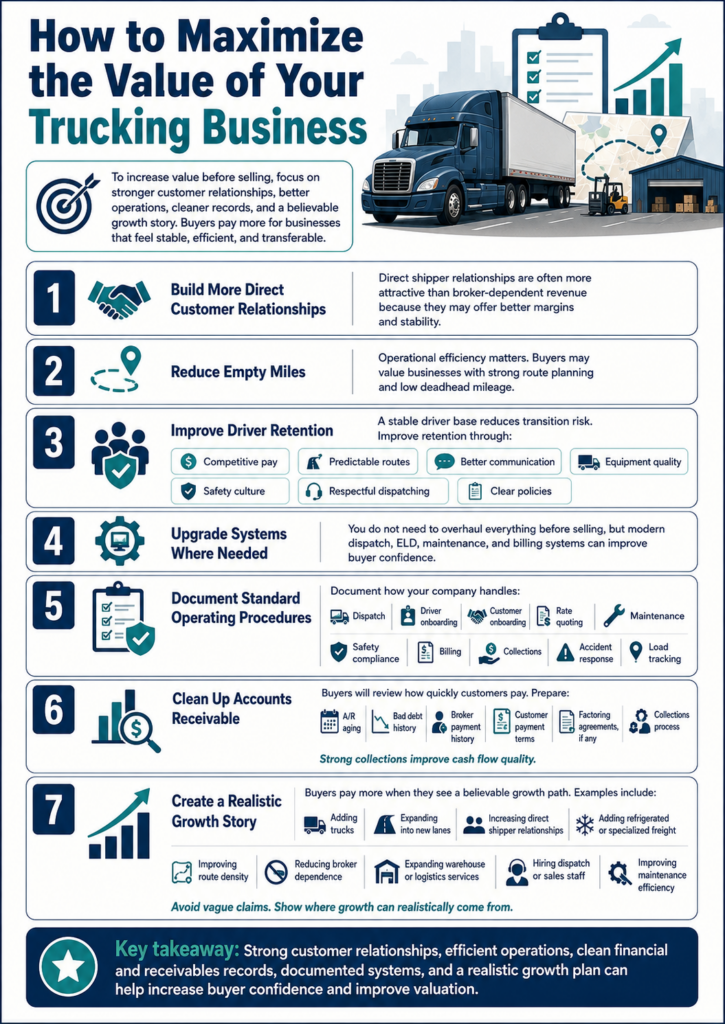
How to Maximize the Value of Your Trucking Business
Build More Direct Customer Relationships
Direct shipper relationships are often more attractive than broker-dependent revenue because they may offer better margins and stability.
Reduce Empty Miles
Operational efficiency matters. Buyers may value businesses with strong route planning and low deadhead mileage.
Improve Driver Retention
A stable driver base reduces transition risk.
Improve retention through:
- Competitive pay
- Predictable routes
- Better communication
- Equipment quality
- Safety culture
- Respectful dispatching
- Clear policies
Upgrade Systems Where Needed
You do not need to overhaul everything before selling, but modern dispatch, ELD, maintenance, and billing systems can improve buyer confidence.
Document Standard Operating Procedures
Document how your company handles:
- Dispatch
- Driver onboarding
- Customer onboarding
- Rate quoting
- Maintenance
- Safety compliance
- Billing
- Collections
- Accident response
- Load tracking
Clean Up Accounts Receivable
Buyers will review how quickly customers pay.
Prepare:
- A/R aging
- Bad debt history
- Broker payment history
- Customer payment terms
- Factoring agreements, if any
- Collections process
Strong collections improve cash flow quality.
Create a Realistic Growth Story
Buyers pay more when they see a believable growth path.
Examples include:
- Adding trucks
- Expanding into new lanes
- Increasing direct shipper relationships
- Adding refrigerated or specialized freight
- Improving route density
- Reducing broker dependence
- Expanding warehouse or logistics services
- Hiring dispatch or sales staff
- Improving maintenance efficiency
Avoid vague claims. Show where growth can realistically come from.
Confidentiality When Selling a Trucking Business
Confidentiality is important during a trucking company sale.
If the sale becomes public too early, it may create concern among:
- Drivers
- Dispatchers
- Customers
- Brokers
- Lenders
- Insurers
- Vendors
- Competitors
Drivers may worry about job security. Customers may worry about service continuity. Competitors may try to use the information against you.
A confidential sale process usually includes:
- Blind teaser materials
- NDAs
- Buyer screening
- Staged information sharing
- Secure data rooms
- Controlled release of customer and fleet information
Competitors may be serious buyers, but they should not receive sensitive customer, pricing, route, or driver information too early.
Who Buys Trucking Businesses?
Strategic Trucking Companies
Strategic buyers may want to expand capacity, add lanes, acquire drivers, or enter a new market.
Competitors
Competitors may understand your business quickly and see operational synergies, but confidentiality must be managed carefully.
Logistics Companies
Logistics companies or freight brokers may buy trucking assets to control capacity or improve service.
Private Equity-Backed Platforms
Private equity-backed transportation platforms may look for trucking companies with strong management, recurring customers, and growth potential.
Search Funds
Search fund buyers often look for stable, profitable businesses they can acquire and operate.
Owner-Operators
An owner-operator may buy a smaller trucking company to scale from one truck to multiple units.
Employees or Management
A management buyout may work if internal leaders can secure financing and operate the business.
Common Deal Structures in Trucking Business Sales
Asset Sale
Many trucking sales are structured as asset sales, where the buyer purchases trucks, trailers, customer relationships, goodwill, equipment, and other operating assets.
Equity Sale
In an equity sale, the buyer purchases the ownership interests of the company. This may be considered when operating authority, contracts, or licenses are difficult to transfer, but it may involve more liability risk.
Fleet and Business Sale
The buyer purchases both the operating business and the fleet assets.
Business Sale With Leased Equipment
If trucks are leased or financed, the buyer may assume leases, refinance equipment, or negotiate payoff terms.
Seller Financing
The seller may finance part of the purchase price. This can expand the buyer pool but creates repayment risk.
Earnout
An earnout may be used if part of the purchase price depends on customer retention, revenue performance, or contract continuation after closing.
Should You Use a Trucking Business Broker or M&A Advisor?
Many owners use a trucking business broker or M&A advisor because transportation deals can be operationally complex.
An advisor may help with:
- Trucking business valuation
- Confidential marketing
- Buyer sourcing
- Buyer screening
- Strategic buyer outreach
- Private equity outreach
- Offer comparison
- Negotiation support
- Due diligence coordination
- Deal structuring
- Closing support
For smaller trucking businesses, a business broker may be enough. For larger carriers, logistics companies, or transportation businesses with significant EBITDA, an M&A advisor may be more appropriate.
The right advisor should understand fleet valuation, DOT/FMCSA compliance, customer concentration, driver retention, route economics, and transportation buyer expectations.
Steps to Sell Your Trucking Business
- Clarify your exit goals and timeline.
- Organize financial statements and tax returns.
- Prepare revenue by customer, lane, and freight type.
- Create detailed truck, trailer, equipment, and maintenance records.
- Review DOT/FMCSA compliance, safety records, and insurance history.
- Identify valuation drivers and business risks.
- Reduce owner dependence where possible.
- Prepare confidential marketing materials.
- Identify and qualify potential buyers.
- Use NDAs before sharing sensitive information.
- Hold buyer meetings and management discussions.
- Receive and compare offers.
- Negotiate price, structure, transition terms, and contingencies.
- Complete financial, operational, legal, fleet, compliance, and insurance due diligence.
- Finalize purchase documents.
- Close the transaction and support the transition.
Common Mistakes to Avoid
Selling With Poor Fleet Records
If buyers cannot verify truck condition, mileage, ownership, and maintenance history, they may lower their offer.
Ignoring Safety and Compliance Issues
DOT/FMCSA issues, poor CSA scores, or incomplete driver files can create serious buyer concerns.
Depending Too Much on One Customer
Customer concentration can reduce valuation, especially if customer relationships are not contractually protected.
Overvaluing Trucks
Fleet value matters, but buyers also evaluate cash flow. Do not assume asset value alone determines business value.
Sharing Sensitive Information Too Early
Protect customer names, rates, lanes, driver details, and contract terms until buyers are properly screened.
Not Preparing for Insurance Review
Insurance costs and claims history can significantly affect buyer interest.
Overpricing the Business
Trucking businesses can be valuable, but buyers will discount for risk, equipment needs, fuel exposure, compliance issues, and customer concentration.
Trucking Business Sale FAQs
How long does it take to sell a trucking business?
Many trucking business sales take 6 to 12 months, although smaller companies may sell faster and larger or more complex transactions may take longer due to fleet inspections, financing, compliance review, and customer diligence.
How is a trucking business valued?
A trucking business may be valued using EBITDA, seller discretionary earnings, fleet value, customer relationships, route stability, safety history, equipment condition, margins, and risk profile.
Who buys trucking companies?
Common buyers include strategic trucking companies, competitors, logistics firms, private equity-backed platforms, search funds, owner-operators, family offices, and management teams.
What makes a trucking business more valuable?
Stable cash flow, direct shipper relationships, recurring freight, well-maintained trucks, strong driver retention, clean safety records, organized compliance files, diversified customers, and low owner dependence can improve value.
Can I sell my trucking business confidentially?
Yes. A confidential process can use blind teasers, NDAs, buyer screening, staged information sharing, and secure data rooms.
Do buyers care about DOT and FMCSA compliance?
Yes. Buyers care deeply about safety ratings, compliance files, driver qualification records, hours-of-service documentation, accident history, and operating authority.
Is the fleet included in the sale?
Usually, trucks, trailers, and equipment are included unless otherwise negotiated. Buyers will review ownership status, debt, liens, mileage, condition, and maintenance history.
Can I sell a trucking business with financed trucks?
Yes, but equipment loans, liens, or leases must be addressed. The buyer may assume financing, refinance equipment, or require payoff at closing.
Should I sell to a competitor?
A competitor may be a strong buyer, but confidentiality must be handled carefully. Avoid sharing customer names, lane pricing, rate sheets, driver details, or sensitive contracts too early.
What if most of my revenue comes from brokers?
Broker-based revenue can still be sellable, but buyers may value direct shipper relationships more highly because they often provide better margins and more stability.
Final Thoughts
Selling your trucking business requires preparation, accurate valuation, confidentiality, and strong operational documentation.
Buyers want confidence that the company has stable revenue, reliable drivers, well-maintained equipment, clean compliance records, manageable insurance costs, diversified customers, and systems that can continue after the owner exits.
Owners who organize financial records, prepare fleet documentation, clean up compliance files, improve margins, reduce owner dependence, and protect confidentiality are usually in a stronger position to attract qualified buyers and negotiate better terms.